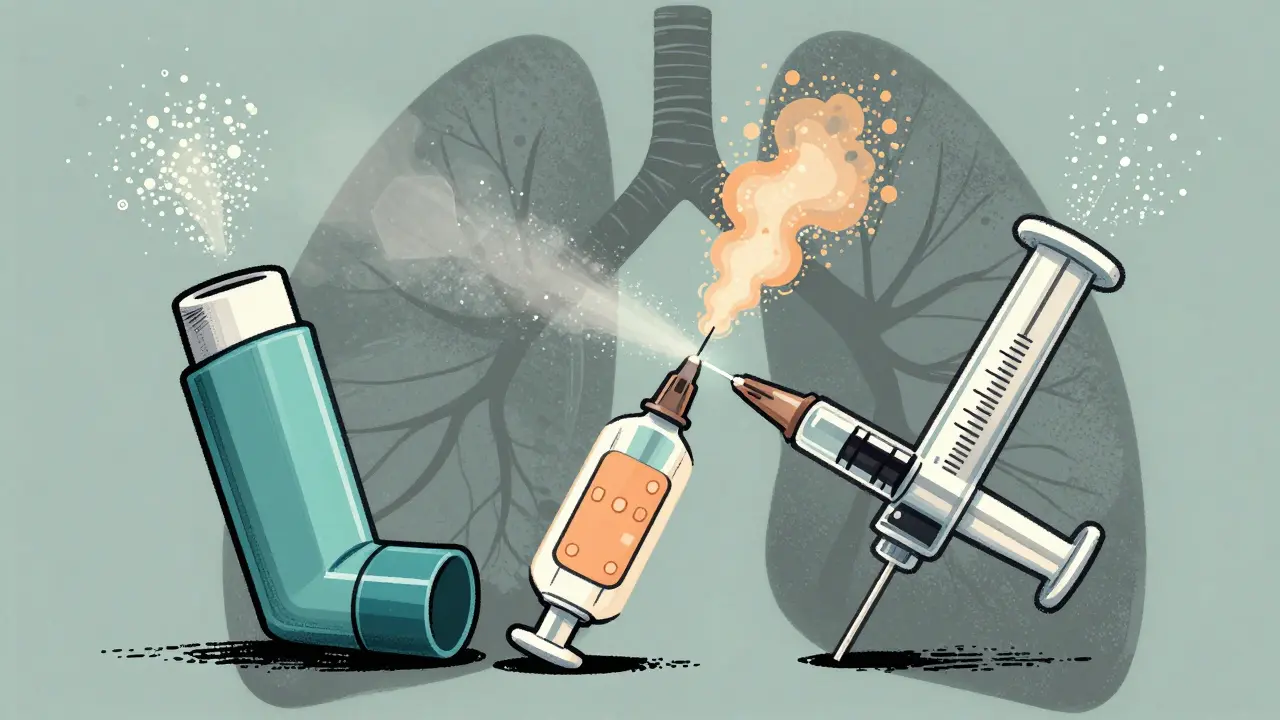
Bioequivalence for Inhalers, Patches, and Injections: How Generic Drugs Match the Real Thing
When you pick up a generic inhaler, patch, or injection, you expect it to work just like the brand-name version. But here’s the truth: bioequivalence for these complex delivery systems isn’t just about matching the amount of drug in the bottle. It’s about making sure the drug gets to the right place in your body at the right speed - and that’s far harder than it sounds.
Why Bioequivalence for Special Delivery Systems Is Different
For a pill, bioequivalence is relatively straightforward. You measure how much drug enters your bloodstream (AUC) and how fast it peaks (Cmax). If the generic’s numbers fall within 80-125% of the brand, it’s approved. Simple. But that doesn’t work for inhalers, patches, or injectables. Why? Because the drug doesn’t always need to enter your blood to work. For an asthma inhaler, the drug’s job is to land in your lungs. For a nicotine patch, it slowly seeps through your skin over hours. For a liposomal injection, the drug is wrapped in tiny fat bubbles designed to target specific tissues. If the delivery mechanism changes, even slightly, the outcome can change too. The FDA, EMA, and other regulators realized this decades ago. That’s why they stopped relying on blood tests alone. Today, proving bioequivalence for these systems means proving equivalence in three areas: physical properties, how the product behaves outside the body (in vitro), and how it behaves inside the body (in vivo).Inhalers: It’s Not Just the Drug - It’s the Plume
A generic albuterol inhaler might contain the exact same active ingredient as the brand. But if the propellant, valve, or nozzle design is off by even a fraction, the drug won’t reach your lungs the same way. The FDA requires three critical tests for inhalers:- Particle size distribution: At least 90% of the drug particles must be between 1 and 5 micrometers. Larger particles hit your throat and get swallowed. Smaller ones get exhaled. Only the right size reaches the lungs.
- Delivered dose uniformity: Each puff must deliver within 75-125% of the labeled dose. No puff should be too weak or too strong.
- Plume geometry: The spray pattern - its shape, speed, and temperature - must match the original. One company lost approval because their generic’s plume was 2°C hotter than the brand. That tiny difference changed how the drug dispersed in the airway.
Transdermal Patches: Slow and Steady Wins the Race
Patches are designed to release drug slowly through your skin. That’s why traditional Cmax measurements don’t make sense. A patch might take 12 hours to reach peak levels - if it ever does. Instead, regulators focus on total exposure (AUC) over time. The FDA requires:- In vitro release rate: The patch must release the drug at the same rate as the brand - within 10% difference - at every time point for 24 hours.
- Adhesion and skin contact: If the patch peels off too easily or doesn’t stick well, the drug won’t absorb properly. Companies test this on human skin models.
- Residual drug content: After use, the patch must leave behind the same amount of unused drug. This ensures consistent delivery over time.

Injectables: The Most Complex of All
Injectables are the hardest. Why? Because they’re not just drugs - they’re engineered systems. For simple injections (like insulin), bioequivalence is similar to oral drugs. But for complex ones - liposomes, nanoparticles, or long-acting suspensions - the rules change entirely. The FDA requires proof of:- Physicochemical identity: Particle size must be within 10% of the brand. Polydispersity index (how uniform the particles are) must be under 0.2. Zeta potential (surface charge) must match within 5mV. Change any of these, and the body treats the drug differently.
- In vitro release profile: The drug must release at the same rate in simulated body fluid. A 10% difference in release speed over 24 hours can mean the difference between effective treatment and toxicity.
- Comparative pharmacokinetics: Blood levels are still measured, but the acceptable range tightens. For drugs like enoxaparin (Lovenox), with a narrow therapeutic window, the limit is 90-111% - not 80-125%.
Why This Matters for Patients
You might think, “If the drug is the same, why does it matter how it’s delivered?” But here’s what happens when it’s not:- A child with asthma gets less medicine because the inhaler sprays too high in the throat.
- An elderly patient on a pain patch doesn’t feel relief because the patch falls off during sleep.
- A diabetic gets a spike in insulin because the injection releases too fast.
The Real Cost of Getting It Right
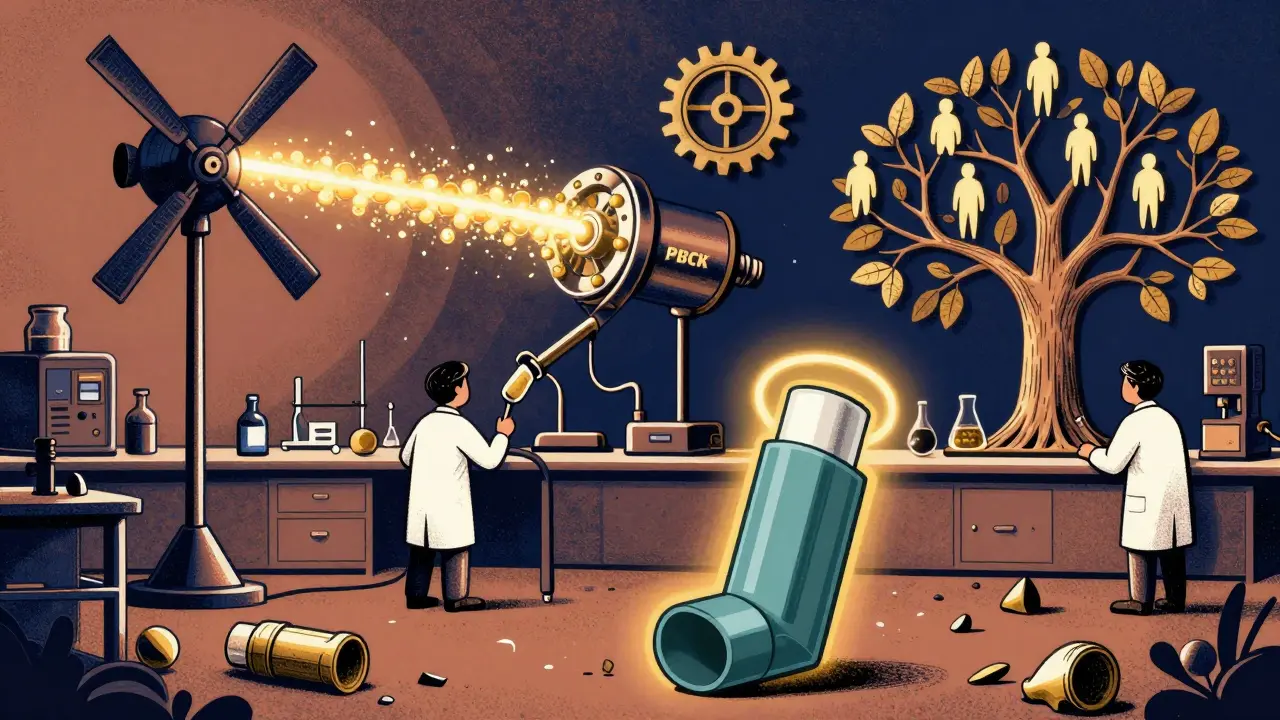
The market for complex generics is growing. It hit $78 billion in 2022 and is projected to reach $112 billion by 2027. But only 15% of the generic market by value comes from these products - even though they make up 30% of prescriptions. Why? Because the barriers are high. Only big players like Teva, Mylan, and Sandoz have the resources to tackle them. Small companies? They can’t afford the $150,000 cascade impactor or the $200,000 particle analyzer. They can’t hire the regulatory scientists who know how to design a PBPK model. But progress is happening. Teva’s generic ProAir RespiClick succeeded because they used scintigraphy to prove lung deposition matched the brand. It captured 12% of the market within 18 months. That’s proof that when bioequivalence is done right, patients get cheaper, effective drugs.What’s Next?
Regulators are moving toward a “totality of evidence” approach. That means combining data from:- Physicochemical tests
- In vitro performance
- Pharmacokinetics
- Pharmacodynamics
- Real-world usage data
Bottom Line
Bioequivalence for inhalers, patches, and injections isn’t about matching numbers on a lab report. It’s about matching real-world performance. It’s about ensuring that when you breathe in, stick on, or inject a generic - you get the same outcome as the brand. It’s expensive. It’s complicated. It takes years. But for patients who depend on these drugs every day - it’s worth it.What does bioequivalence mean for inhalers?
For inhalers, bioequivalence means proving that the generic delivers the same amount of drug to the lungs at the same rate as the brand. This requires matching particle size (1-5 micrometers), delivered dose per puff, plume shape, and spray temperature. Blood tests aren’t enough - lung deposition is measured using imaging or lung function tests like FEV1.
Why are generic patches harder to approve than pills?
Patches release drug slowly through the skin, so peak blood levels (Cmax) don’t reflect effectiveness. Instead, regulators look at total exposure (AUC) over 24 hours. They also test how well the patch sticks to skin, how fast it releases the drug in lab conditions, and how much drug remains after use. Skin differences between people make this even harder to predict.
Can a generic injection be approved if it’s chemically identical to the brand?
No. For complex injectables like liposomes or nanoparticles, chemical identity isn’t enough. The particle size, surface charge, and release rate must match exactly. Even a 10% difference in particle size can change how the body absorbs the drug. Device design matters too - for auto-injectors, timing and pressure can affect delivery.
Why do so many generic inhalers get rejected?
Inhalers have the lowest approval rate - only 38% - because small changes in valve design, propellant, or nozzle geometry alter how the drug is sprayed. A 2°C difference in plume temperature, or a 5% shift in particle size, can mean the drug lands in the throat instead of the lungs. These details are hard to replicate, and regulators won’t approve a product unless it matches the original exactly.
Are generic complex drugs safer than brand-name ones?
Yes - if they pass the same strict bioequivalence tests. Regulatory agencies require complex generics to meet the same performance standards as brands. In fact, because these products are harder to make, they often undergo more testing than standard generics. The goal isn’t to lower safety - it’s to ensure that cheaper options work just as well.


8 Comments
Melissa Taylor
December 15 2025It’s wild how much engineering goes into something most people think is just a can of medicine. I’ve used inhalers since I was a kid, and I never realized the spray temperature could make or break the treatment. This post opened my eyes - thanks for breaking it down so clearly.
John Brown
December 15 2025Been in pharma for 12 years and I’ll tell you - the inhaler stuff is the most frustrating. We had a project die because the nozzle was 0.1mm too wide. No one noticed until the lung deposition scan showed 22% less drug reaching the alveoli. It’s not about cutting corners. It’s about not killing people by accident.
Sai Nguyen
December 16 2025US regulators are too slow. In India, we make generics that work fine. Why waste millions on plume geometry? Just match the active ingredient and move on.
Benjamin Glover
December 16 2025Of course the FDA demands perfection. That’s why American healthcare costs so much. In Europe, we accept 90% equivalence and call it good. This over-engineering is a luxury no one can afford.
Raj Kumar
December 18 2025bro the patch thing is real. my grandma’s fentanyl patch used to peel off in the shower, and she’d be in pain for days. they need to test on real skin, not lab models. also, why is particle size sooo important? like, if the drug’s the same, why does it matter if 8% lands in the throat? she still gets some, right?
Jocelyn Lachapelle
December 20 2025So many people think generic = cheap = worse. But when they get it right - like Teva’s ProAir - it’s just as good and saves lives. We need more of this, not less. Stop treating patients like guinea pigs.
Mike Nordby
December 22 2025Biocreep is the silent crisis. We’re not talking about one off-brand inhaler - we’re talking about a chain of 5-6 generic iterations, each with 2% deviation. After five generations, you’re at 90% efficacy. That’s not bioequivalence. That’s erosion. Regulators need longitudinal tracking systems - now.
John Samuel
December 23 2025Let me just say this: the fact that a 0.3-second delay in an auto-injector can tank a $45M project is either the most beautiful example of precision medicine… or the most absurd overreach in regulatory history. Either way, it’s poetry in motion. 🙌