Bile Acid Sequestrants and Other Medications: How to Time Them Right to Avoid Dangerous Interactions
Medication Timing Calculator
Select Your Bile Acid Sequestrant
Select Your Other Medication
How to Use This Tool
1. Select your bile acid sequestrant
2. Select the other medication you're taking
3. The tool will calculate minimum separation time
4. Take your medications at least this many hours apart for safe absorption
Results
Choose medications to see separation time
Important Notes
• For warfarin: Always get INR tests regularly
• For levothyroxine: 8 hours is recommended, not just 4
• For birth control: 4 hours separation may still be insufficient
• Colesevelam has lower binding capacity (2.8 mEq/g vs cholestyramine's 3.5 mEq/g)
• Never take with food if taking critical medications
• Consult your pharmacist for personalized timing
When you’re taking a bile acid sequestrant like cholestyramine, colestipol, or colesevelam, you’re not just managing cholesterol-you’re managing a ticking time bomb for your other meds. These drugs work by binding to bile acids in your gut, which forces your liver to pull cholesterol from your blood to make more. Simple enough. But here’s the catch: they don’t just bind bile acids. They bind everything else too-your thyroid medicine, your blood thinner, your birth control, even your diabetes pills. And if you don’t time it right, you could be taking these drugs and getting none of the benefit.
How Bile Acid Sequestrants Really Work
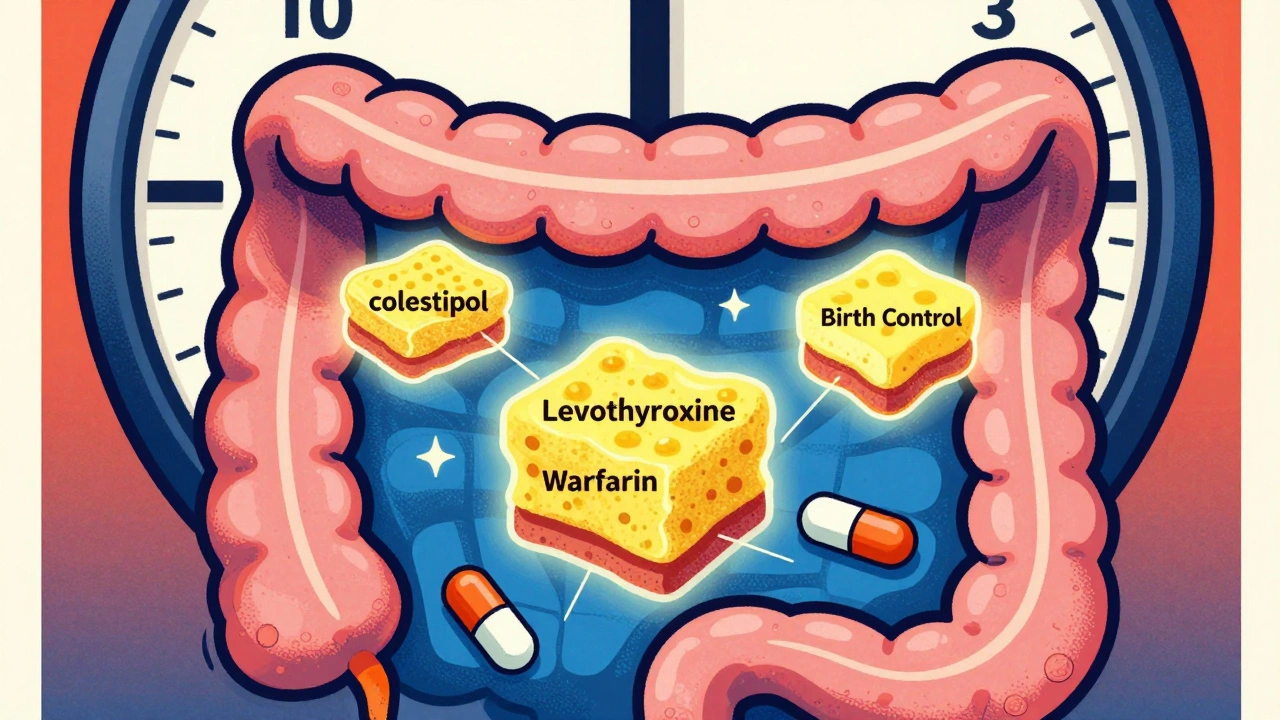
Bile acid sequestrants (BAS) are resins. Think of them like tiny magnetic sponges floating in your intestines. Cholestyramine (Questran), colestipol (Colestid), and colesevelam (Welchol) are all made of different polymers, but they all do the same thing: grab onto bile acids and flush them out before your body can reuse them. That’s how they lower LDL cholesterol-by 15% to 30%. And unlike statins, they don’t get absorbed into your bloodstream. That’s why they’re often used when statins cause muscle pain or liver issues.
But that same binding power is what makes them dangerous with other pills. These resins don’t care if it’s your warfarin or your metformin. If it’s in your gut at the same time, they’ll stick to it. And you won’t absorb it. That means your INR could drop. Your blood sugar could spike. Or worse-you could get pregnant because your birth control didn’t work.
Why Timing Isn’t Just Advice-It’s a Lifesaver
Doctors will tell you to take your BAS at least 4 hours before or after other medications. That’s not a suggestion. That’s the minimum. And even that might not be enough.
Take levothyroxine, for example. It’s the go-to thyroid hormone replacement. If you take it within 4 hours of colesevelam, your thyroid levels can drop by 23%, according to a study in Endocrine Practice. That means fatigue, weight gain, brain fog-symptoms you might blame on stress or aging, when it’s just your meds fighting each other. The fix? Take levothyroxine at least 8 hours before your BAS. Many patients do it first thing in the morning, then wait until after lunch for their cholesterol pill.
Warfarin is even trickier. A single missed dose of absorption can send your INR crashing. Studies in Thrombosis Research show that even 4 hours apart isn’t always safe. For warfarin users, 6 hours is the new standard. Some patients end up taking their BAS at bedtime and their warfarin at breakfast to create a 10-hour buffer.
Which Medications Are Most at Risk?
Not all drugs are created equal when it comes to BAS interference. Some are more likely to get trapped than others. Here’s the shortlist of high-risk meds:
- Levothyroxine - Requires 8-hour separation
- Warfarin - Needs 6-hour minimum, frequent INR checks
- Oral contraceptives - 4-hour separation, but some women still get pregnant
- Metformin (extended-release) - 4-hour separation with colesevelam
- Thyroid hormones - All types, not just levothyroxine
- Antibiotics like tetracycline and ciprofloxacin - Binding reduces effectiveness
- Fat-soluble vitamins (A, D, E, K) - Long-term use can cause deficiency
And here’s the kicker: colesevelam (Welchol) is the least likely to cause problems. It binds less aggressively than cholestyramine. One user on EverydayHealth said, “I switched from Questran to Welchol and suddenly I could take my metformin just 2 hours before instead of 4.” That’s because colesevelam has a lower binding capacity-2.8 mEq/g versus cholestyramine’s 3.5 mEq/g. That difference matters.
The Real-World Chaos of Timing
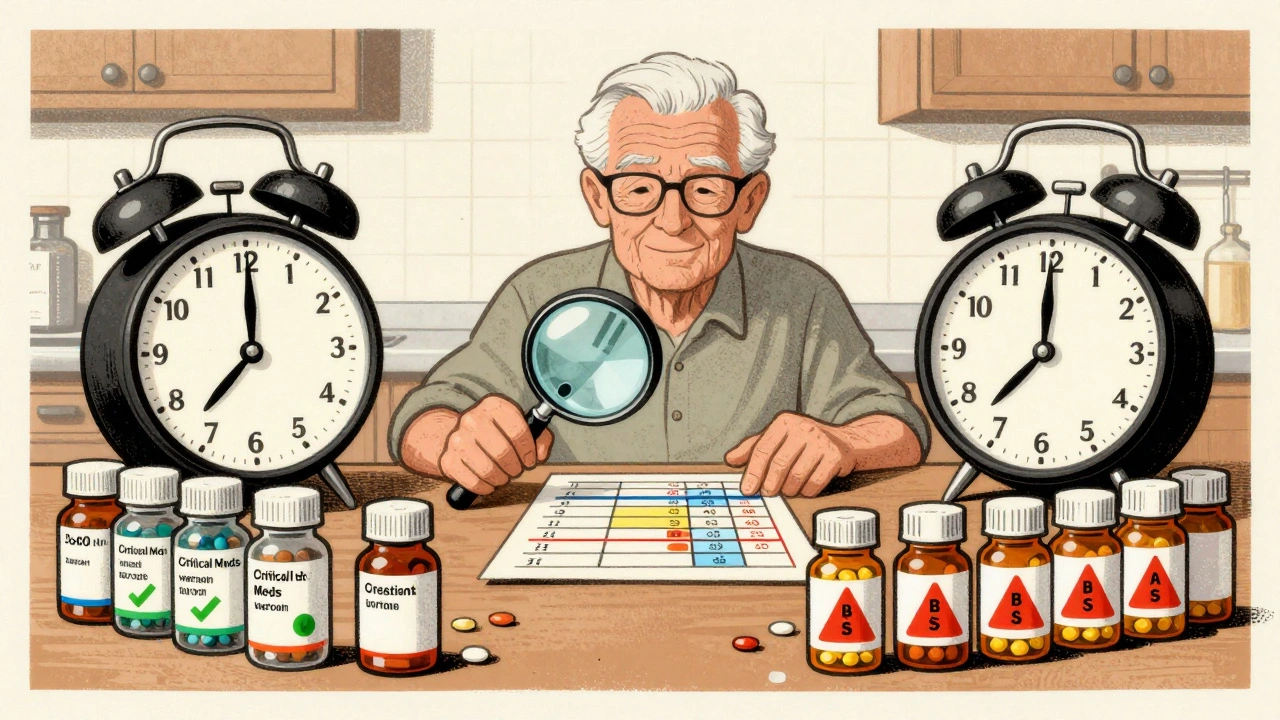
Imagine this: You’re 68. You take warfarin in the morning, levothyroxine at 7 a.m., metformin at breakfast, and your BAS at lunch. Your spouse reminds you to take your vitamin D at dinner. Your daughter calls and you forget to take your BAS until 8 p.m. Now your metformin didn’t absorb. Your INR is off. You’re dizzy. You call your doctor. This isn’t hypothetical. It happens every day.
A 2022 survey of 452 BAS users found that 41% had at least one medication interaction, even when they thought they were following the rules. The most common? Warfarin and levothyroxine. And 68% of patients said managing the timing was their biggest challenge.
Constipation makes it worse. Cholestyramine causes it in 57% of users. If you’re bloated and backed up, your meds sit in your gut longer. That means more binding. More risk. Some patients skip doses because they’re too uncomfortable. That’s when cholesterol spikes again.
How to Get It Right-Without Losing Your Mind
You don’t need to be a pharmacist to get this right. You just need a system.
- Use a medication log. Write down every pill, time, and dose. Paper works. But apps like Medisafe or MyTherapy are better-they send reminders and flag potential interactions.
- Group your meds by timing. Put all your BAS at one end of the day. Put your thyroid, warfarin, and birth control at the other. Keep your vitamins separate.
- Ask your pharmacist to map it out. A 2023 study showed pharmacist-led timing plans cut interaction incidents by 63%. They’ll print you a color-coded schedule.
- Never take BAS with food if you’re on a critical med. Food slows digestion. Slower digestion = longer exposure = more binding. Take your BAS with water, not juice or milk.
- Switch to colesevelam if you can. It’s easier to manage. Fewer interactions. Fewer GI issues. And it’s also approved for type 2 diabetes, so if you have both high cholesterol and diabetes, it’s a two-in-one.

What About Newer Options?
There’s a reason BAS are still around. They’re cheap. Generic cholestyramine costs $15 a month. Colesevelam runs $50. Compare that to PCSK9 inhibitors like evolocumab, which cost $5,800 a year and require monthly injections. Or inclisiran, which is given twice a year but still costs $3,500 per dose.
But the future is changing. In May 2023, the FDA approved a new version of colesevelam with 22% less binding capacity. Early trials show fewer interactions with warfarin and metformin. That’s huge. And researchers at the NIH are testing AI tools that adjust timing based on your meal patterns, sleep schedule, and even your gut motility. The goal? Personalized dosing-no more guesswork.
For now, though, you’re stuck with the old rules. And if you’re on BAS, those rules are non-negotiable.
What Happens If You Mess Up?
One missed timing window might not cause disaster. But repeated mistakes? That’s how people end up in the ER.
Low INR? Risk of stroke. Low thyroid levels? Heart problems. Failed birth control? Unplanned pregnancy. Low vitamin D? Bone fractures. And if you’re over 65, you’re more likely to be on multiple meds-making errors more likely and consequences more severe.
That’s why adherence is so low. A 2023 study in JAMA Cardiology found 48% of people quit BAS within a year-not because it didn’t work, but because it was too hard to manage.
If you’re struggling, talk to your doctor. Maybe you can switch to a different cholesterol drug. Maybe you can try a lower dose. But don’t just stop. Cholesterol doesn’t care if you’re tired of timing pills. It’s still building up in your arteries.
Can I take my bile acid sequestrant with food?
Yes, you can-and often should-take bile acid sequestrants with food. Food helps reduce stomach upset and improves bile acid binding. But if you’re taking a medication that’s sensitive to binding (like levothyroxine or warfarin), avoid taking it with food at the same time as your BAS. Wait at least 4 hours after your BAS before eating a meal if you’re on those meds. The goal is to separate the BAS from other drugs, not necessarily from food.
Is colesevelam safer than cholestyramine?
Yes, colesevelam (Welchol) has a lower binding capacity than cholestyramine (Questran), meaning it’s less likely to interfere with other medications. Studies show it causes 30-40% fewer interactions with warfarin and less disruption to vitamin absorption. It also causes less constipation. For patients on multiple medications, colesevelam is often the preferred choice-especially if you’re also managing type 2 diabetes.
How long should I wait between my BAS and my birth control pill?
At least 4 hours. But studies show that even with 4 hours of separation, some women still experience reduced absorption of oral contraceptives. If you’re on BAS and birth control, consider switching to a non-oral method like an IUD or implant. If you stick with pills, use backup contraception and talk to your OB-GYN about your risk.
Can I take vitamins with bile acid sequestrants?
Take fat-soluble vitamins (A, D, E, K) at least 4 hours before or after your BAS. Long-term use can lead to deficiencies-especially vitamin K, which affects blood clotting. A 2019 study found 12.7% of long-term BAS users had vitamin K deficiency. Your doctor should check your levels annually and may recommend a daily multivitamin, timed correctly.
What should I do if I forget to separate my BAS and another medication?
If you accidentally take your BAS within 4 hours of another medication, don’t panic-but don’t ignore it either. Note the time and the meds involved. If it’s a critical drug like warfarin or levothyroxine, contact your doctor or pharmacist. You may need a blood test (like an INR or TSH) sooner than usual. Going forward, use a medication app with alerts to avoid repeat mistakes.
If you’re on bile acid sequestrants, you’re not alone. But you’re also not powerless. With the right timing, the right meds, and a little help from your pharmacist, you can manage your cholesterol without putting your other treatments at risk. It’s not easy. But it’s doable.




9 Comments
Inna Borovik
December 8 2025Just had my INR crash last month after forgetting to space my warfarin from Welchol. Turned out I was taking them 3 hours apart thinking it was fine. ER visit, three days of blood tests, and my cardiologist looked at me like I’d betrayed him. The 6-hour rule isn’t a suggestion-it’s a survival protocol. I now use Medisafe with color-coded alerts. No more guessing.
Jackie Petersen
December 9 2025They’re lying about how safe colesevelam is. Big Pharma pushed it because it’s more profitable. Same binding, just slower to cause symptoms so you don’t notice until your thyroid’s dead and your blood’s thick as syrup. They want you dependent on expensive meds and constant monitoring. Wake up.
brenda olvera
December 10 2025Hey I was so scared when I started cholestyramine but switching to Welchol changed everything. I still take my thyroid at 6am and my pill after lunch. I don’t even think about it anymore. You got this. And yes you can take vitamins just not at the same time. Just keep a little notebook. You’re doing better than you think
Myles White
December 11 2025I’ve been on colesevelam for five years now and I’ve never had a single interaction. I take it right after dinner, which is around 7:30 p.m., and I take all my other meds-levothyroxine, metformin, even my vitamin D-at 7 a.m. That’s a 12.5-hour gap. It’s not hard, it’s just a habit. I also don’t eat anything for 30 minutes after taking my BAS, just water. I used to take it with applesauce because it tasted like chalk, but now I just mix it with a little unsweetened almond milk and it’s fine. The key is consistency. Your body adapts if you give it a routine.
Brooke Evers
December 11 2025I know how overwhelming this feels. I was diagnosed with high cholesterol and hypothyroidism at the same time and I cried for a week because I thought I’d never get it right. But here’s what helped me: I printed out a color-coded chart from my pharmacist-green for BAS, red for thyroid, blue for warfarin, yellow for vitamins. I taped it to my fridge next to my pill organizer. I started using a voice reminder on my phone: ‘Thyroid first. Wait 8 hours. Then BAS.’ It sounds silly but it worked. You’re not failing. You’re learning. And you’re not alone.
Chris Park
December 12 2025The entire premise is flawed. Bile acid sequestrants are not 'binding everything'-they're selective resins with defined affinity profiles. The FDA's own data shows that only drugs with low solubility and high intestinal absorption are significantly affected. The 4-hour rule is arbitrary and inflated for liability purposes. Studies cited here are either outdated or conflated with non-resin statin interactions. Real pharmacokinetic models show negligible interference with metformin when taken 2 hours apart. This is fearmongering dressed as medical advice.
Saketh Sai Rachapudi
December 12 2025Why do americans make everything so complicated? In india we just take our medicine and dont worry. Thyroid and cholestyramine? Take them together. If you get sick its god's will. Why waste time on apps and charts? My uncle took 5 pills at once for 20 years and lived to 89. You people overthink everything
joanne humphreys
December 13 2025I appreciate how detailed this is. I’ve been on Welchol for a year and I do take my levothyroxine 8 hours before, but I didn’t realize vitamin K deficiency was a real risk. I’ve been taking my D and E at bedtime and just assumed it was fine. I’ll get my levels checked next month. I also didn’t know colesevelam was approved for diabetes-that’s actually great news for me. Thanks for sharing the practical stuff, not just the scary parts.
Nigel ntini
December 14 2025This is the kind of post that makes Reddit worth it. Clear, practical, and not full of hype. I’m a pharmacist in London and I’ve seen so many patients panic over this. The truth? Timing matters, but perfection isn’t the goal. Consistency is. If someone takes their BAS 3 hours after their thyroid instead of 8, they won’t have a stroke tomorrow. But if they do it every day for six months? That’s when the TSH creeps up. My advice? Pick one anchor point-like taking your BAS after dinner-and build everything else around it. And if you’re struggling, ask your pharmacist for a printed schedule. They’ll do it for free. You don’t need to be a genius to manage this-you just need to be steady.