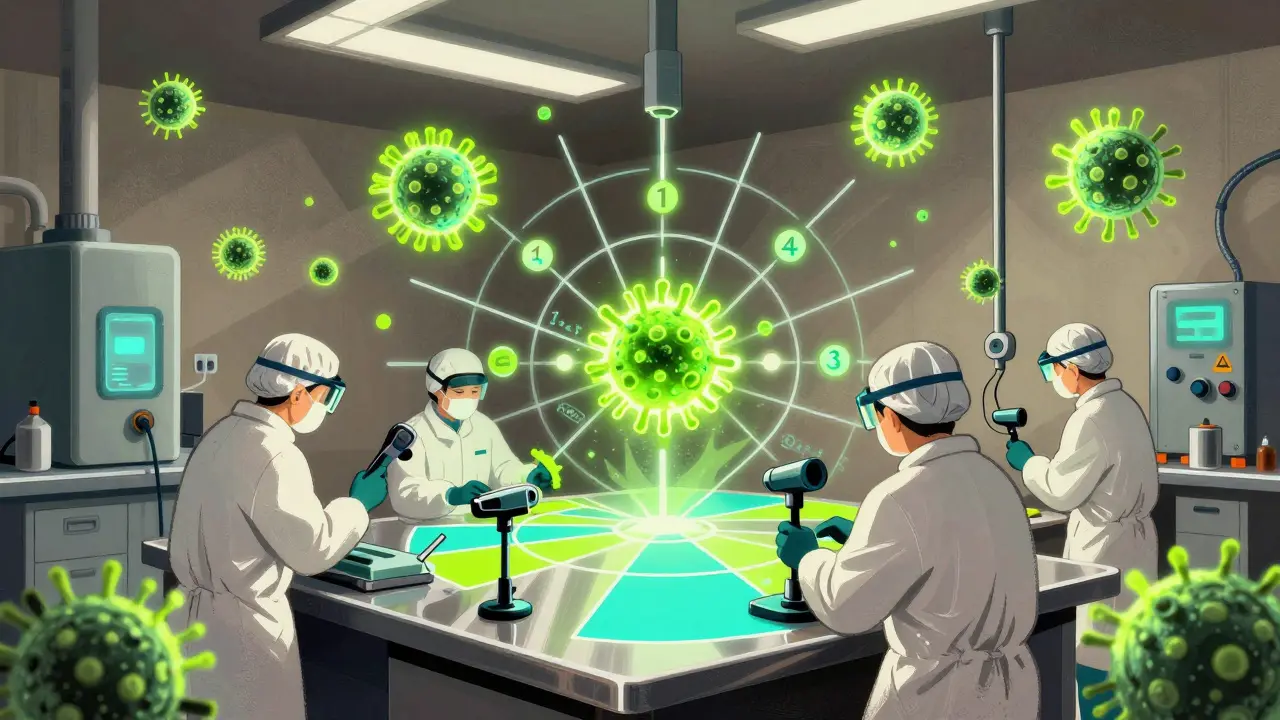
Environmental Monitoring in Manufacturing: How Testing Facilities Prevent Contamination
When you buy a bottle of medicine, a ready-to-eat meal, or a jar of face cream, you assume it’s safe. But behind that assumption is a quiet, relentless system of testing-environmental monitoring-that checks for contamination before it ever touches the product. This isn’t optional. It’s the line between a safe product and a public health crisis.
Why Environmental Monitoring Matters
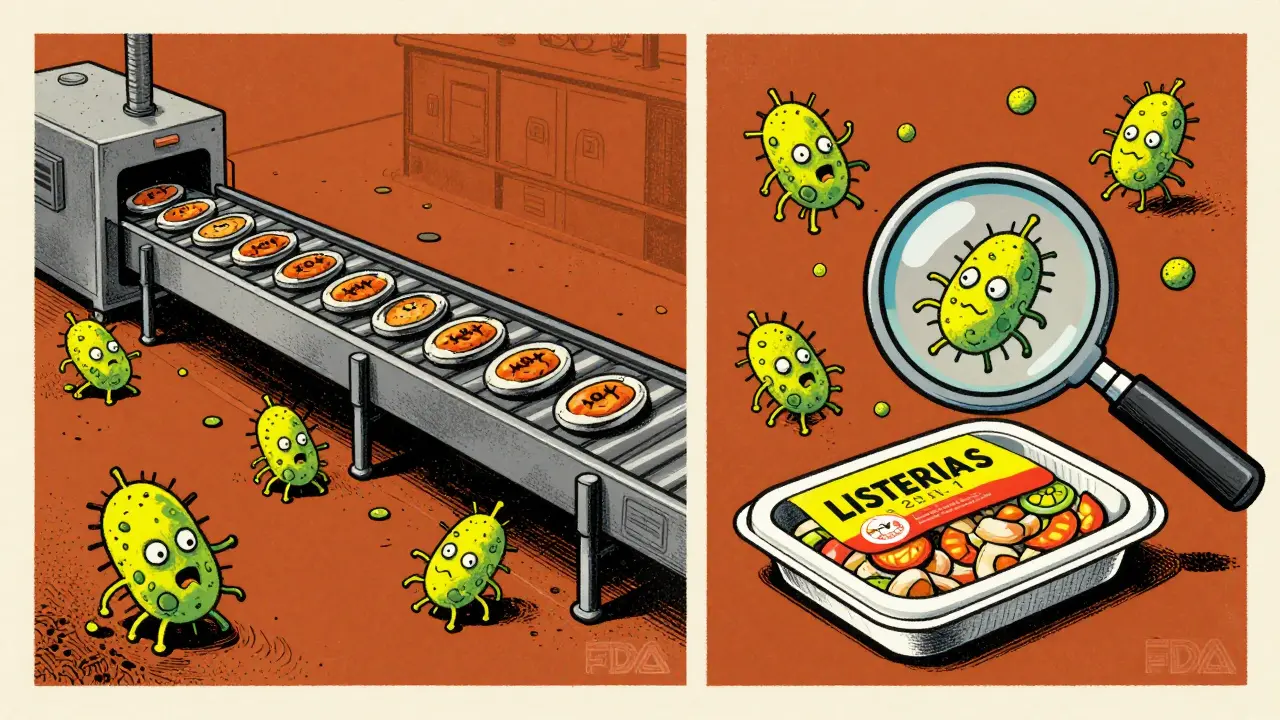
Contamination doesn’t always come from the ingredients. Sometimes, it comes from the floor, the air, or the handle of a machine that hasn’t been cleaned properly. In pharmaceutical plants, a single mold spore in the air can ruin an entire batch of injectable drugs. In food factories, Listeria on a conveyor belt can trigger nationwide recalls. The CDC says 87% of foodborne illness outbreaks tied to environmental sources could have been stopped with better monitoring.
Regulators don’t leave this to chance. The FDA requires environmental sampling in food and drug facilities. The EU’s Annex 1 rules demand real-time air monitoring in cleanrooms. The USDA’s Listeria Rule forces ready-to-eat food plants to test surfaces daily. These aren’t suggestions-they’re legal requirements. And the cost of failing? Billions in recalls, lawsuits, and lost trust.
How Contamination Gets Detected
Environmental monitoring isn’t just swabbing surfaces. It’s a mix of science, technology, and strict protocols. Different contaminants need different tools:
- Microbial testing finds bacteria, yeast, and mold using culture plates or rapid DNA tests.
- Air sampling pulls in liters of air through slit or sieve devices to count airborne particles and microbes per cubic meter.
- ATP testing gives results in seconds by detecting organic residue-used to check if cleaning worked before production resumes.
- TOC and conductivity tests measure water purity in pharmaceutical systems to ensure no chemical traces remain.
- ICP and chromatography spot heavy metals or chemical residues in raw materials or rinse water.
Each method has its place. ATP is fast but doesn’t identify specific pathogens. Culture tests take 24-72 hours but tell you exactly what’s there. That’s why smart facilities use both.
The Zone System: Risk-Based Sampling
Not all surfaces are created equal. That’s why every facility uses a zone system to prioritize testing:
- Zone 1: Direct food or drug contact surfaces-slicers, mixers, filling nozzles. These get tested daily or before every shift.
- Zone 2: Surfaces near Zone 1-equipment housings, refrigeration units, nearby walls. Tested weekly.
- Zone 3: Remote but still in production areas-forklifts, carts, overhead pipes. Tested monthly.
- Zone 4: Outside production-offices, hallways, restrooms. Tested quarterly, but don’t ignore them.
Here’s the twist: 62% of contamination events in bioassay labs came from Zone 3 and 4-floors, drains, and equipment frames. People think the high-risk zones are the only problem. They’re not. Contamination spreads. A dirty floor near a machine can aerosolize particles that land on a product contact surface. That’s why monitoring Zone 4 isn’t optional-it’s a safety net.
Industry Differences: Pharma vs. Food vs. Cosmetics
Not all industries monitor the same way. The stakes and rules vary:
| Factor | Pharmaceutical | Food & Beverage | Cosmetics |
|---|---|---|---|
| Primary Target | Endotoxins, sterile pathogens | Salmonella, Listeria monocytogenes | Mold, Pseudomonas |
| Air Monitoring | Continuous, ISO Class 5 (Grade B) | Periodic, no formal class system | Periodic, often ISO Class 7-8 |
| Water Testing | USP <645> standards, TOC + conductivity | EPA municipal standards | USP <645> for water used in products |
| Sampling Frequency (Zone 1) | Daily to twice daily | Daily for RTE foods | Weekly |
| Regulatory Driver | EU GMP Annex 1, FDA 21 CFR Part 211 | FSMA, USDA 9 CFR Part 430 | EU Cosmetics Regulation 1223/2009 |
Pharmaceuticals demand the tightest controls because their products go directly into the body. Food plants focus on pathogens that cause illness. Cosmetics are in the middle-they need to prevent skin infections but aren’t ingested. Yet all three rely on the same core idea: detect early, act faster.
Real-World Challenges
Even with good rules, implementation is messy. Here’s what goes wrong:
- Inconsistent zone definitions: One plant calls a pipe Zone 1 because it drips condensation. Another calls it Zone 3. No standard means no fair comparison.
- Bad sampling technique: Swabs aren’t sterile. Samplers aren’t cleaned between uses. Air samplers get contaminated before they even start. The CDC says this happens more often than you’d think.
- Data silos: ATP results, microbiology reports, and allergen tests live in different spreadsheets. No one connects the dots until it’s too late.
- Understaffing: Medium-sized food plants spend $15,000-$25,000 a year on testing and need 2-3 full-time staff just for monitoring. Many small facilities can’t afford it.
And here’s the irony: facilities that use ATP testing see 32% faster production turnarounds because they don’t wait days for culture results. But only 60% of food plants use it regularly. Why? Training gaps. Budgets. Outdated habits.
What’s Changing in 2026
Environmental monitoring is evolving fast. Here’s what’s new:
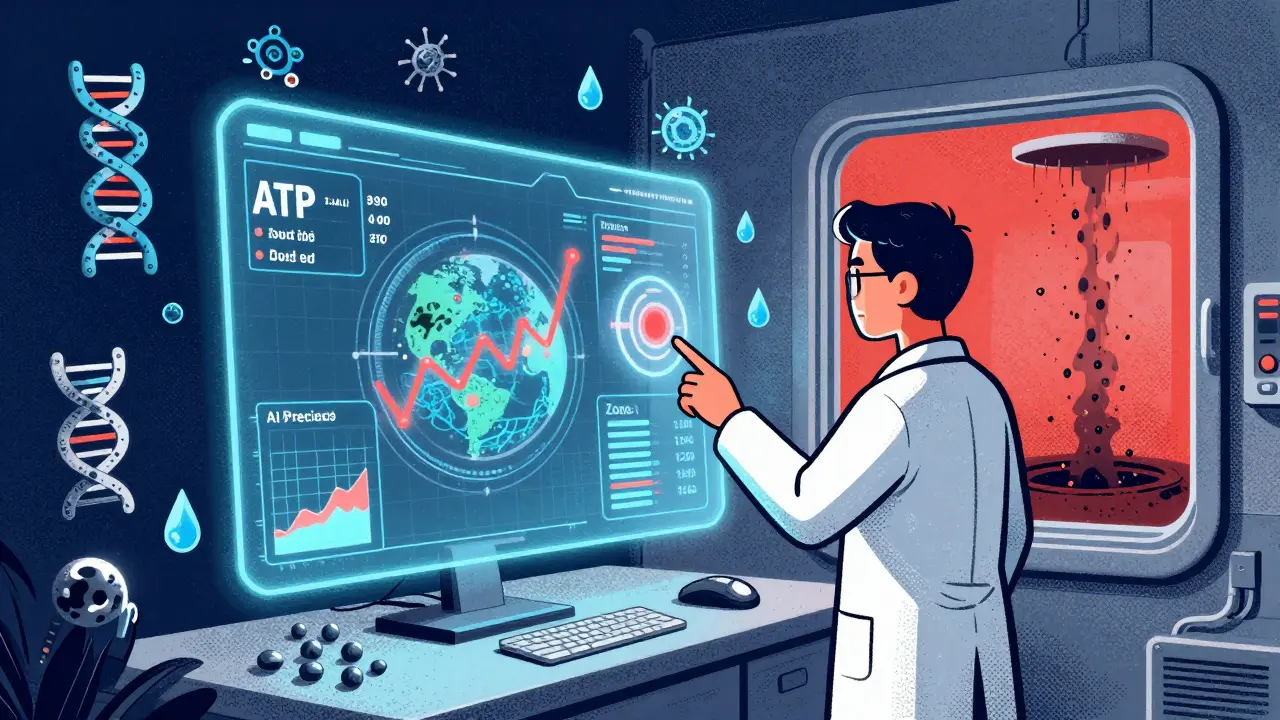
- Real-time data dashboards: EU Annex 1 now requires continuous monitoring with automated alerts. If humidity spikes or particle count rises, the system flags it instantly.
- AI-powered trend analysis: Systems now learn normal patterns. A sudden spike in mold spores? The AI compares it to 10,000 past samples and predicts if it’s a real threat.
- Next-generation sequencing (NGS): Instead of waiting 72 hours to ID Listeria, labs can now sequence its DNA in under 24 hours. That’s huge for outbreak response.
- Antibiotic-resistant pathogens: 19% of Listeria strains from food plants now resist multiple antibiotics. Monitoring now includes resistance profiling-not just presence.
By 2027, nearly 40% of facilities will use AI-driven monitoring systems. The market, worth $7.2 billion in 2022, is on track to hit $12.5 billion. That’s not just growth-it’s necessity.
What You Can Do
If you’re responsible for quality in a manufacturing facility, here’s how to get it right:
- Define your zones clearly-document why each surface is classified where it is. Train everyone on it.
- Use ATP for quick sanitation checks-combine it with culture testing, don’t replace it.
- Sample Zone 3 and 4 regularly-don’t ignore the floor just because it’s not touching the product.
- Integrate your data-use one system to track ATP, microbiology, and environmental conditions together.
- Train your team-the FDA recommends 40 hours of hands-on training. Don’t skip it.
Environmental monitoring isn’t about checking boxes. It’s about protecting people. The data doesn’t lie. If your facility isn’t testing systematically, you’re gambling with public health. And in 2026, regulators aren’t just watching-they’re auditing harder than ever.
What is environmental monitoring in manufacturing?
Environmental monitoring in manufacturing is the systematic testing of air, surfaces, water, and equipment to detect and control contamination-like bacteria, mold, chemicals, or particles-that could compromise product safety. It’s used in pharmaceutical, food, and cosmetic production to prevent contamination before it reaches consumers.
What are the four zones in environmental monitoring?
Zone 1 includes direct product contact surfaces like mixers and filling nozzles. Zone 2 covers nearby surfaces such as equipment housings. Zone 3 includes remote production area surfaces like forklifts and overhead pipes. Zone 4 is non-production areas like hallways and restrooms. Sampling frequency decreases from Zone 1 to Zone 4, but all zones must be monitored to prevent cross-contamination.
How often should environmental sampling be done?
Frequency depends on the zone and industry. Zone 1 surfaces in food and pharma are tested daily or before each shift. Zone 2 is sampled weekly. Zone 3 and 4 are tested monthly to quarterly. Regulatory requirements vary-FDA mandates weekly Listeria testing in ready-to-eat food Zone 1 areas, while EU GMP Annex 1 requires continuous air monitoring in cleanrooms.
What’s the difference between ATP testing and microbial testing?
ATP testing detects organic residue (like food or skin cells) in seconds using light-emitting reactions. It tells you if cleaning worked, but not what microbe is present. Microbial testing grows samples in labs to identify specific pathogens like Listeria or Salmonella, but takes 24-72 hours. Facilities use ATP for quick checks and microbial tests for confirmation.
Why is Zone 4 monitoring important if it’s not near production?
Contamination spreads. A dirty floor (Zone 4) can kick up particles or harbor bacteria that get carried on shoes, carts, or air currents into Zone 1. Studies show 62% of contamination events originate in Zone 3 and 4. Ignoring these areas creates blind spots-what looks like a clean production line might be contaminated from an unseen source.
How do regulations differ between the U.S. and EU?
The FDA focuses on risk-based sampling and pathogen detection (like Listeria in food), while the EU’s Annex 1 requires continuous real-time monitoring of air particles and environmental conditions in cleanrooms. The EU mandates data trending and automated alerts, whereas the U.S. allows more flexibility as long as control is demonstrated. Both require documentation, but the EU’s standards are more prescriptive on technology use.


10 Comments
Linda O'neil
January 28 2026Zone 4 gets ignored so often, and it’s crazy. I worked at a food plant where a mold outbreak started in the restroom hallway-no one thought to swab it until three batches got recalled. Dirty floors don’t care if they’re ‘far’ from production. They win.
ATP testing saved us 12 hours a day. We started using it for shift handoffs, and our downtime dropped by 40%. Still, half the staff thought it was ‘just a glow stick.’ Training matters more than tech.
Also-why are we still using paper logs? We had a cloud-based dashboard by 2023. If you’re not digitizing your data, you’re not monitoring-you’re guessing.
James Dwyer
January 28 2026This is the kind of post that makes you realize how much you take for granted. That bottle of hand sanitizer? Someone tested the air 12 times today to make sure it wouldn’t kill you. Wild.
Mel MJPS
January 30 2026I’m a nurse, and I’ve seen what happens when contamination slips through. Not just recalls-real people, real infections. I’ve held a baby whose IV got contaminated because a tech skipped a swab because ‘it looked clean.’
Don’t underestimate Zone 3. A forklift tire tracking in dirt from the parking lot? That’s how it starts. It’s not glamorous, but it’s life-or-death work.
Also, shoutout to the QA teams who show up at 4 AM to run samples. You’re the quiet heroes.
Rhiannon Bosse
January 31 2026Oh, so now we’re supposed to believe the FDA and EU are ‘protecting us’? LOL. They’re just making sure Big Pharma and Big Food don’t get caught with their pants down-until the next scandal.
Did you know 80% of ‘contamination’ is just a lab tech mislabeling a plate? And AI? Ha! It’s trained on data that’s already corrupted. You think the algorithm knows what’s real when the humans can’t even agree on what Zone 2 is?
And don’t get me started on NGS. They’re sequencing bacteria like it’s a Netflix show. Meanwhile, the real problem? Underpaid workers doing 12-hour shifts with no gloves. The system’s rigged.
Next they’ll say we need ‘real-time emotional monitoring’ for the machines. Because why not?
Also, I heard the CDC faked the 87% stat to get more funding. I have screenshots. DM me if you want them.
Lance Long
January 31 2026Let me tell you something-this isn’t just about science. This is about dignity.
Every time someone swabs a nozzle at 3 AM, they’re saying: ‘I won’t let you die because I was too tired to care.’
And when that same person gets yelled at for taking 10 extra seconds to change gloves? That’s not negligence. That’s betrayal.
I’ve seen facilities where the QA lead gets fired for a false positive. Meanwhile, the plant manager gets a bonus for ‘cost savings.’
We’re not just testing for microbes-we’re testing for humanity. And right now? We’re failing that test.
If you work in this field-you’re not a technician. You’re a guardian. And you deserve better.
Lexi Karuzis
February 2 2026Zone 4? You’re kidding, right? I’ve seen it-restroom doors left open, janitors using the same mop for the floor AND the production room! And they call this ‘compliance’?!
And don’t even get me started on ‘ATP testing’-it’s a placebo! It glows if there’s ANY organic residue-even sweat from a worker’s hand! You think that’s safe? You’re being lied to!
And AI? Please. It’s trained on corporate data-corporate data that’s been scrubbed to hide violations! The FDA’s ‘continuous monitoring’? It’s a PR stunt! They don’t even check the logs!
And who funds this? Big Pharma! They want you to think you’re safe while they pump out drugs with hidden toxins! It’s all connected!
And why are cosmetics only tested weekly?! Are your eyelashes more important than your life?!
Someone’s lying. Someone’s always lying. And you’re just the sucker who believes the glow stick.
Brittany Fiddes
February 2 2026Oh, so the Americans think they’ve got this figured out? Please. In the UK, we’ve had real cleanroom standards since the 1980s. Annex 1? We wrote that. You’re still using paper swabs while we’ve got automated drones sampling air in real-time.
And your ‘Zone 4’? We call it ‘Controlled Environment’-and we don’t just ‘monitor’ it-we engineer it out of existence. Your ‘mold spores’ are a symptom of your lax culture.
And don’t even mention ‘ATP’ like it’s revolutionary. We’ve had luminometers since 1997. Your ‘innovation’ is just catching up.
Frankly, your entire system looks like a middle school science fair project compared to what we do in Milton Keynes.
Still, I suppose you’re trying. That’s… something.
Amber Daugs
February 3 2026It’s not just about testing-it’s about morality. If you’re not testing Zone 4 daily, you’re literally choosing to risk someone’s life for a few hours of downtime. That’s not negligence. That’s evil.
And why do so many facilities skip training? Because they’d rather save $15K than save a child from a contaminated bottle of formula. I’m not exaggerating. I’ve seen the reports.
And if you think AI is the answer-you’re delusional. AI doesn’t have a soul. It doesn’t care if a baby gets sick. Only you can care. So stop outsourcing your conscience to a dashboard.
Wake up. This isn’t compliance. This is your soul on the line.
Robert Cardoso
February 4 2026Let’s zoom out. Environmental monitoring is a proxy for our entire relationship with risk.
We live in a world that demands absolute safety but refuses to pay for it. We want our medicine sterile, our food safe, our lotion non-toxic-but we won’t fund the labor, the training, the tech.
So we get band-aid solutions: ATP because it’s fast, Zone 1 because it’s visible, and silence everywhere else.
It’s not about contamination-it’s about denial. We don’t want to face the cost of safety. So we pretend the system works.
And when it fails? We blame the worker. The system? Never. The system is sacred.
That’s the real contamination. The moral rot behind the swabs.
Bryan Fracchia
February 6 2026Honestly? This whole thing gives me hope.
People are doing this work-quietly, underpaid, often unappreciated-and they’re not giving up. They’re showing up with swabs and ATP kits and spreadsheets because they know someone’s life depends on it.
It’s not perfect. Zones are messy. Data is siloed. Training’s inconsistent. But we’re moving. AI isn’t magic-but it’s a tool. NGS isn’t flashy-but it saves lives.
Maybe we don’t need to fix everything at once. Maybe we just need to keep showing up.
And if you’re reading this and you’re in QA? Thank you. You’re the reason I can buy a sandwich without wondering if it’ll kill me.
We’re not there yet. But we’re trying. And that counts.