How to Plan Annual Open Enrollment for Medication Coverage in Medicare
Don’t Assume Your Medicare Drug Plan Stays the Same
Every year, your Medicare prescription drug plan changes-sometimes dramatically. A medication that cost $10 last year might jump to $120 this year. Your local pharmacy could drop out of the network. A drug you rely on might move from Tier 2 to Tier 4, meaning you pay three times as much. If you don’t review your coverage during Annual Open Enrollment, you could be paying hundreds or even over a thousand dollars extra for the same meds.
The window to fix this is short: October 15 to December 7 each year. Changes you make during this time take effect on January 1. For 2026 coverage, that means you need to act between October 15, 2025, and December 7, 2025. Missing the deadline means you’re stuck with your current plan until next year-even if your insulin just got 50% more expensive.
Start by Listing Every Medication You Take
Before you even look at a plan, write down every prescription you take. Include the name, dosage, and how often you take it. Don’t forget over-the-counter meds if they’re part of your daily routine and covered under your plan. For example, if you take metformin 500mg twice daily, lisinopril 10mg once a day, and a monthly GLP-1 like Ozempic, list them all. Some plans treat these differently, and missing one can blow up your budget.
Pro tip: Use the pill organizer you already have. Count how many pills you go through in a month. That’s your real usage-not what you think you take. Many people forget they refill a medication early or skip doses, which skews cost estimates.
Get Your Annual Notice of Change (ANOC)
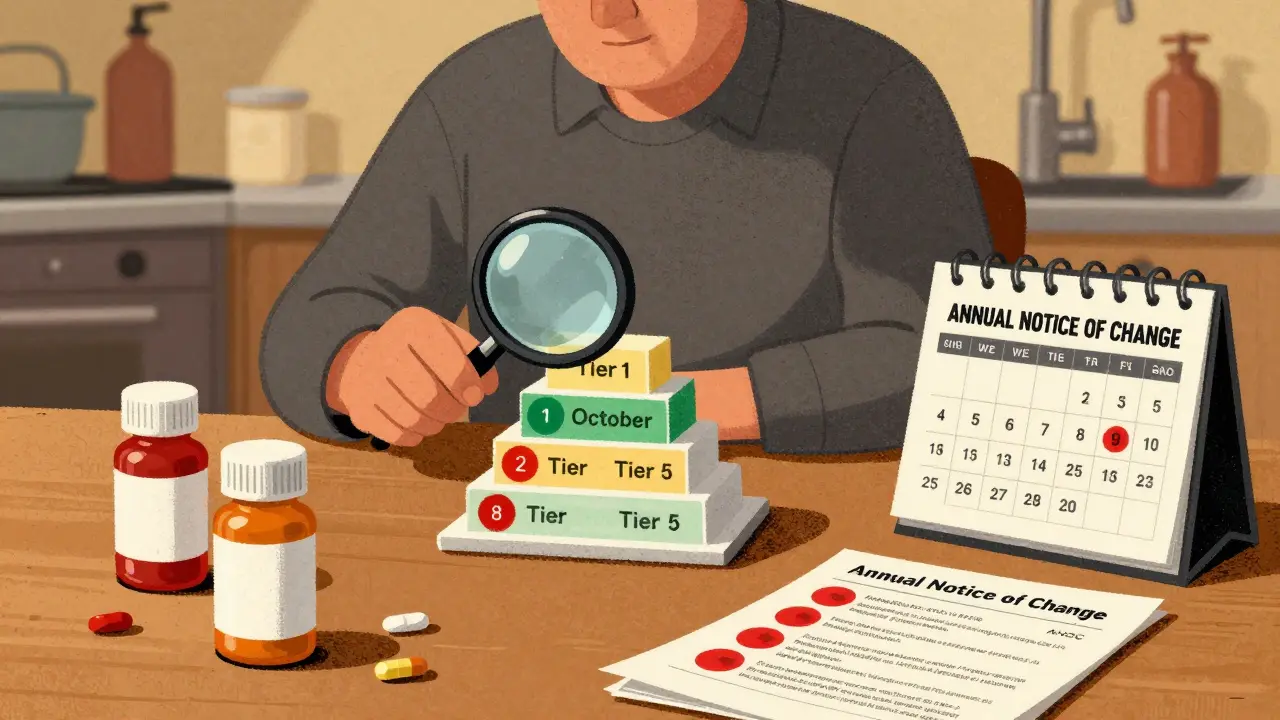
By September 30, your current plan should mail you the Annual Notice of Change. Don’t ignore it. This document tells you exactly what’s changing for 2026: new premiums, higher deductibles, removed drugs from the formulary, or pharmacy network cuts. It’s the only official source for what’s changing with your current plan.
Look for three things:
- Formulary changes: Did your drug get moved to a higher tier? Was it removed entirely?
- Cost changes: Did your monthly premium go up? What about your copay for your top three meds?
- Network changes: Is your pharmacy still in-network? Was your preferred pharmacy downgraded to "standard"?
According to Medicare Rights Center data, 78% of Medicare Advantage plans changed their provider networks between 2023 and 2024. If your pharmacy isn’t on the list anymore, you’ll pay more-or have to drive farther.
Use the Medicare Plan Finder Tool
Go to Medicare.gov/plan-compare and enter your zip code, medications, and preferred pharmacy. The tool lets you compare every plan available in your area side-by-side.
Here’s what to focus on:
- Enter your exact medications and dosages. The tool calculates your estimated annual drug cost based on real data.
- Sort by "Total Drug Cost"-not monthly premium. A $0 premium plan with a $500 deductible and high copays on your meds could cost you more than a $40/month plan with low copays.
- Check the formulary tier for each drug. Tier 1 is cheapest. Tier 5 (specialty) is most expensive.
- Verify your pharmacy is "preferred" in the network. Preferred pharmacies usually cut your copay by 20-40%.
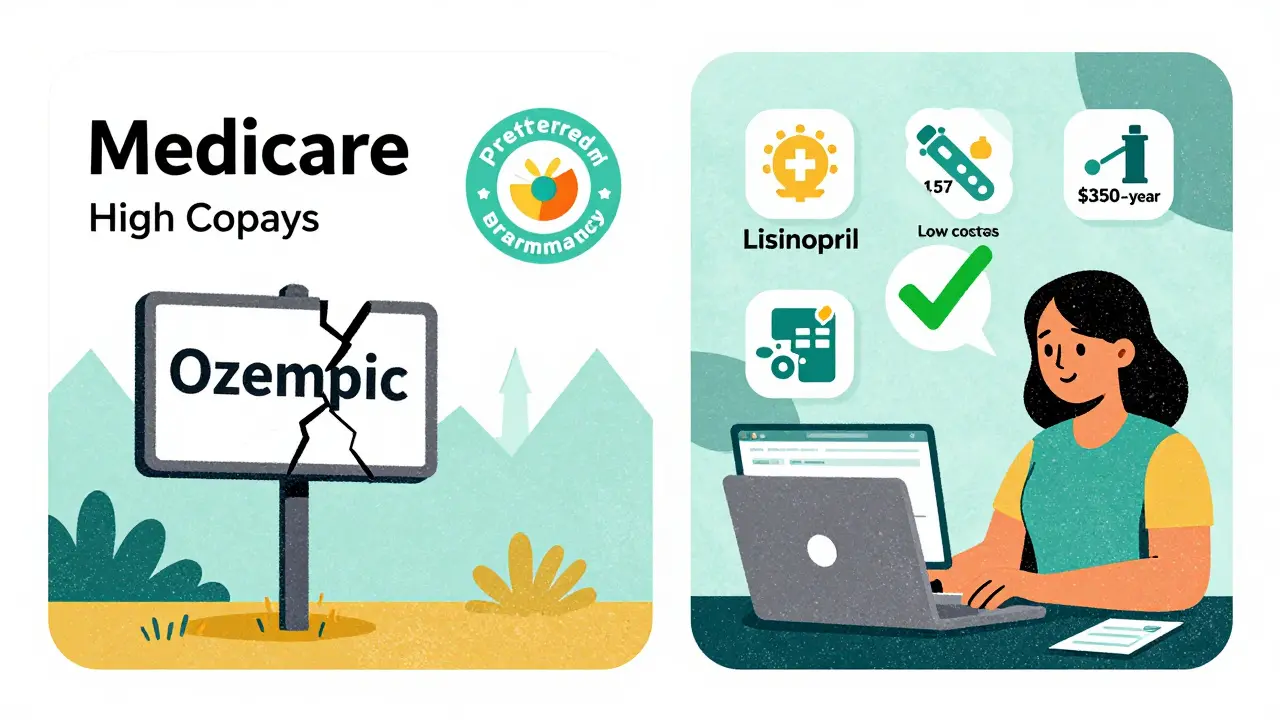
Beneficiaries who use this tool are 3.2 times more likely to find a cheaper plan than those who don’t. One woman in Birmingham switched from a plan where her Ozempic cost $1,200/year to one where it cost $350-just by checking the formulary tier.
Watch Out for the Hidden Traps
Not all savings are what they seem. Here are the three biggest traps:
1. The "Low Premium, High Copay" Trap
A plan with a $0 premium might look great-until you find out your metformin copay jumped from $10 to $45. Add in your other meds, and you’re paying $800 more a year. Always calculate total drug cost, not just the monthly fee.
2. The "Network Cut" Trap
Some plans have two pharmacy networks: preferred and standard. Preferred means lower cost. Standard means higher. If your pharmacy is now "standard," you’re paying more-even if you didn’t change anything.
3. The "Specialty Tier" Trap
Drugs like Ozempic, Humira, or Enbrel are often in specialty tiers. In 2025, 42% of plans increased cost-sharing on these drugs. You might pay 33% coinsurance instead of $10 copay. That’s $1,000+ extra per year.
Also, check for prior authorization or step therapy requirements. Some plans force you to try cheaper drugs first-even if your doctor says they won’t work for you. That can delay care and cause health problems.
Don’t Forget About the Inflation Reduction Act Changes
For 2026, the Inflation Reduction Act is still reshaping drug coverage. Here’s what matters:
- Insulin is capped at $35/month-no matter your plan. If your insulin costs more, switch plans or ask your pharmacy to apply the cap.
- The donut hole is gone. You no longer face a coverage gap. Once you hit your out-of-pocket limit, you pay 25% coinsurance for the rest of the year.
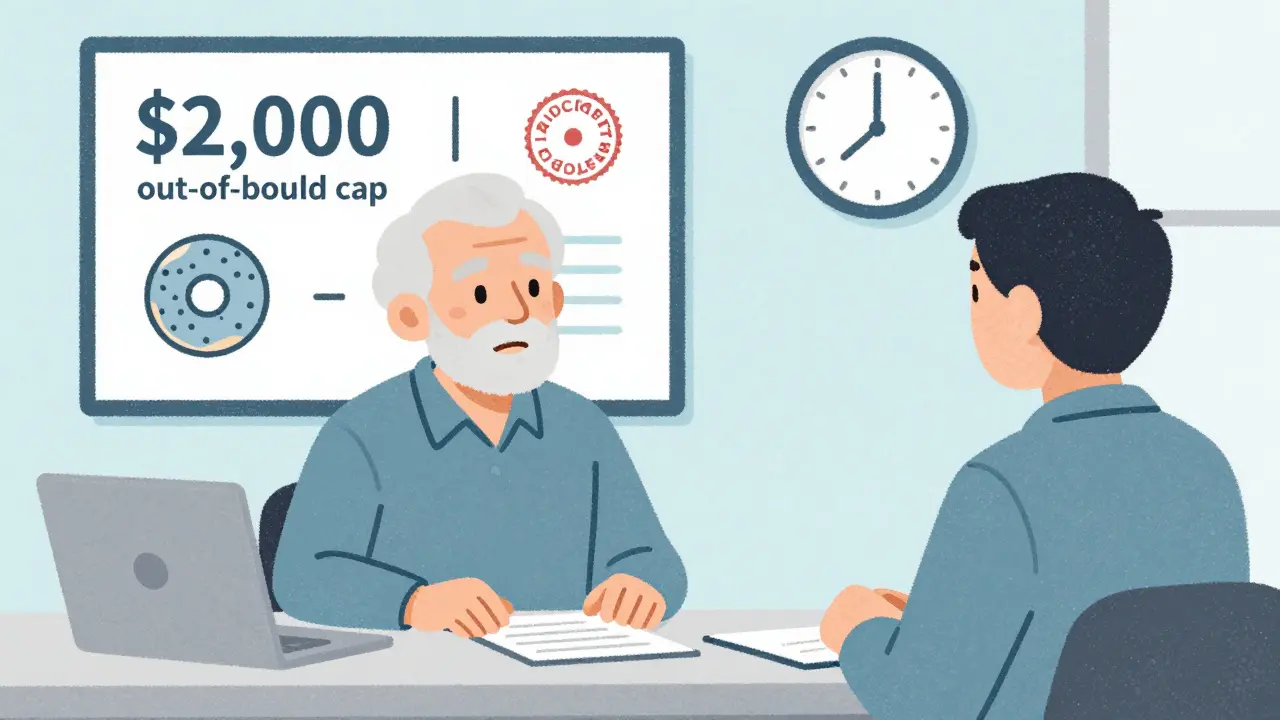
- Out-of-pocket cap is $2,000 for Part D. That’s the most you’ll pay for drugs in 2026. If your plan doesn’t cap costs, it’s not compliant.
These rules apply to all Part D and Medicare Advantage plans. If your plan says you’re still paying $100 for insulin, it’s wrong. Contact Medicare or your State Health Insurance Assistance Program (SHIP).
Call Your SHIP Counselor
If you’re confused, don’t guess. Every state has free, certified counselors through SHIP. In the UK, you’d go to NHS or Citizens Advice-but in the U.S., SHIP is your lifeline. They help you compare plans, read the ANOC, and even file complaints if a plan misrepresents coverage.
SHIP counselors helped 68% of callers in 2024 understand formulary changes. They’re not salespeople. They don’t get paid by plans. They just want you to get the best coverage.
To find yours, call 1-800-MEDICARE or visit medicare.gov/ship.
Final Checklist Before December 7
Here’s what to do before the deadline:
- ✅ List all your meds with dosages
- ✅ Get your current plan’s ANOC
- ✅ Use Medicare Plan Finder to compare total drug cost
- ✅ Confirm your pharmacy is preferred
- ✅ Check if your specialty drugs are capped or restricted
- ✅ Call SHIP if anything’s unclear
- ✅ Submit your new plan choice by December 7
It takes about 3.7 hours total. But the savings? On average, people who do this save $532 a year on prescriptions. Some save over $1,200.
What If You Miss the Deadline?
If you miss December 7, you’re locked in until next year-unless you qualify for a Special Enrollment Period. Those are rare. Examples: moving out of state, losing employer coverage, or your plan leaves Medicare. If you don’t qualify, you pay more for a full year.
And if you drop Part D coverage and later rejoin, you’ll pay a late enrollment penalty-1% of the national base premium for every month you were without creditable coverage. That’s permanent.
Can I switch Medicare Advantage plans after January 1?
Yes-but only once, between January 1 and March 31, during the Medicare Advantage Open Enrollment Period (MAOEP). You can switch from one Medicare Advantage plan to another, or drop it and go back to Original Medicare. But you can’t switch Part D plans during this time. If you want to change your drug coverage, you must wait until next October.
Why does my drug cost more this year even though my plan didn’t change?
Your drug’s formulary tier may have changed, even if your plan didn’t. Plans update their formularies every year. A drug that was on Tier 2 last year could move to Tier 4 this year, increasing your copay from $15 to $60. Always check the ANOC for formulary changes-not just premium changes.
Is it better to get a Medicare Advantage plan or a Part D plan?
It depends. Medicare Advantage plans bundle Parts A, B, and usually D, and include an out-of-pocket maximum (capped at $8,000 in 2025). But they have narrow networks-only 43% offer out-of-network coverage. Standalone Part D plans have broader pharmacy networks but no cap on total out-of-pocket costs. If you take multiple high-cost drugs, Advantage might be better. If you see many specialists, Original Medicare + Part D may give you more flexibility.
How do I know if my pharmacy is preferred?
When using the Medicare Plan Finder tool, enter your pharmacy’s name and zip code. It will show whether it’s "preferred" or "standard." Preferred pharmacies usually have lower copays. You can also call your pharmacy and ask if they’re in-network with your plan. Don’t assume-they change networks often.
What if my medication is removed from the formulary?
If your drug is removed, your plan must notify you 60 days before the change. You can request a formulary exception-ask your doctor to submit a letter explaining why you need it. If approved, the plan must cover it. You can also switch to a new plan during Open Enrollment that covers your drug. Don’t wait until you run out.





15 Comments
Uzoamaka Nwankpa
January 4 2026I just found out my insulin went from $20 to $90 last month. I didn't even realize my plan changed until I got the bill. This post saved me from a financial nightmare.
Chris Cantey
January 4 2026The real issue isn't the system-it's the illusion of choice. Medicare Advantage plans are designed to confuse, not to care. You're not selecting coverage; you're navigating a labyrinth built by actuaries who've never held a prescription bottle.
Abhishek Mondal
January 5 2026I must emphasize-this entire framework is predicated on a flawed assumption: that individuals possess the cognitive bandwidth to parse formulary tiers, pharmacy networks, and tiered copays simultaneously. The Inflation Reduction Act's $35 insulin cap is a band-aid on a hemorrhage. Moreover, the structural inequity embedded in Part D's design is not merely bureaucratic-it's epistemologically violent.
Oluwapelumi Yakubu
January 6 2026Man, I used to think my $1,200 Ozempic bill was normal until I saw someone on Reddit break it down. Now I'm saving $800 a year just by switching to a preferred pharmacy. Don't sleep on the Plan Finder tool-it's like having a financial wizard in your pocket. And yes, I cried when I saw the new price. Not from sadness-from relief.
Terri Gladden
January 6 2026I JUST FOUND OUT MY PHARMACY GOT REMOVED AND I DONT EVEN KNOW WHERE TO GO NOW AND MY DR DOCTOR SAID I CAN'T SWITCH BECAUSE I HAVE A SPECIAL NEEDS PLAN AND I'M SO STRESSED I CAN'T SLEEP
Jennifer Glass
January 6 2026I appreciate how thorough this is. One thing I’d add: if you're on a fixed income, don’t just look at the monthly premium. Look at the total out-of-pocket cost for your top three meds. That’s where the real savings-or disaster-hides. I used to pick plans based on $0 premiums and ended up paying $700 more annually. Now I use the Plan Finder and sort by 'Total Drug Cost' every year. Game changer.
Joseph Snow
January 8 2026Let’s be honest: this whole system is a rigged game. The government touts the $2,000 cap as a win, but the premiums have skyrocketed to compensate. Meanwhile, the pharmaceutical companies quietly reprice drugs the moment a cap is announced. This isn’t reform-it’s theater. And the 'free' SHIP counselors? They’re funded by the same agencies that oversee the plans they 'help' you pick.
melissa cucic
January 9 2026I’ve been helping my mother navigate Medicare for five years now. The ANOC is the single most important document you’ll receive all year-and 80% of people throw it away without reading. I print it, highlight every change, and compare it side-by-side with last year’s. It takes two hours, but it’s saved us over $1,500 in cumulative costs. Please, don’t ignore it.
Akshaya Gandra _ Student - EastCaryMS
January 9 2026i used the plan finder but i think i put my dose wrong bc now i think im payin more?? can someone help??
en Max
January 10 2026The structural integrity of the Part D benefit is predicated upon a series of regulatory arbitrage mechanisms that incentivize plan sponsors to optimize for actuarial risk rather than beneficiary outcomes. Consequently, the formulary tiering architecture functions as a de facto rationing mechanism, wherein specialty pharmaceuticals are systematically relegated to higher cost-sharing tiers to preserve margin. This is not inefficiency-it is design.
Angie Rehe
January 11 2026I called my plan and they said my Ozempic was still covered, but when I went to the pharmacy, they said it was $1,100. I demanded to speak to a supervisor. They hung up on me. Then I called SHIP and they got me a formulary exception in 48 hours. If you're being gaslit by your insurer, don't back down. Fight.
Jacob Milano
January 12 2026I was terrified to switch plans last year-I thought I’d mess up and lose my meds. But I just used the Plan Finder, printed the results, and took it to my pharmacist. She helped me compare two plans and we picked the one that saved me $600. It felt like a victory. You don’t need to be a genius. You just need to take one step.
John Wilmerding
January 12 2026For those who are overwhelmed: start with Step 1-list your medications. Do it today. Even if you don’t have time to compare plans, having that list ready will cut your research time in half. I’ve walked dozens of seniors through this process. The most common mistake? Assuming their plan is still good. It’s not. And the cost of inaction is not abstract-it’s in your wallet, and it’s real.
Peyton Feuer
January 13 2026just did this last week and saved like $800. i didnt even know my pharmacy changed to 'standard' until i checked. also, the insulin cap thing? i had no clue. now i'm paying $35 and i feel like i won the lottery. thanks for this.
Siobhan Goggin
January 13 2026This is the most useful thing I’ve read about Medicare all year. I’ve been helping my neighbor sort through her plans and I’m going to share this with her right away. Thank you for making it so clear.