Healthcare Provider Reporting: What Doctors and Nurses Must Report and When
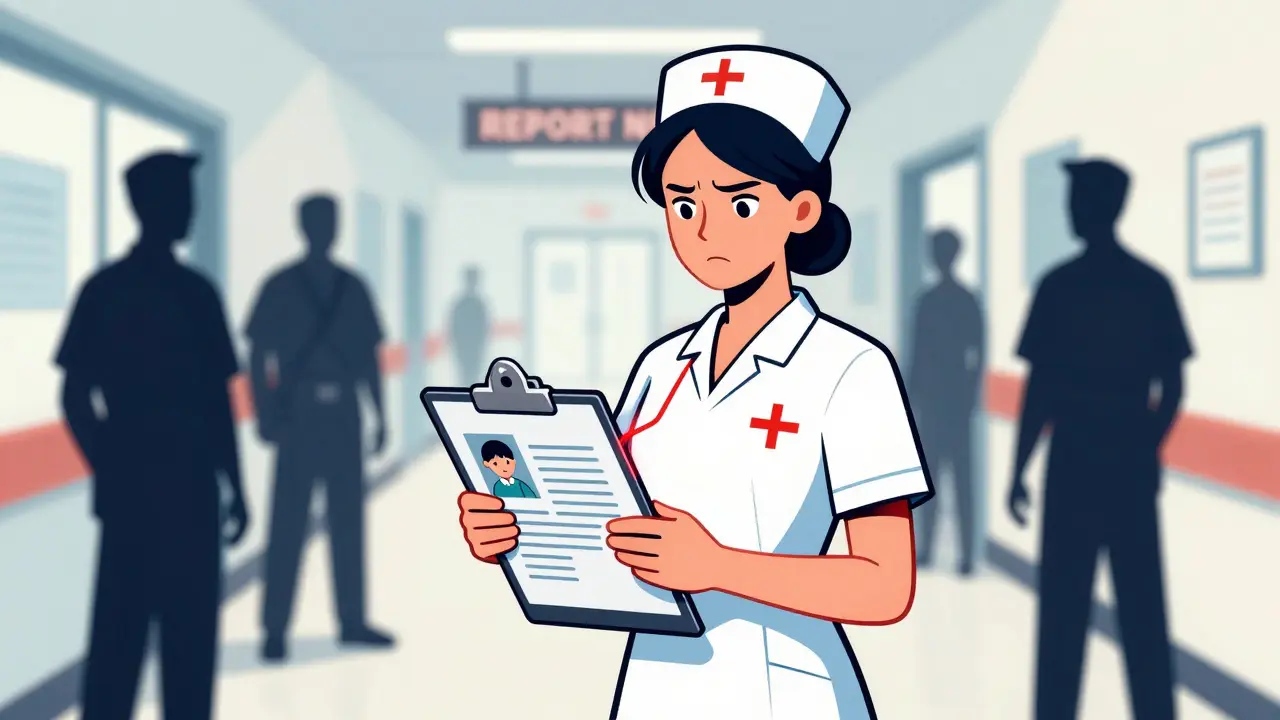
When a doctor sees signs of abuse on a child, or a nurse notices a colleague making dangerous medication errors, they don’t just have a moral duty-they have a legal obligation to report it. In the U.S., healthcare providers are on the front lines of public safety, required by law to speak up in specific situations-even when it’s uncomfortable, messy, or risks breaking patient trust. This isn’t about bureaucracy. It’s about stopping harm before it escalates.
What You Must Report: The Big Four Categories
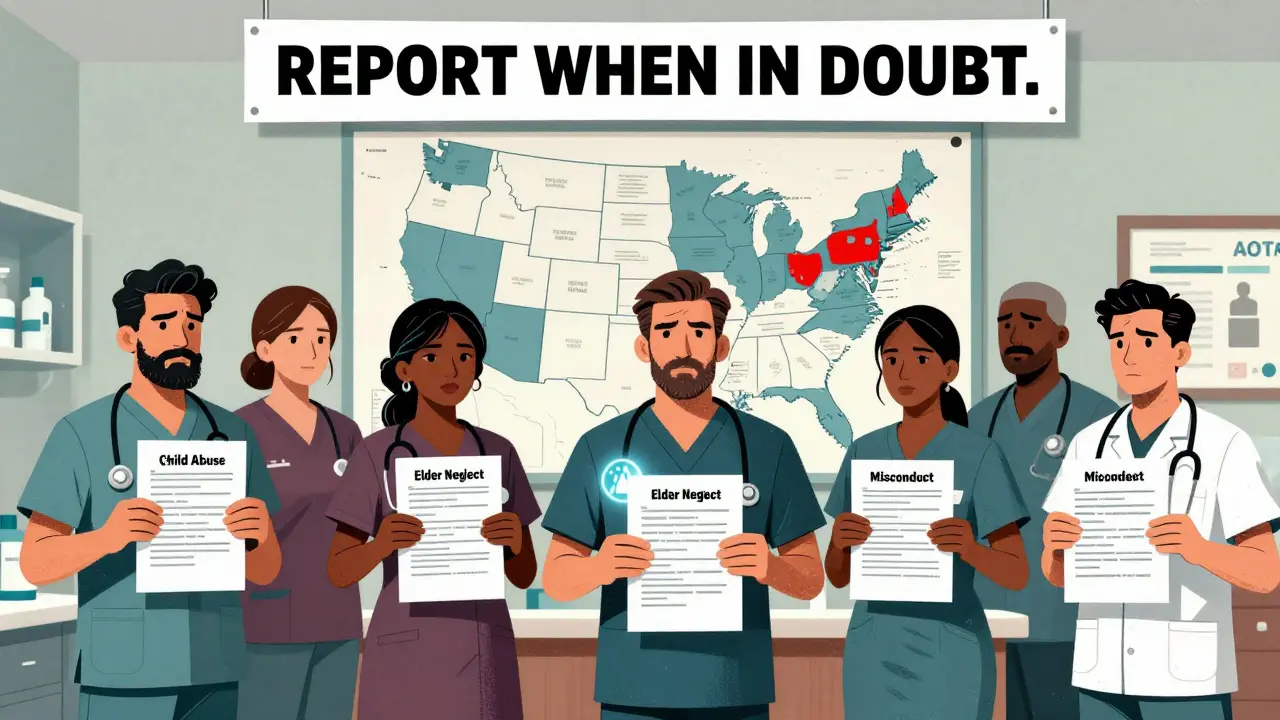
Every state has its own rules, but there are four main types of mandatory reporting that apply to nearly all doctors and nurses:- Child abuse and neglect: Required in all 50 states. This includes physical injury, sexual abuse, emotional harm, and severe neglect. You don’t need proof-just reasonable suspicion.
- Elder and vulnerable adult abuse: 47 states and D.C. require reporting of abuse against adults over 60 or those with disabilities. This covers physical violence, financial exploitation, and neglect in homes or facilities.
- Public health threats: You must report certain infectious diseases to health departments. Some, like anthrax or botulism, require a call within an hour. Others, like Lyme disease, allow up to seven days.
- Professional misconduct: In 42 states, supervisors or institutions must report impaired or unsafe colleagues-think drug use, falsifying records, or gross negligence. Some states require individual providers to report too.
These aren’t suggestions. Failing to report can cost you your license, lead to fines, or even criminal charges. In 2021, 12% of malpractice claims against physicians involved a failure to report, according to legal experts in the New England Journal of Medicine.
When to Report: Timing Matters
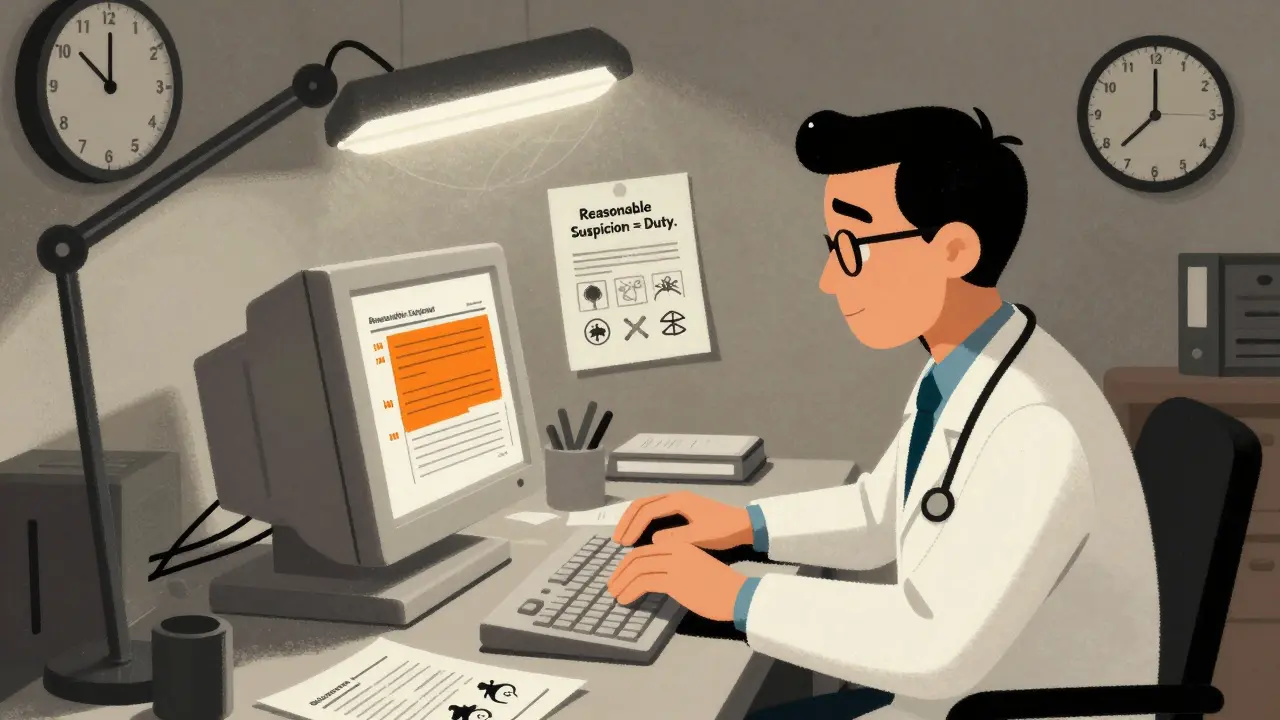
The clock starts ticking the moment you suspect something. But “suspect” doesn’t mean “know.” If a child comes in with unexplained bruises, or an elderly patient flinches when touched, that’s enough to trigger your duty.Timing varies by state and type:
- Child abuse: 12 states require immediate reporting-meaning within 24 hours. California, Michigan, and Minnesota demand reports within 36 to 48 hours. Some states allow phone calls first, followed by written reports.
- Elder abuse: Only 14 states require all providers to report. In others, only staff at nursing homes or hospitals must act. Texas, for example, doesn’t require individual doctors to report elder abuse.
- Public health: The CDC lists 57 reportable diseases. High-risk ones like meningitis or measles demand same-day notification. Others can wait. Electronic systems (eCR) now auto-submit many of these, cutting report time from 30 minutes to under five.
- Colleague misconduct: In Minnesota and Nebraska, institutions must report nurse misconduct within 30 days. But if you’re a nurse who sees a coworker stealing meds? You might be required to report it immediately-depending on your state.
Confused? You’re not alone. A 2022 survey by the American Telemedicine Association found 42% of telehealth providers didn’t know which state’s rules applied when treating patients across borders.
What Information Goes in the Report
A good report isn’t just a quick call. It needs specific details. Missing key info can delay intervention-or get you in trouble for an incomplete report.Typical required elements:
- For child abuse: The child’s name, age, address, description of injuries, names and addresses of parents or guardians, and how the injury occurred.
- For elder abuse: Victim’s location, type of abuse (physical, financial, neglect), and your contact info. California requires the reporter’s license number too.
- For nurse misconduct: The nurse’s license number, date of incident, specific violation (e.g., “administered incorrect dose,” “falsified chart”), and any witnesses.
Documentation is your shield. If you report, write it down-date, time, what you saw, who you told, and how you reported it. If you don’t report and something goes wrong, your notes might be the only proof you did your job.
How Reporting Conflicts With Patient Trust
This is the hardest part. Many patients open up only because they believe their secrets are safe. When you report, you break that trust.One pediatrician on Reddit shared they filed 17 abuse reports last year-15 led to protective action. But another said a patient with opioid addiction stopped coming entirely because they feared a report to child services. The American Medical Association found 68% of physicians feel mandatory reporting stops patients from being honest.
It’s not just about abuse. A nurse who reports a coworker for being drunk on shift might be protecting lives-but they could also be ostracized. A 2021 study in the Journal of Patient Safety found 8% of nurses who reported misconduct faced retaliation: demotions, shifts changed, or silent treatment.
Still, the American Nurses Association is clear: “Nurses have an ethical obligation to report unsafe practices.” The law backs them up in some states. Utah, for example, makes it illegal to punish someone for reporting. But not everywhere. That’s why many providers wait for institutional support before acting.
How Hospitals and Clinics Are Making Reporting Easier
No one should have to figure this out alone. Leading hospitals now build reporting into their systems:- California requires annual training for all staff on abuse reporting.
- Minnesota uses an online portal where nurses can submit misconduct reports anonymously.
- Washington State offers a 24/7 hotline for reporting questions (1-800-252-0230).
- Electronic reporting tools (eCR) now auto-fill public health forms using data from hospital labs.
Some systems even use AI to flag possible abuse cases. A 2023 pilot at Massachusetts General Hospital reduced reporting errors by 38% by analyzing patient notes for red flags like inconsistent injury explanations or frequent ER visits.
But here’s the gap: Only 28 states offer comprehensive online guides for providers. In 14 states, you’re on your own. If your hospital doesn’t train you, you need to find the info yourself.
What You Need to Know Right Now
You don’t need to memorize every state’s law. But you must know:- Which state’s rules apply to you-especially if you work across state lines.
- What your employer’s policy is. Does your hospital have a reporting protocol? Who do you contact?
- How to document everything. Keep a personal log: date, time, what you observed, who you reported to.
- Where to get help. Use the Child Welfare Information Gateway or the National Center on Elder Abuse for state-by-state summaries.
Don’t wait for a crisis. Ask your supervisor for a copy of your facility’s reporting policy. If they don’t have one, push for it. If you’re in a small clinic or telehealth role, check your state’s health department website. Most have downloadable PDFs with reporting forms and timelines.
What Happens After You Report
Once you file, you’re not done. You might be asked to testify. You might get a call from social services asking for more details. You might not hear back for weeks.But here’s what you should expect:
- You won’t be told the outcome. Privacy laws protect the patient’s records.
- You’re protected from retaliation in most states-if you report in good faith.
- Most reports lead to investigation, not immediate removal. The goal is intervention, not punishment.
One Michigan nurse reported a father who was beating his child. The child was removed temporarily. The father got counseling. The child returned home six months later, safer and healthier. That’s the win.
But another nurse in Minnesota reported unsafe staffing levels. She was demoted within two weeks. Her state had protections on paper-but no enforcement. That’s the risk.
Bottom Line: Report When in Doubt
The system isn’t perfect. It’s fragmented, confusing, and sometimes unfair. But the data is clear: states with mandatory reporting identify 37% more cases of child abuse than those without.If you see something that feels wrong-trust your gut. You’re not a detective. You’re not a judge. You’re the first line of defense.
Don’t wait for proof. Don’t wait for a colleague to speak up. Don’t wait until you’re sure.
Report.
Do I need to report if I’m not 100% sure?
Yes. Mandatory reporting is based on "reasonable suspicion," not proof. If a child has unexplained bruises, or an elderly patient seems afraid to speak, that’s enough. You’re not expected to investigate-just alert the authorities. Waiting for certainty can cost lives.
Can I get in trouble for reporting someone incorrectly?
No, as long as you report in good faith. Most states have legal immunity for providers who report suspected abuse or misconduct honestly-even if the investigation finds no wrongdoing. The risk isn’t from reporting too much-it’s from not reporting when you should.
What if I work in telehealth and the patient is in another state?
You must follow the laws of the state where the patient is physically located at the time of the encounter-not where you are. This is a major source of confusion. If you’re in Alabama but treating a child in California, you’re bound by California’s reporting rules. Always confirm the patient’s location before deciding what to report.
Does HIPAA stop me from reporting?
No. HIPAA allows-and in some cases requires-disclosure of protected health information for mandatory reporting. You can share names, addresses, injury details, and diagnoses with child protective services, public health departments, or licensing boards without patient consent. The law overrides confidentiality in these cases.
What if I report a colleague and they get fired-am I responsible?
No. Your responsibility is to report unsafe or illegal behavior. What happens after that-investigation, discipline, termination-is up to the employer or licensing board. You’re not a judge or jury. You’re a witness. As long as your report is truthful and based on facts you observed, you’re protected under most state laws.
Are there tools to help me report faster?
Yes. Many hospitals use electronic reporting systems that auto-fill forms using data from your EHR. Public health reporting is mostly automated through CDC’s eCR system. For child or elder abuse, some states offer online portals (like Minnesota’s) or hotlines. Check your state’s health department website-they often list approved reporting tools.



13 Comments
Ajay Brahmandam
December 22 2025Been a nurse for 12 years and I can tell you this: if you wait for proof, you're already too late. I had a kid come in with a spiral fracture at 3 years old-mom said he fell off the couch. Yeah right. Didn't need X-rays to know it wasn't an accident. Reported it. Kid got placed with grandma. Still checks in on us every Christmas.
Trust is fragile, but lives are heavier.
jenny guachamboza
December 22 2025ok but what if the ‘abuse’ is just strict parenting?? like my cousin’s mom made her do 50 pushups at 5am and called it ‘discipline’?? now the state took her away and put her in foster care with a guy who wears socks with sandals?? this is why i don’t trust gov’t 😭
Gabriella da Silva Mendes
December 22 2025Look, I get it. But let’s be real-this whole system is just a woke witch hunt disguised as ‘safety.’ You report one guy for being tired on shift and suddenly he’s labeled a monster? Meanwhile, the real problem is hospitals understaffed to hell and nurses working 16-hour shifts like slaves. Why not fix the system instead of turning every mistake into a federal case?
Also, who the hell is checking if the child protective services themselves aren’t abusive? I’ve seen kids get transferred to homes where they’re forced to eat cold cereal for dinner every night. So who protects the protectors?
And don’t even get me started on the ‘mandatory reporting’ for elderly abuse. Half the time it’s just family members fighting over inheritance and using the system as a weapon. I’ve seen it. And no, I’m not paranoid. I’m just awake.
Kiranjit Kaur
December 23 2025My mom was a nurse in Punjab before she moved here. She told me in India, reporting abuse was dangerous-families would turn on you, threaten you, even burn your house down. But she still did it. Quietly. Because she knew silence meant death.
Here, we have hotlines, portals, training, legal protection. We have tools they never dreamed of. So if we’re still hesitating? That’s on us.
Don’t wait for permission to do what’s right. Just do it. And if you’re scared? Text me. I’ll walk you through it. We’re not alone in this.
❤️
Johnnie R. Bailey
December 23 2025There’s a quiet tension here between ethics and bureaucracy. We’re told to report, but rarely trained to hold the weight of what happens after. That child you report? They might end up in a system that’s more broken than the one they fled. That colleague you name? They might be drowning in addiction because no one checked in on them for years.
We’re not just reporting facts-we’re making moral decisions with zero emotional support. The law doesn’t ask if you’re okay after. It just asks if you filed.
Maybe the real question isn’t ‘what do we report?’ but ‘what do we owe each other?’
Tony Du bled
December 25 2025I’ve been in rural ERs for 18 years. We don’t have social workers on call. We don’t have AI flagging bruises. We have a fax machine from 1997 and a state hotline that plays hold music for 22 minutes.
Reported a case last year-got a callback three weeks later saying ‘case closed, no further action.’ The kid was still there. With the same guy.
So yeah, the rules are clear. The system? Not so much.
Julie Chavassieux
December 25 2025Report. Report. REPORT. That’s all anyone says. But nobody talks about how after you report, you become the villain. The family blames you. The hospital whispers. Your name gets passed around like a dirty secret. And then you’re the one who’s ‘too emotional’ or ‘too involved.’
It’s not about the law. It’s about survival.
Candy Cotton
December 26 2025As a former federal compliance officer, I must emphasize: the legal framework governing mandatory reporting is codified under Title 42 U.S.C. § 13032 and reinforced by the Child Abuse Prevention and Treatment Act (CAPTA) of 1974, as amended. Failure to comply constitutes a Class C misdemeanor in 42 states and may trigger civil liability under 42 U.S.C. § 1983. Furthermore, the Health Insurance Portability and Accountability Act (HIPAA) explicitly permits disclosures under 45 CFR § 164.512(b)(1)(i) for public health and safety purposes. Any provider who claims ignorance is not merely negligent-they are willfully disregarding federal statutory obligations. This is not a suggestion. It is a legal imperative. Period.
Sam Black
December 27 2025When I first moved from Sydney to Texas, I thought the reporting rules here were insane. Then I saw a toddler with third-degree burns from a cigarette-mom said the dog did it. I reported. Two weeks later, the mom was in jail. The kid? Now lives with his aunt who bakes him cookies every Sunday.
It’s messy. It’s hard. But it’s worth it.
Don’t wait for the system to be perfect. Just be the person who shows up.
And if you’re scared? You’re not broken. You’re human. That’s why we need each other.
Cara Hritz
December 29 2025wait so if i report my coworker for being drunk on shift and they get fired but it turns out they were just tired and had a headache and i misread the slurring-do i get sued?? i think i might have done this once and i still have nightmares
Jamison Kissh
December 31 2025What’s the cost of silence? We talk about legal liability, but what about moral liability? If you see a pattern-a child who comes in every month with new bruises, a patient who flinches every time a nurse enters the room-what are you really protecting by staying quiet? Not trust. Not dignity. Just your own comfort.
Reporting isn’t about being a hero. It’s about refusing to be complicit.
Art Van Gelder
December 31 2025I’ve seen it all. The kid with the broken arm who says ‘I fell’ every time. The elderly woman whose bank account is drained every payday by her ‘caregiver’ son. The nurse who’s nodding off during med passes because she’s been up 36 hours.
And every time? I report. Not because I want to. Because I have to.
But here’s the thing no one says: the system doesn’t thank you. It doesn’t thank you when the child is saved. It doesn’t thank you when the colleague gets help. It doesn’t thank you when you’re the only one who spoke up.
So you do it anyway. Because someone has to.
And if you’re reading this and you’ve never reported something because you were scared? You’re not alone. But you’re also not off the hook.
Go to your hospital’s portal. Find the form. Fill it out. Send it.
Just do it.
Tomorrow, you’ll be glad you did.
Kathryn Weymouth
January 1 2026Documentation is everything. I once had a patient who came in with a suspicious pattern of fractures. I wrote down the time, the exact location of each bruise, the parent’s inconsistent story, the child’s body language. When CPS came, they said my notes were the most thorough they’d seen in years. That report led to a full investigation and the child’s removal.
But here’s what mattered more: I kept a copy. Just in case. Because in this job, your paper trail is your armor.
Write it down. Date it. Sign it. Don’t rely on memory. Don’t rely on emotion. Just write it down.
That’s how you protect yourself-and them.