Inactive Ingredient Differences: Can Excipients Affect Safety or Efficacy?
When you take a pill, you think you’re swallowing just the medicine-the active ingredient that treats your condition. But what you’re actually swallowing is mostly stuff that isn’t supposed to do anything at all. These are called excipients: fillers, binders, coatings, flavors, preservatives. They make the pill hold together, taste better, dissolve at the right time. And for decades, regulators and manufacturers treated them like harmless bystanders. But science is now saying: they’re not always inert.
What excipients actually do
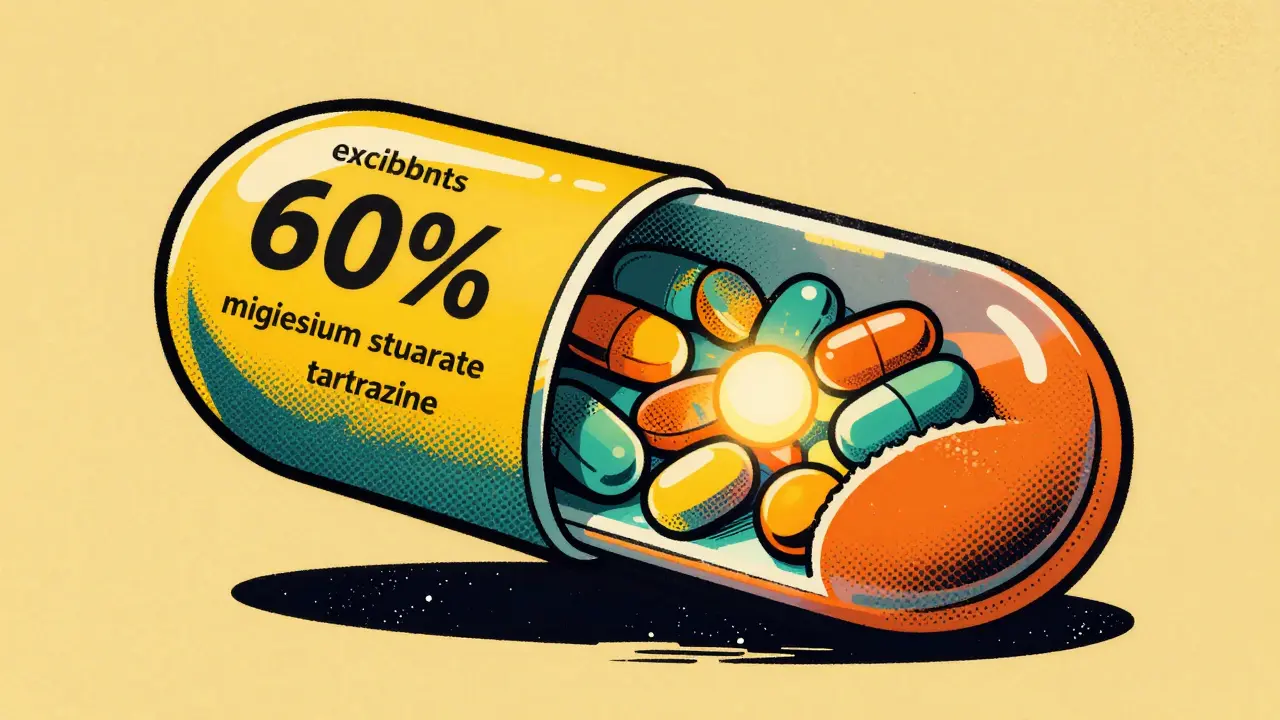
Excipients make up 60% to 99% of the total weight of a typical pill. That’s right-most of what you swallow isn’t the drug. In a 500mg tablet of ibuprofen, maybe 200mg is the actual medicine. The rest? Lactose, microcrystalline cellulose, magnesium stearate, croscarmellose sodium, tartrazine. These aren’t random additives. Each has a job. Fillers give the pill bulk. Binders glue everything together. Disintegrants help it break apart in your stomach. Lubricants keep it from sticking to manufacturing machines. Colorants make it look consistent. Flavorings hide bitterness.The U.S. Food and Drug Administration (FDA) lists about 1,500 approved excipients across all routes of administration-oral, injectable, eye drops, nasal sprays. Each has a safe concentration limit. For example, polysorbate 80 is fine up to 5% in pills, but only 0.05% in IV solutions. Why? Because your body handles these substances differently depending on how they enter. A compound that’s harmless swallowed might cause a reaction if injected directly into your bloodstream.
The myth of "inactive"
The term "inactive ingredient" is misleading. It sounds like these substances are biologically dead. But a 2020 study published in Science found that 38 out of 314 tested excipients interacted with biological targets in the body. Some matched or exceeded concentrations seen during normal use. That’s not a fluke. Aspartame, used as a sweetener in some chewable tablets, showed activity against the glucagon receptor at levels you’d actually reach after taking a dose. Sodium benzoate, a preservative, inhibited monoamine oxidase B-an enzyme targeted by Parkinson’s drugs. Propylene glycol, common in liquid meds, blocked monoamine oxidase A, which is linked to mood regulation.These aren’t theoretical findings. They’re measurable. In vitro activity doesn’t always translate to real-world effects-but when concentrations overlap, it raises red flags. The FDA’s own Center for Drug Evaluation and Research admitted in 2022 that "the assumption of inertness for excipients may not hold for all compounds at all concentrations." That’s a big deal. For 80 years, we’ve assumed these additives were safe by default. Now we know some aren’t.
Why generic drugs can be different
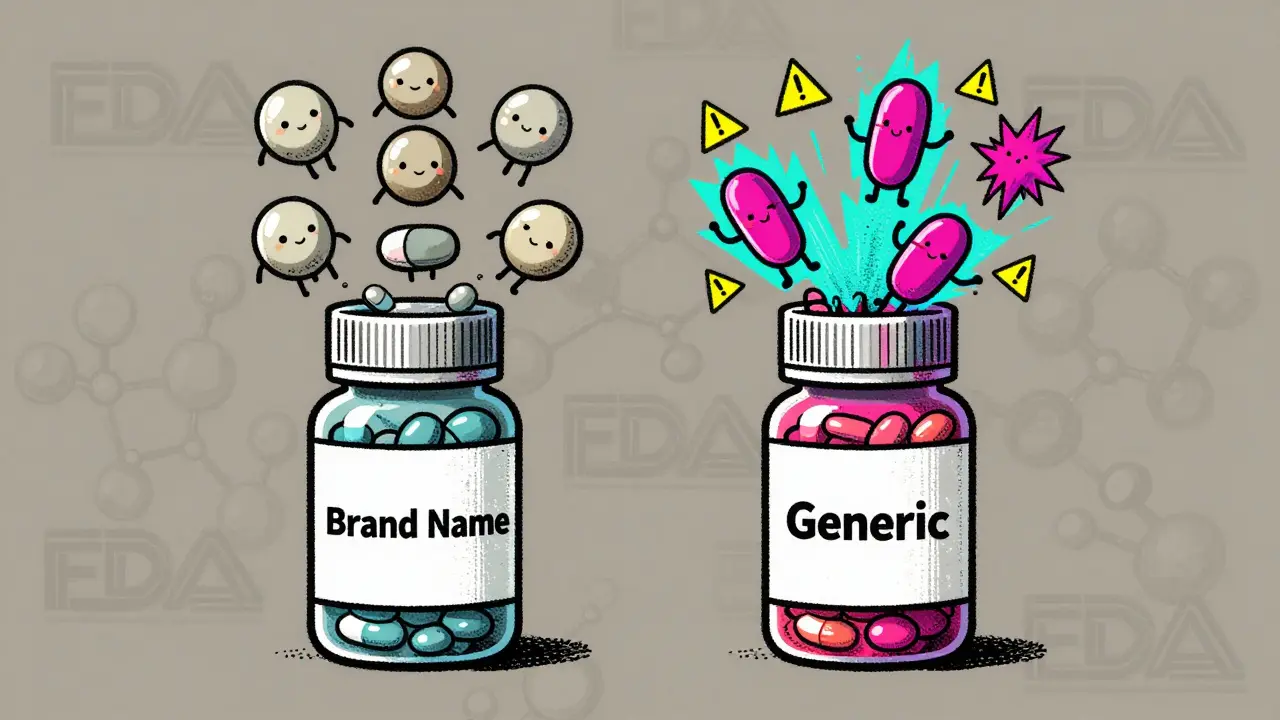
Here’s where it gets personal. If you switch from a brand-name drug to a generic, you might get a completely different set of excipients. The FDA allows this-as long as the active ingredient is the same and the drug works the same way. But "works the same way" doesn’t always mean "feels the same." A 2020 rejection of Aurobindo’s generic version of Entresto shows why. The company swapped magnesium stearate for sodium stearyl fumarate. Sounds minor. But in vitro tests showed a 15% difference in how fast the drug released at stomach pH. The FDA said: no go. That change could alter absorption, especially in patients with gut issues.That’s not an isolated case. In 2018, 14 generic valsartan products were recalled because a new solvent used in manufacturing created a cancer-causing contaminant (NDMA). The solvent wasn’t the active ingredient. It was an excipient-related processing aid. And it slipped through because regulators didn’t require full toxicology screening for every new excipient variant.
Regulatory gaps and real-world risks
The rules aren’t the same for every drug. For injectables, eye drops, or ear drops, generic makers must match the original drug’s excipients exactly-down to the concentration. Why? Because these bypass your body’s natural filters. But for oral pills? You can swap out almost anything, as long as you prove bioequivalence. And proving that takes time and money. Generic manufacturers spend an average of $1.2 million and 18 months justifying a new excipient.But here’s the catch: most of that money goes into proving the drug works the same. Not whether the new excipients are safe for everyone. The FDA’s Inactive Ingredient Database (IID) tracks approved excipients, but it doesn’t predict interactions. It doesn’t account for individual differences-like allergies, gut sensitivity, or genetic variations in how you metabolize things. A person with lactose intolerance might have diarrhea from a generic version of metformin that uses lactose as a filler, even though the brand version uses microcrystalline cellulose. That’s not a drug reaction. It’s an excipient reaction.
Who’s at risk?
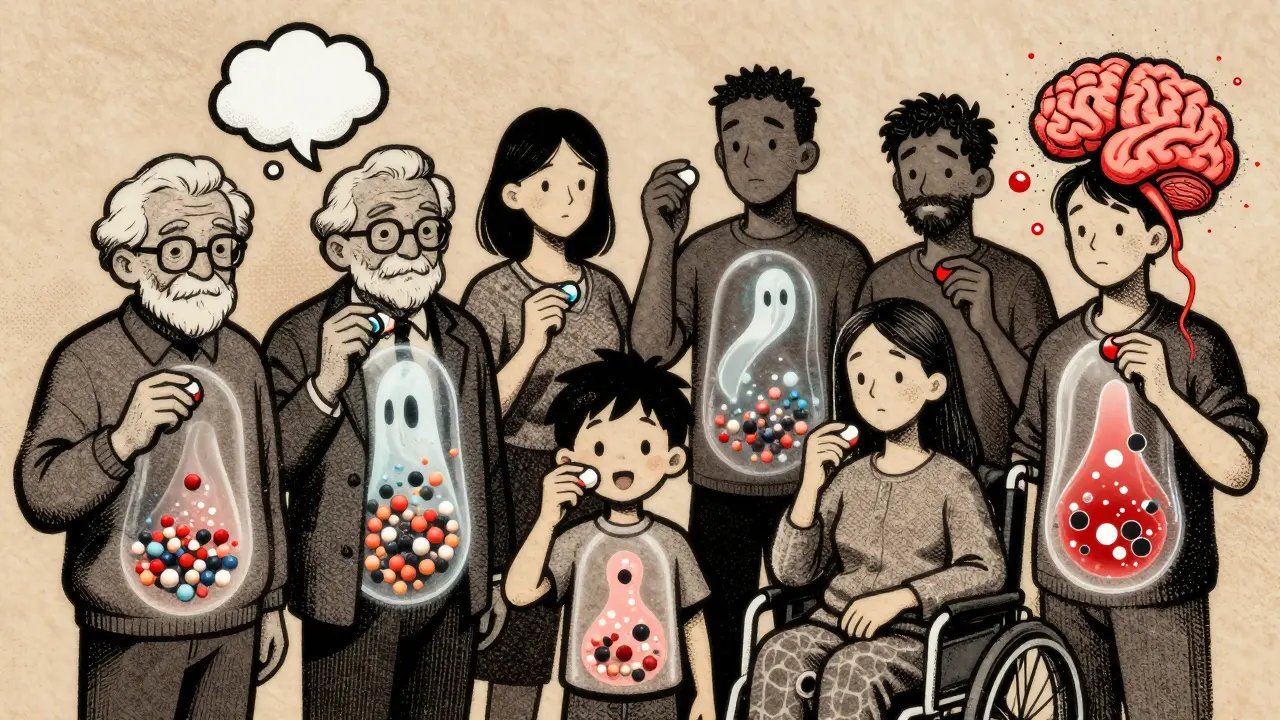
Most people won’t notice a difference. But certain groups are more vulnerable. People with autoimmune conditions, chronic gut disorders, or multiple allergies are at higher risk. Children and elderly patients, who often take more pills, are exposed to more excipients over time. Those on long-term meds-like thyroid hormones, antihypertensives, or antidepressants-could be accumulating low-level biological interference from excipients they never knew about.There are also cases of hypersensitivity. In 2023, the FDA launched a pilot program to require extra safety data for 12 high-risk excipients in orally disintegrating tablets-including aspartame and saccharin-after reports of rare but real allergic reactions in 0.002% of users. That’s one in 50,000. Small. But if you’re that one person, it’s everything.
What’s changing-and what’s next
The industry is waking up. The FDA is developing a computational model to predict which excipients might interact with human targets, based on the 2020 Science study. They’re also proposing to update the IID with predicted tissue concentrations for each excipient. That’s a start. But it’s not enough. The International Pharmaceutical Excipients Council (IPEC) is trying to set universal thresholds below which excipients are assumed safe. But critics say that ignores individual variability. One person’s harmless dose is another’s trigger.By 2025, experts predict 30% of complex generic applications will need extra excipient safety studies-up from 18% in 2022. That’s because new drug forms are popping up: extended-release pills, chewables, nasal sprays, patches. These need novel excipients. And novel excipients mean novel risks.
What you can do
You don’t need to become a chemist. But you can be smarter about your meds. If you’ve had unexplained side effects after switching to a generic-bloating, headaches, rashes, fatigue-ask your pharmacist for the ingredient list. Compare it to your brand-name version. If the fillers or coatings changed, that could be why.Don’t assume generics are identical. They’re therapeutically equivalent-but not chemically identical. And sometimes, that difference matters.
Pharmacies and doctors rarely mention excipients. But if you have a history of sensitivities, allergies, or chronic conditions, it’s worth asking: "What’s in this pill besides the active drug?" You have a right to know. And if you’re switching brands, keep track of how you feel. A small change in excipients might be the hidden cause of your new symptoms.
The science is clear: excipients aren’t just filler. They’re part of the story. And that story is still being written.