Lyme Disease: Tick-Borne Infection and Treatment Timeline
Every year, nearly half a million people in the U.S. get Lyme disease. Most won’t even know they were bitten. The tick that carried the bacteria is tiny-smaller than a poppy seed-and often goes unnoticed until it’s too late. By then, the infection has already begun spreading. But here’s the thing: if you catch it early, it’s one of the most treatable infections out there. If you miss it? The consequences can last for years.
How Lyme Disease Starts
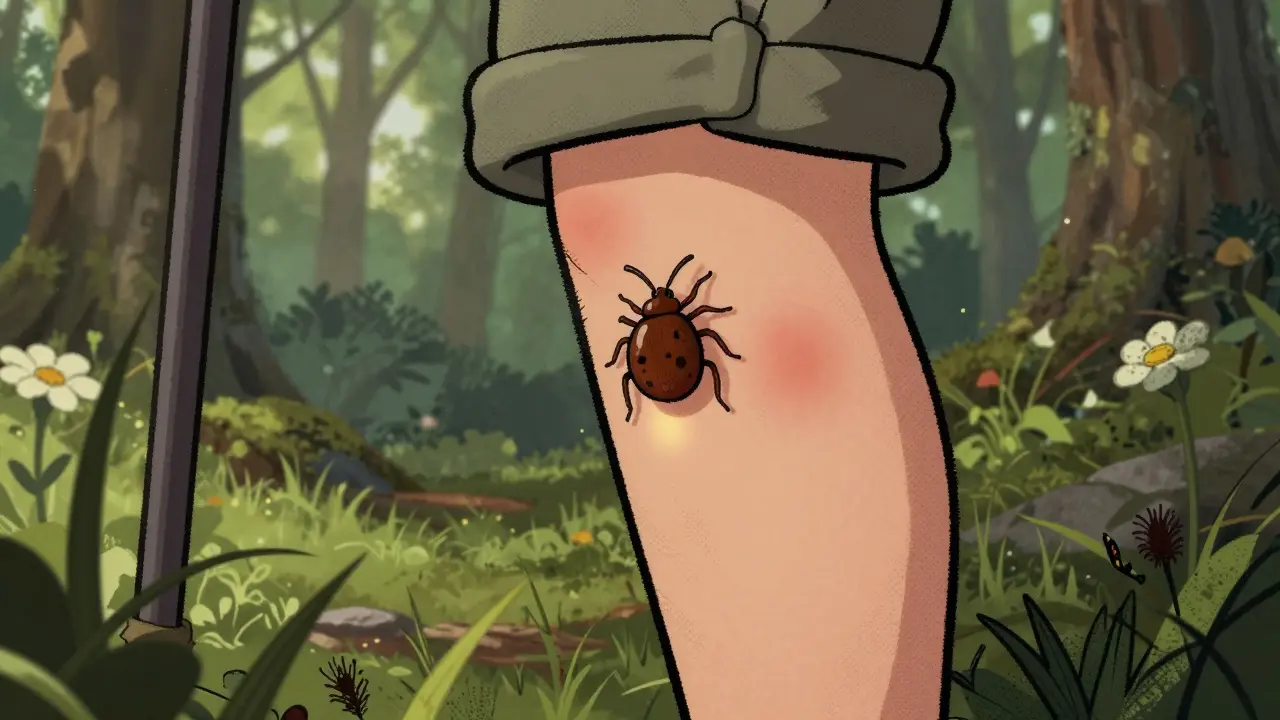
Lyme disease isn’t caused by a virus or a fungus. It’s a bacterial infection from Borrelia burgdorferi, a spiral-shaped bacterium carried by blacklegged ticks. These ticks live in wooded, grassy areas-especially in the Northeast, Mid-Atlantic, and upper Midwest. They don’t jump or fly. They wait on blades of grass or low bushes, latch onto you as you brush past, and then feed.
The real danger comes from nymph ticks. These are the teeny, barely visible stage of the tick’s life cycle. They’re active in spring and summer, when people are outside hiking, gardening, or playing with kids in the yard. A nymph can attach without you feeling it. And if it’s infected, it takes time to pass the bacteria. The CDC says transmission usually needs more than 24 hours. Some studies suggest it can start as early as 15 hours. The bottom line? The sooner you remove a tick, the better.
Removing a tick properly matters. Use fine-tipped tweezers. Grab it as close to the skin as you can. Pull upward with steady pressure. Don’t twist, don’t squeeze its body, and don’t use matches, nail polish, or petroleum jelly. Those myths don’t work-and they might make things worse.
The Three Stages of Lyme Disease
Lyme disease doesn’t happen all at once. It unfolds in stages. And each stage has different symptoms, different risks, and different treatment needs.
Stage 1: Early Localized (1-28 days after bite)
This is when the infection is still near the bite. About 70-80% of people develop a rash called erythema migrans. It looks like a bull’s-eye: a red circle that expands outward, sometimes with a clear center. But not everyone gets the classic ring. Some see a solid red patch. Others don’t notice it at all-especially if it’s on their back, scalp, or behind the knee.
Along with the rash, you might feel flu-like symptoms: fever, chills, fatigue, headache, muscle aches, swollen lymph nodes. These are easy to mistake for a cold or the flu. That’s why so many people delay treatment.
Stage 2: Early Disseminated (weeks to months after bite)
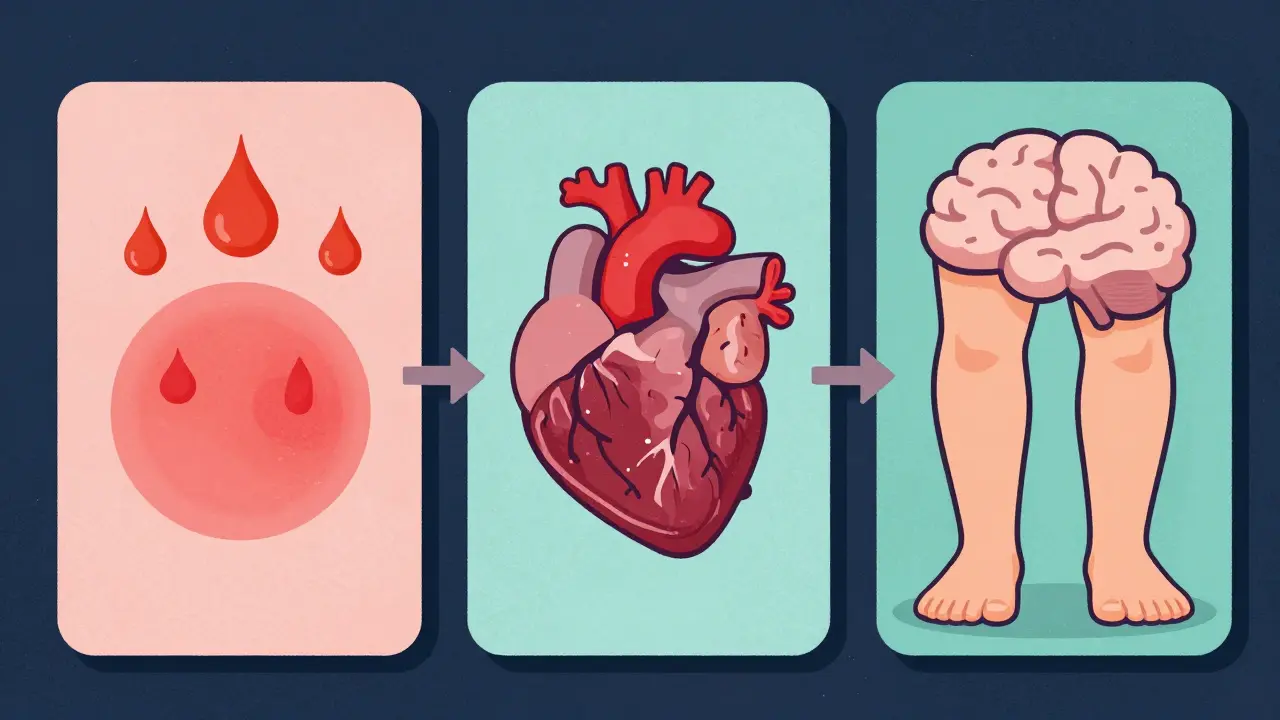
If the bacteria aren’t stopped, they spread through the bloodstream. Now the infection hits other parts of the body.
You might get multiple rashes in new places. You could develop facial palsy-sudden weakness or drooping on one side of the face. Some people get heart problems: irregular heartbeat, dizziness, or shortness of breath. This is called Lyme carditis. It’s rare, but serious. About 4-10% of untreated cases develop it.
Neurological symptoms can show up too: numbness, tingling, shooting pains, or brain fog. Memory issues. Trouble concentrating. These can be mistaken for multiple sclerosis or chronic fatigue syndrome.
Stage 3: Late Disseminated (months to years after bite)
This is what happens when Lyme disease goes untreated for a long time. The bacteria settle into joints, nerves, and tissues.
Severe joint pain and swelling-especially in the knees-are common. Some people develop chronic arthritis that comes and goes. Nerve damage can lead to long-term numbness or pain. Cognitive problems may persist: difficulty finding words, memory lapses, mental exhaustion.
At this stage, treatment becomes harder. Antibiotics still help, but recovery takes longer. And some people never fully bounce back.
How Lyme Disease Is Treated
There’s no mystery here. Lyme disease responds well to antibiotics-if you start early.
Stage 1 treatment: Oral antibiotics for 10 to 21 days. Doxycycline is the go-to for adults and kids over 8. Kids under 8 and pregnant people get amoxicillin or cefuroxime. If you catch it within the first few days of the rash, your chances of full recovery are over 90%.
Stage 2 treatment: If the infection has spread to the nervous system or heart, you’ll need intravenous (IV) antibiotics for 14 to 28 days. Ceftriaxone is the most common. This isn’t a quick fix-you’ll need a port or a PICC line. But most people recover completely with this treatment.
Stage 3 treatment: Even after months or years, antibiotics can help. But recovery is slower. Some patients need longer courses. Others need physical therapy for joint damage or cognitive rehab for brain fog.
There’s one exception: if you’re in a high-risk area (like Connecticut or Wisconsin), find a tick that’s been attached for more than 36 hours, and it’s engorged, you might qualify for a single dose of doxycycline (200 mg) within 72 hours of removal. This isn’t a cure-all-but it cuts your risk of infection by up to 87%.
The Diagnosis Problem
Here’s the hard truth: Lyme disease is often missed.
Doctors don’t always recognize the rash. Blood tests can be wrong, especially early on. The standard two-tier test (ELISA followed by Western blot) only catches about 30% of early cases. Why? Because your body hasn’t made enough antibodies yet. It takes weeks.
That’s why experts like Dr. Allen Steere say: if you have the bull’s-eye rash, you don’t need a blood test. Treat it. Now.
But if you don’t have the rash? Testing becomes tricky. False negatives are common. False positives happen too-especially if you’ve had other infections or autoimmune conditions.
A new test, the MiQLick test, came out in March 2023. It detects Lyme bacteria DNA in urine. It’s 92% accurate in early cases. That’s a big step forward. But it’s not widely available yet.
And here’s another problem: only 52% of primary care doctors can correctly identify all three stages of Lyme disease. Many patients see three, four, even seven doctors before getting a correct diagnosis. The average delay? Nearly two years.
What Happens After Treatment?
Most people recover fully. But not all.
About 10-20% of treated patients develop something called Post-Treatment Lyme Disease Syndrome (PTLDS). Their symptoms-fatigue, pain, brain fog-linger for months or even years. It’s not an active infection. The bacteria are gone. But something in the body remains out of balance.
There’s no proven cure for PTLDS. Antibiotics won’t help. Some patients try supplements, physical therapy, or cognitive behavioral therapy. Others find relief with pacing-learning to rest before they crash.
The controversy? Some groups claim Lyme disease becomes a chronic, lifelong infection that needs years of antibiotics. The Infectious Diseases Society of America says there’s no solid evidence for that. But the International Lyme and Associated Diseases Society disagrees. And 28 U.S. states now protect doctors who prescribe long-term antibiotics for these patients.
Here’s what we know for sure: prolonged antibiotics come with risks-C. diff infections, yeast overgrowth, antibiotic resistance. And they don’t reliably help people with PTLDS.
Prevention Is Still the Best Strategy
You can’t eliminate all risk. But you can cut it way down.
- Use EPA-approved insect repellents with DEET, picaridin, or oil of lemon eucalyptus.
- Wear long pants tucked into socks when walking in tall grass or woods.
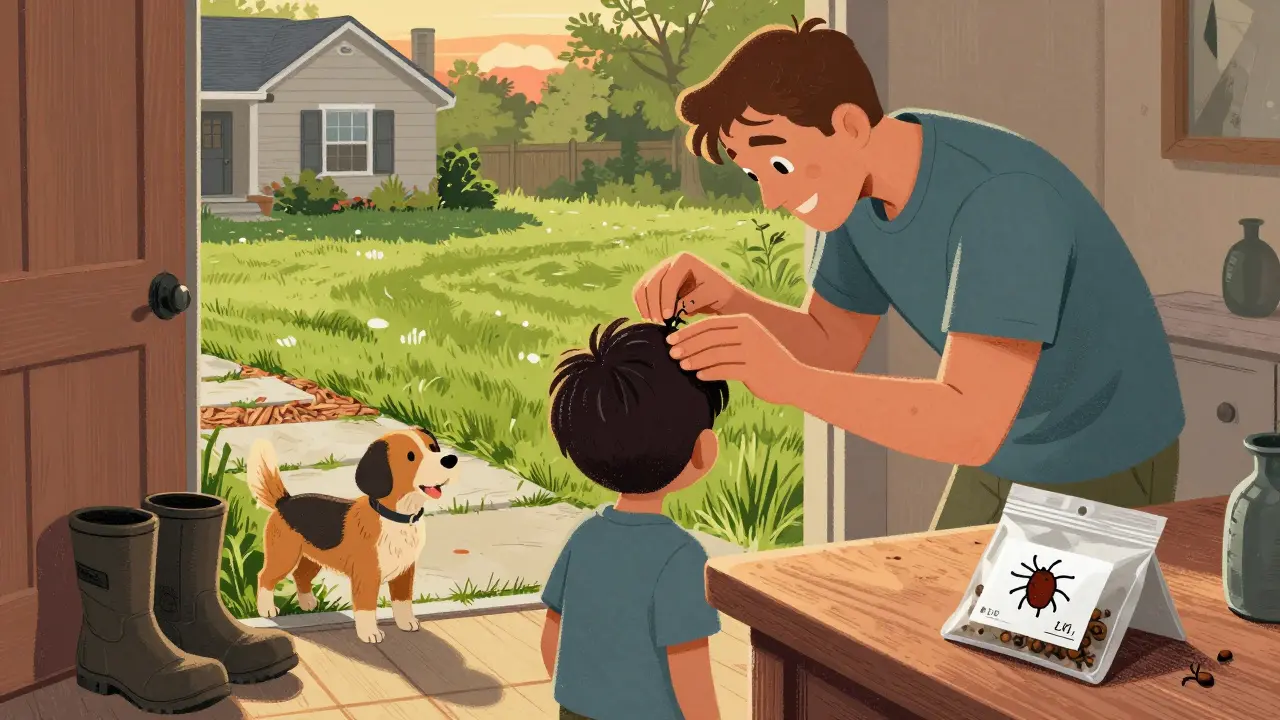
- Check your body, hair, and pets for ticks within two hours of coming inside.
- Shower soon after being outdoors-it washes off unattached ticks.
- Keep your yard clear: mow the lawn, remove leaf litter, and create a wood chip barrier between grass and wooded areas.
And if you find a tick? Don’t panic. Remove it. Save it in a sealed bag with the date. If you develop symptoms later, that tick can be tested.
What’s Coming Next?
There’s real hope on the horizon.
A new Lyme vaccine, VLA15, is in phase 3 trials. It’s being developed by Valneva and Pfizer. Early results show 70-96% effectiveness against different strains of the bacteria. If approved, it could be available by 2027.
Researchers at NIAID are also working on an mRNA vaccine-similar to the ones used for COVID-19. Human trials are expected to start in mid-2024.
Climate change is making things harder. Ticks are spreading north. In Canada, their habitat has expanded by 50% since 2000. By 2050, Lyme disease cases could double.
But here’s the good news: we know how to stop it. We know what to look for. We know how to treat it. The problem isn’t science. It’s awareness.
Frequently Asked Questions
Can you get Lyme disease from a dog or cat?
No. Dogs and cats can get Lyme disease from ticks, but they can’t pass it directly to humans. However, ticks that bite your pet can crawl off and bite you. That’s why tick prevention for pets is so important.
Is Lyme disease contagious between people?
No. You can’t catch Lyme disease from touching, kissing, or having sex with someone who has it. There’s no evidence it spreads through blood transfusions or breastfeeding, either. The only way it spreads is through infected tick bites.
Why do some people feel sick for months after treatment?
Some people develop Post-Treatment Lyme Disease Syndrome (PTLDS). It’s not an ongoing infection. The bacteria are gone. But inflammation, nerve damage, or immune system changes may cause lingering symptoms like fatigue, joint pain, or brain fog. There’s no magic pill for it-rest, pacing, and physical therapy help most.
Can a negative blood test rule out Lyme disease?
Not if you’re in the early stage. Blood tests look for antibodies, and your body doesn’t make enough of them for weeks after the bite. A negative test in the first month doesn’t mean you don’t have Lyme. If you have the rash or symptoms, treat it anyway.
Are herbal remedies or supplements effective for Lyme disease?
No. There’s no scientific proof that herbs, essential oils, or supplements cure Lyme disease. Antibiotics are the only proven treatment. Some people use supplements to manage symptoms like fatigue or pain, but they don’t kill the bacteria. Relying on them instead of antibiotics can let the infection spread.



10 Comments
Ian Cheung
January 10 2026Just got back from a hike and found a tick on my calf-no bullseye, no fever, but my gut’s been weird all week. I’m saving the little bugger in a ziplock with today’s date. If I start feeling like my brain’s wrapped in cotton wool, I’m not waiting for a blood test to tell me what I already know.
McCarthy Halverson
January 10 2026Remove ticks with tweezers. No exceptions. No myths. No petroleum jelly. If you’re doing anything else you’re playing Russian roulette with your nervous system.
Aurora Memo
January 10 2026I appreciate how clear this is. I’ve seen too many people dismiss early symptoms because they didn’t have the classic rash. The fact that 70-80% get it doesn’t mean the other 20-30% are less deserving of care. Awareness saves lives.
neeraj maor
January 11 2026Let’s be real-the CDC and Big Pharma don’t want you to know that Lyme isn’t just a tick thing. It’s a bioweapon experiment gone wrong. They suppress the MiQLick test because if everyone knew how easy it is to detect, the whole antibiotic industry would collapse. And don’t get me started on the mRNA vaccine-why are they pushing it now? Coincidence? Or just another vector for tracking?
Dwayne Dickson
January 12 2026While the clinical framework presented here is methodologically sound, it remains critically deficient in its ontological framing of Borrelia burgdorferi as a singular-pathogen entity. The literature increasingly supports pleomorphic persistence, biofilm-mediated immune evasion, and coinfection synergism-particularly with Babesia and Bartonella-which the current diagnostic paradigm systematically ignores. Consequently, the 90% recovery statistic is statistically misleading without stratification by co-morbidity burden and treatment duration. The reliance on ELISA/Western blot is not merely suboptimal-it is epistemologically bankrupt in early-stage disease.
Jaqueline santos bau
January 12 2026My cousin had Lyme for 7 years and was told she was just anxious. Then she found a holistic healer who did 18 months of herbal protocols and now she’s running marathons. Meanwhile, her doctor still says antibiotics are the only answer. Who’s really lying here? The system is broken and people are suffering because of it. Why won’t they just listen?
Paul Bear
January 13 2026There is no such thing as 'Post-Treatment Lyme Disease Syndrome' as a legitimate medical diagnosis. The term is a euphemism for chronic, unexplained fatigue that arises from non-infectious etiologies. The Infectious Diseases Society of America guidelines are evidence-based. Those who promote long-term antibiotics are violating the Hippocratic Oath by exposing patients to preventable harm. The data is unequivocal: prolonged antibiotic therapy does not improve outcomes and increases risk of C. diff, candidiasis, and antimicrobial resistance. This is not a debate-it is settled science.
Ashlee Montgomery
January 14 2026If the body can clear the infection with a few weeks of antibiotics, why does it sometimes stay stuck in a loop of fatigue and fog afterward? Is it immune memory gone rogue? Is it nerve damage that never fully heals? Or is it that we’ve been treating the symptom, not the root? Maybe the bacteria are gone, but the trauma they left behind isn’t. We treat the infection, but we don’t treat the person who lived through it.
Bradford Beardall
January 16 2026Coming from India, I never thought ticks would be a problem here. But my sister just came back from a trip to upstate New York and now we’re all Googling Lyme like it’s a Netflix show. I didn’t know ticks could be smaller than a poppy seed. That’s wild. And the fact that you can get a single dose of doxycycline if you catch it fast? That’s life-changing info. Why isn’t this on every park sign?
chandra tan
January 18 2026My uncle in Wisconsin got Lyme last year. They gave him 21 days of doxy. He’s fine now. But his wife? She’s still tired. She says her brain feels like a slow computer. They told her it’s all in her head. I don’t think so. I think we still don’t get it. And I think we need to stop pretending we do.