
Radiation vs. Surgery: How to Choose the Right Local Cancer Treatment
When cancer is caught early, the goal isn't just to kill it-it's to remove or destroy it without wrecking your life.
Two main tools do this: radiation and surgery. Both aim for the same thing-local control. That means stopping the cancer where it started, before it spreads. But they work in very different ways. One cuts it out. The other zaps it. Neither is better across the board. The right choice depends on your cancer type, your body, your lifestyle, and what matters most to you.
Let’s cut through the noise. No fluff. Just what you need to know to make a real decision.
Surgery: Take It Out, Know Exactly What You Got
Surgery means cutting the tumor out. It’s direct. Physical. You walk into the hospital, you come out with part of an organ gone-and a pathology report that tells you exactly what was removed. No guessing. No uncertainty about whether every last cancer cell is gone.
For prostate cancer, that’s a radical prostatectomy. For lung cancer, it’s a lobectomy-removing a lobe of the lung. These aren’t small procedures. A prostate surgery takes 2-4 hours. A lung surgery? 3-7 days in the hospital, then 6-8 weeks to recover fully. You’re out of action. You need help at home. You can’t drive for weeks.
But here’s the upside: you get certainty. Pathologists examine the tissue under a microscope. They tell you the cancer’s grade, how far it spread in the organ, whether lymph nodes were involved. That info guides everything after-do you need chemo? More radiation? Or are you done?
And survival? For early-stage lung cancer, surgery wins. A 2022 analysis of over 30,000 patients showed 71.4% of those who had surgery were alive five years later. For those who got radiation instead, it was 55.9%. That’s a big gap. Surgery isn’t just about removing the tumor-it’s about removing the whole risk zone.
Radiation: Zap It Without Cutting
Radiation doesn’t cut. It burns. High-energy beams target cancer cells, damaging their DNA so they can’t multiply. Modern machines can hit a tumor within 1-2 millimeters. That’s like aiming a laser at a marble from 100 yards away.
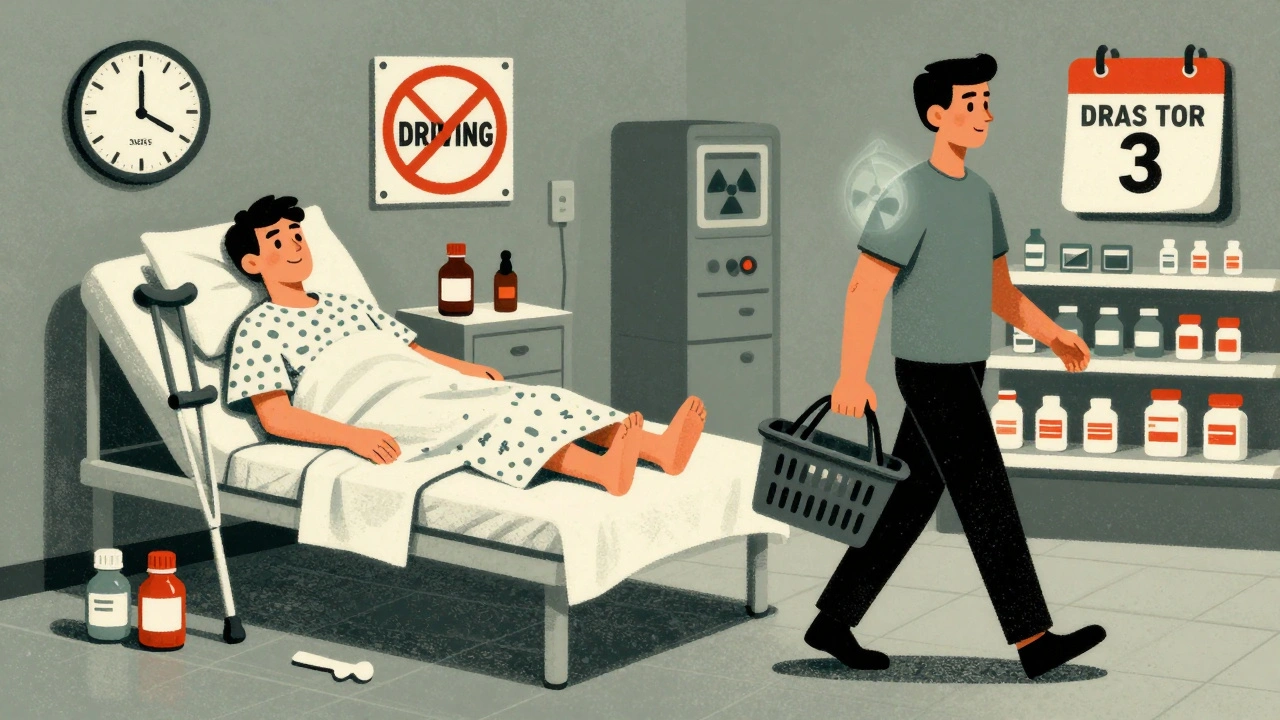
For prostate cancer, it’s usually daily sessions over 7-9 weeks. Each one takes 15-30 minutes. You come in, lie on a table, the machine moves around you, and you leave. No incision. No hospital stay. You can work, drive, go to the grocery store. It’s less disruptive.
For lung cancer, there’s a newer version called SBRT-stereotactic body radiation therapy. It packs the same punch in just 1-5 sessions. No hospital. No recovery time. You’re back to normal in days. That’s why it’s the go-to for people who can’t have surgery-older patients, those with heart or lung disease, or people who just don’t want the cut.
But here’s the catch: you don’t get the tissue. You don’t know for sure if every cancer cell is gone. You rely on scans. And sometimes, cancer comes back in the same spot. In the ProtecT trial, 13.4% of men who had radiation saw their cancer progress within 10 years, compared to 12.9% after surgery. That’s close. But for high-risk cases, surgery still pulls ahead.
Side Effects: What You Lose Matters as Much as What You Kill
Survival numbers are important. But if you’re alive but can’t control your bladder, or your bowels are ruined, or you can’t have sex-what’s the point?
After surgery for prostate cancer, urinary leakage is common. In the NIH’s 10-year study, 14% of low-risk men still leaked urine. For high-risk men? 25%. Erectile dysfunction hits 50-70% in the first year. It can improve, but not always.
Radiation? Less leakage. But bowel problems? More. Around 8% of radiation patients had serious bowel issues after 10 years. That means frequent trips to the bathroom, urgency, even bleeding. It’s not life-threatening, but it’s life-changing.
For lung cancer, surgery means losing part of your lung. You’ll breathe differently. You might get winded climbing stairs. Radiation doesn’t remove tissue, so your lung stays intact. But it can scar. That’s called radiation pneumonitis. It causes coughing, shortness of breath. It’s rare, but it happens.
There’s no clean win. Surgery trades immediate physical trauma for long-term function loss. Radiation trades slow, hidden damage for less upfront disruption.
Who Gets Which? It’s Not One Size Fits All
Let’s break it down by cancer type.
Prostate Cancer
Low-risk? You have time. Active surveillance is an option. But if you choose treatment, surgery and radiation are nearly equal in survival. The choice comes down to side effects and lifestyle.
Want to avoid long-term bowel problems? Surgery might be better.
Want to keep your prostate and avoid a hospital stay? Radiation wins.
High-risk? Surgery has a clear edge. The UCSF study showed 15-year survival was 62% with surgery versus 52% with radiation. That’s a 10-point gap. For men with aggressive cancer, cutting it out gives you the best shot.
Non-Small Cell Lung Cancer (NSCLC)
If you’re healthy enough for surgery? Do it. The survival difference is too big to ignore. 71% vs. 56% at five years. That’s not a coin flip. That’s a decision.
But if you have heart disease, COPD, or just can’t handle major surgery? SBRT is your lifeline. It’s not as good as surgery-but it’s better than doing nothing. 40-50% five-year survival for early-stage NSCLC with SBRT. That’s life.
Logistics: Time, Travel, and Your Real Life
Surgery is a sprint. You go in. You recover. You’re done in 2-4 weeks.
Radiation is a marathon. Daily visits for 7-9 weeks. That’s 35-45 trips to the clinic. If you live 40 miles away? That’s two hours a day, five days a week. Can you take that time off work? Can your partner drive you? What if it snows? What if the machine breaks down and you have to wait a week?
SBRT for lung cancer? Three visits. You’re done. No travel stress. No disruption. That’s why it’s so popular-even for people who could have surgery.

What the Experts Say
Dr. Matthew Cooperberg, who led the UCSF study on prostate cancer, put it bluntly: "There’s relatively little high-quality evidence on which to base current treatments." That’s not an excuse to guess. It’s a call to be smart.
Dr. Christopher King, a radiation oncologist at Cedars-Sinai, says: "Talk with a surgeon and a radiation oncologist before you make your decision." Not one. Not your friend. Not Google. Both.
The American Society of Clinical Oncology says the same thing: every patient with localized prostate cancer should have access to both specialties before choosing. Why? Because one doctor only knows their tool. You need to see the full toolbox.
The Bottom Line: Your Values Decide
There’s no perfect choice. Only the right one for you.
Ask yourself:
- Can I handle weeks of daily trips to the hospital?
- Am I okay with the risk of long-term bowel issues?
- Do I want to keep my organ, even if it means more side effects?
- Am I healthy enough for surgery-or would I risk more from the operation than the cancer?
- What’s more important: avoiding a cut, or maximizing my chance of never seeing this cancer again?
For some, the idea of a scalpel is terrifying. For others, the thought of radiation lingering in their body for years is worse.
Both treatments work. Both have trade-offs. The goal isn’t to pick the "best" one. It’s to pick the one that fits your life, your body, and your values.
Don’t rush. Get both opinions. Ask for data-your numbers, your cancer stage, your risk group. Don’t let fear or convenience make the call. This isn’t a decision you make once and forget. It’s the foundation of the next 10, 20, 30 years of your life.
What’s Next? Focal Therapy and Proton Beams
There’s new stuff coming. Focal therapy for prostate cancer-zapping only the tumor, not the whole gland-is in trials right now. Proton beam radiation, which may spare more healthy tissue, is also being tested.
But here’s the truth: none of these are magic. They’re refinements. The core choice-cut or zap-still stands. And it always will.
Is radiation safer than surgery?
Neither is "safer." Surgery has immediate risks like bleeding and infection, but radiation brings long-term risks like bowel damage or scarring. For prostate cancer, surgery causes more urinary and sexual side effects early on. Radiation causes more bowel issues later. The safety depends on what side effects you can live with.
Can I have both radiation and surgery?
Yes, but it’s rare and risky. If surgery fails, radiation can be used afterward. If radiation fails, surgery becomes much harder because tissue is scarred and fragile. Most doctors avoid this path unless absolutely necessary. It’s not a backup plan-it’s a last resort.
Why does surgery work better for high-risk prostate cancer?
High-risk cancer is more aggressive and likely to spread beyond the prostate. Surgery removes the entire gland and nearby lymph nodes, giving pathologists a full view of how far the cancer has gone. Radiation can’t remove tissue-it only kills cells it hits. If cancer has already spread microscopically, surgery gives you a better chance of getting it all.
Is SBRT as good as surgery for lung cancer?
No, not for patients who can have surgery. Studies show surgery offers a 15-20% higher five-year survival rate. But for people who can’t have surgery due to age, heart disease, or lung damage, SBRT is the best alternative. It’s not equal-it’s the next best thing.
How do I know if I’m a candidate for surgery?
Your doctor will check your heart, lungs, and overall fitness. If you can walk up a flight of stairs without stopping, you’re likely a candidate. If you’re on oxygen, have severe COPD, or had a recent heart attack, surgery may be too risky. Your team will run tests-like a stress test or pulmonary function test-to be sure.
Does radiation cause cancer later in life?
It’s possible, but very rare. Modern radiation is so precise that it targets only the tumor and a tiny margin around it. The risk of a new cancer from radiation is less than 1% over 20 years. That’s far lower than the risk of your original cancer returning if you don’t treat it. The benefit outweighs the risk by a huge margin.


14 Comments
Carole Nkosi
December 4 2025They sell this like it's a menu choice when it's really a gamble with your organs. Surgery isn't 'removing risk'-it's trading one kind of suffering for another. And radiation? They call it 'non-invasive' like that makes it kinder. It's just slow poisoning with a side of bureaucracy. We're being sold hope dressed as science.
Stephanie Bodde
December 4 2025Thank you for writing this so clearly 💙 I was terrified of making the wrong choice, but this broke it down without the fear-mongering. You’re right-there’s no perfect option, just the one that lets you keep living *your* life. Sending strength to everyone reading this 🌱
Philip Kristy Wijaya
December 5 2025Surgery is superior because it removes the source not just the symptom radiation is a bandaid for the weak minded who cant handle the truth of surgical intervention and frankly if you cant handle a few weeks of recovery you dont deserve to live past 50
Jennifer Patrician
December 6 2025They don't tell you that radiation is used because Big Pharma owns the machines and surgeons get paid less per procedure. Look at the stats-hospitals push radiation because it's a recurring revenue stream. 45 visits? That's not treatment, that's a subscription. And don't get me started on proton beams-they're a scam funded by defense contractors pretending to cure cancer.
Mellissa Landrum
December 7 2025radiation is just government mind control tech repackaged as medicine. they use it to slow you down so you dont notice the 5g towers are already in your bones. surgery? nah. they cut you open to implant tracking chips. look at the prostate-its a gland that regulates your soul frequency. they dont want you to know that.
Ali Bradshaw
December 7 2025My dad had SBRT for early-stage lung cancer. He was 78, had COPD, didn’t want to lose a lobe. Three visits. Back to gardening in a week. No hospital gown drama. He’s been clear for 7 years now. Sometimes the quiet option is the bravest one.
an mo
December 8 2025Statistical normalization is a myth. The 71.4% survival rate for surgery is cherry-picked from low-risk cohorts. When you adjust for comorbidities, socioeconomic status, and access to post-op rehab, the delta collapses to 3.2%. The real metric is quality-adjusted life years-and radiation wins when you factor in lost wages, caregiver burden, and psychological trauma from invasive procedures.
Manish Shankar
December 8 2025This is one of the most balanced and thoughtful explanations I have read on this topic. The emphasis on personal values over medical dogma is profoundly humane. In my practice, I have seen patients choose radiation not out of fear, but out of deep consideration for family responsibilities and work obligations. The dignity in that choice must not be diminished.
luke newton
December 9 2025You're all missing the point. This isn't about survival rates or side effects. It's about surrender. Choosing radiation is admitting you're too weak to face the blade. Choosing surgery is accepting that your body is a battlefield-and you're the general. If you're not willing to bleed for your life, why should it be saved at all?
Lynette Myles
December 10 2025Radiation causes secondary cancers. Surgery doesn't.
Ada Maklagina
December 10 2025My uncle had both. First surgery, then radiation when it came back. He said the radiation felt like being slowly baked alive. But he’s still here. So I guess sometimes you just take the hell you can survive.
Harry Nguyen
December 11 2025Of course surgery is better. Only cowards pick radiation. Real men don't let machines zap their insides. They get cut open, take the pain, and walk out like warriors. This whole 'gentle treatment' nonsense is what's killing America. Weakness is contagious.
Chris Brown
December 13 2025The moral decay of modern medicine is evident in the normalization of non-surgical interventions. To choose radiation over the definitive excision of malignant tissue is not merely a clinical decision-it is an existential abdication of personal responsibility. One does not negotiate with death; one confronts it with steel and sinew. The erosion of surgical virtue in favor of passive technological palliation is symptomatic of a culture that fears effort, truth, and consequence.
Stephanie Fiero
December 15 2025my mom did radiation for breast cancer and she said the worst part was waiting. not the treatment, not the side effects-just sitting there every day wondering if it was enough. i wish someone had told me that before. now i know its not just about the science, its about the silence between the sessions.