Medications Requiring Refrigeration: Proper Home Storage Guide for 2026
Not all medicines can sit on your kitchen counter. If you’re taking insulin, certain biologics, vaccines, or other temperature-sensitive drugs, improper storage could mean your treatment stops working-sometimes with serious consequences. You might think your fridge is good enough, but the truth is, most household fridges aren’t designed for medicine. And if your insulin gets too hot, too cold, or sits near the door too long, it could lose potency without you ever noticing.
What Medications Actually Need Refrigeration?
Not every pill or liquid needs to be cold. But if your medication is a biologic, insulin, or vaccine, it’s likely one of the 15-20% of prescriptions that require refrigeration. These include:
- Insulin (Lantus, Humalog, NovoRapid, and others)
- Biologics like Humira, Enbrel, Remicade, and Ocrevus
- Vaccines (including flu shots, COVID boosters, and shingles vaccines)
- Certain antibiotics (like reconstituted amoxicillin clavulanate)
- Injectable hormones (growth hormone, some fertility drugs)
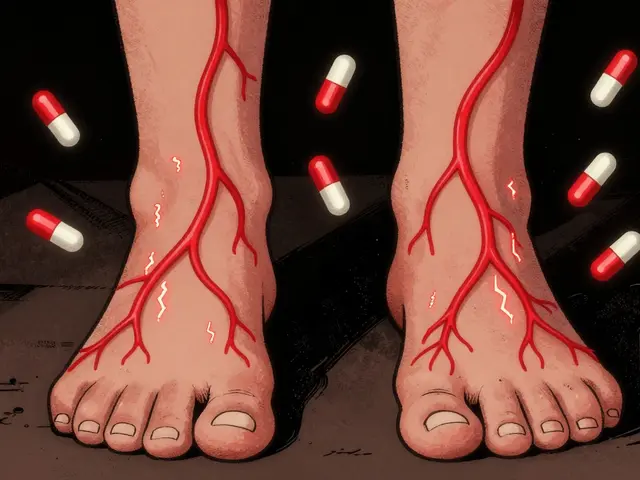
These drugs are made from proteins or living cells. Heat or freezing breaks them down. Once that happens, they don’t work like they should. You might not see it. You might not feel it. But your blood sugar could spike, your immune system might not respond to the vaccine, or your flare-up could get worse.
The Right Temperature: 2°C to 8°C (36°F to 46°F)
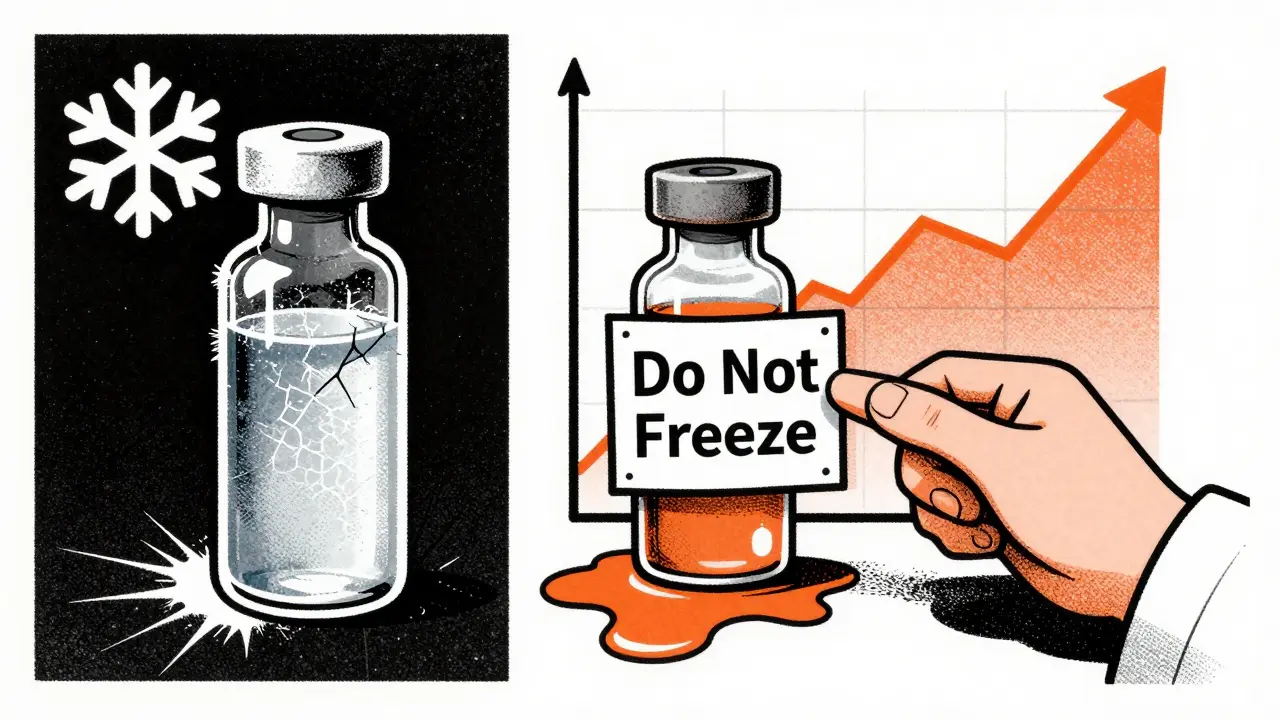
The official standard for refrigerated medications is 2°C to 8°C. That’s not just “keep it cold.” That’s a narrow window. Too warm-above 8°C-and the medicine starts degrading. Too cold-below 0°C-and proteins freeze, irreversibly damaging the structure. Even one night in the freezer can ruin a vial of insulin.
Here’s what that looks like in practice:
- Insulin: Must stay refrigerated until first use. After opening, most can sit at room temperature (up to 30°C) for 28-30 days.
- Vaccines: No exceptions. Must stay between 2°C and 8°C from pharmacy to injection. Even brief exposure to heat can make them ineffective.
- Remicade (infliximab): Can be kept at room temperature (up to 30°C) for up to 6 months, but only once. Once it’s been refrigerated and then warmed, you can’t re-refrigerate it.
- Novo Nordisk’s newer insulins (as of 2023): Some can now stay at 37°C (98.6°F) for up to 7 days-longer than older versions. Always check your specific product label.
The FDA says any deviation from labeled storage conditions is an unapproved use. That’s not just a warning-it’s a legal and safety standard.
Why Your Kitchen Fridge Isn’t Good Enough
Your fridge might seem fine. But studies show household refrigerators have wild temperature swings. Door shelves? Around 11°C. Back bottom shelf? Around 3.4°C. That’s a 7.6°C difference in the same appliance.
Here’s what happens when you store medicine in a regular fridge:
- Medicines near the door get hit with warm air every time you open it.
- Freezer compartments can leak cold air and accidentally freeze vials.
- Temperature logs from the Journal of the American Pharmacists Association show that 15-25% of home-stored refrigerated meds experience at least one dangerous temperature excursion each month.
- One user on Reddit reported their insulin pump reservoir failed after being left in a car at 85°F. Blood sugar spiked to 450. Took 12 hours to fix.
That’s not rare. A GoodRx survey of 1,247 insulin users found 68% had experienced at least one suspected temperature-related failure. Common signs? Unexplained high blood sugar, cloudy or clumped insulin, or injections that just don’t seem to work anymore.
How to Store Medications Safely at Home
You don’t need a hospital-grade fridge. But you do need to be smart.
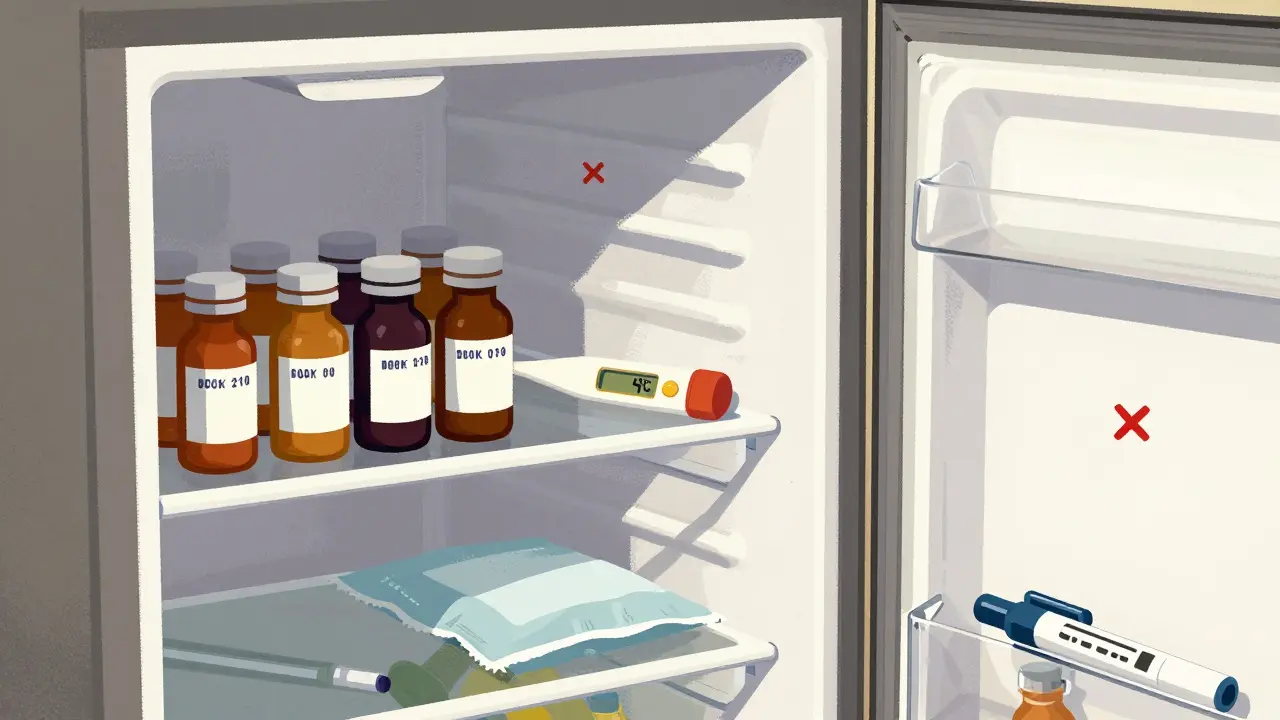
- Use the middle shelf. That’s the most stable spot in your fridge. Avoid the door, the back wall (risk of freezing), and the crisper drawer.
- Buy a small digital thermometer. A $30 thermometer with a min/max reader lets you see if your fridge is actually staying between 2°C and 8°C. Check it weekly.
- Don’t overcrowd. Air needs to circulate. Pile too many items in, and the fridge struggles to cool evenly.
- Label your meds. Use tape or a marker to write the date you opened the vial. Most insulins last 28 days after opening.
- Keep a backup. If you’re on insulin or a biologic, keep an extra vial or pen in a cooler with a cold pack when you travel.
Some people use a dedicated mini-fridge just for meds. Basic models like the Whynter FM-50G cost around $150. They’re small, quiet, and can be set to a precise 4°C. No more guessing.
What to Do During Power Outages or Travel
Power goes out? You have 4-6 hours before meds start to warm up dangerously-depending on how cold your fridge was to begin with.
Here’s how to handle it:
- Keep the fridge door shut. Every time you open it, you lose cold air.
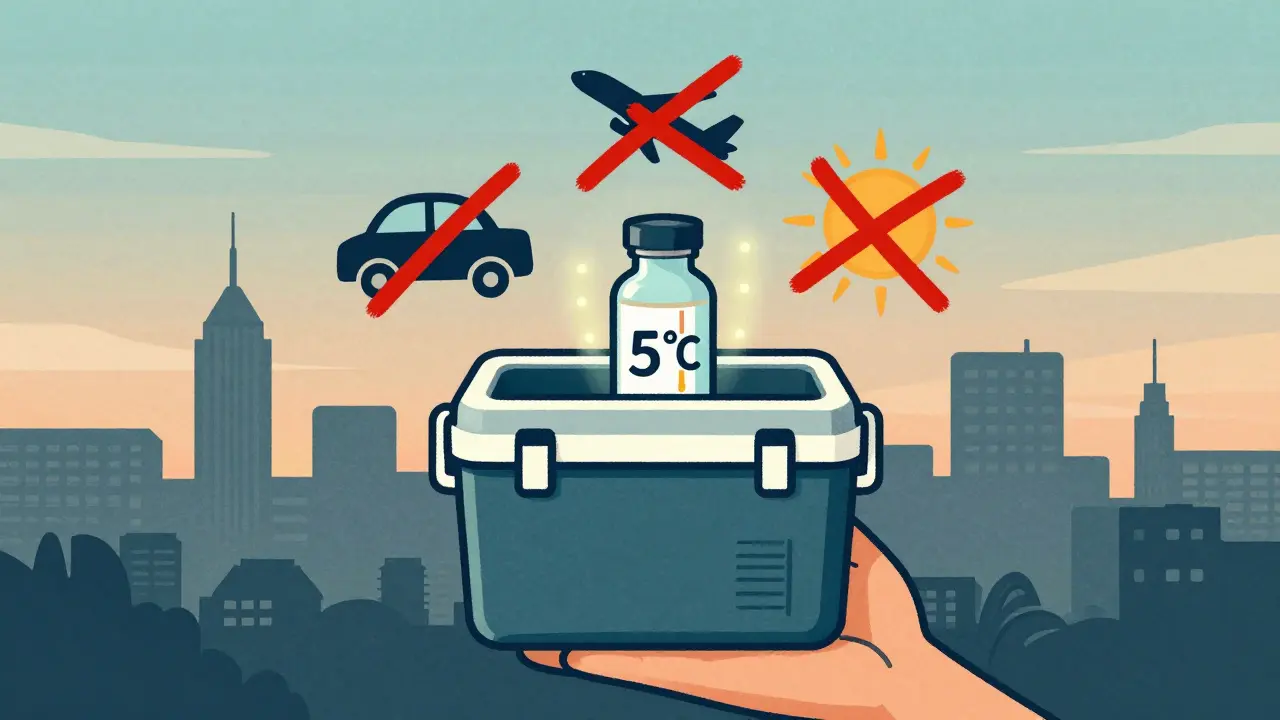
- Use insulated travel coolers with phase-change cold packs. Brands like TempAid MediCool keep meds between 2°C-8°C for up to 48 hours.
- If you’re traveling, keep meds in your carry-on-not checked luggage. Airplane cargo holds can drop below freezing.
- For long trips, ask your pharmacy for a portable medication cooler. Many offer them for free with biologic prescriptions.
And never, ever leave medicine in a hot car. Even on a 20°C day, the inside of a parked car can hit 45°C in under an hour. That’s enough to ruin insulin in 24 hours.
What Happens When Medication Fails?
It’s not just “it won’t work as well.” It’s dangerous.
Insulin that’s been exposed to heat doesn’t lower blood sugar properly. That can lead to diabetic ketoacidosis-something that landed a patient in the hospital in a documented 2021 FDA case.
Vaccines that lose potency? You think you’re protected. You’re not. That’s how outbreaks spread.
Biologics like Humira? If they degrade, your inflammation doesn’t calm down. Your joints keep hurting. Your flare-ups get worse. And you don’t know why.
And once it’s frozen? It’s ruined. Thawing it won’t fix it. That’s not a myth. That’s science.
What Experts Say
Dr. Robert99, a pharmacist at Baystate Health, says: “The impact of a less-than-effective heart medication or asthma inhaler has the potential to be dangerous or even fatal.”
The American Society of Health-System Pharmacists (ASHP) calls temperature excursions one of the top three preventable causes of treatment failure for biologic therapies.
But here’s a twist: Some experts think manufacturers are too cautious. Dr. Emily Roberts at Johns Hopkins says insulin often lasts longer at room temperature than labels say-but companies add warnings to avoid liability.
Still, the FDA doesn’t budge. Their rule is clear: Follow the label. No exceptions.
What’s Changing in 2026?
Things are evolving. Newer insulins from Novo Nordisk can handle higher temperatures longer. Samsung released a fridge in 2023 with a built-in “medication mode” that maintains 3°C-5°C with precision monitoring.
The CDC now requires digital data loggers for vaccine storage-not just basic thermometers. And by 2030, ASHP predicts 30% of all prescriptions will need refrigeration.
This isn’t going away. It’s getting more common. The biologics market is expected to hit $530 billion by 2027. More people will need this knowledge.
Bottom Line: Don’t Guess. Check.
If your medication says “refrigerate,” treat it like a baby. It’s fragile. It needs consistency. Your health depends on it.
Do this today:
- Find your meds in the fridge. Are they on the door? Move them to the middle shelf.
- Grab a $30 thermometer. Put it next to your meds. Check it once a week.
- Write the opening date on every vial or pen.
- When traveling, bring a cooler. Don’t risk it.
It’s not about being perfect. It’s about being aware. One small mistake can cost you your health. Don’t let it happen because you didn’t know.
Can I store insulin in the freezer if I want it to last longer?
No. Freezing insulin damages its molecular structure permanently. Even if it thaws and looks normal, it won’t work properly. Always keep insulin between 2°C and 8°C when unopened, and never freeze it.
How do I know if my insulin has gone bad?
Look for cloudiness, clumping, or particles in the liquid. If it’s supposed to be clear and it’s not, throw it out. Also, if your blood sugar suddenly becomes harder to control without a clear reason, the insulin may have degraded.
Can I leave my biologic medication in my purse for a few hours?
If it’s below 30°C and you’re out for less than 24 hours, most biologics are fine. But never leave it in direct sunlight or a hot car. Use a small insulated pouch with a cold pack if you’re out longer than 4-6 hours.
Do I need a special fridge just for my medications?
Not always. If your kitchen fridge is stable and you monitor the temperature, you can store meds safely on the middle shelf. But if you take multiple refrigerated drugs, or live in a hot climate, a small dedicated fridge ($150-$250) is worth the investment for safety and peace of mind.
What should I do if I think my medication was exposed to bad temperatures?
Call your pharmacist or doctor. Don’t guess. For insulin, if you’re unsure, use a new vial. For vaccines, you may need a repeat dose. Never risk using a potentially degraded medication. It’s safer to replace it than to risk treatment failure.
Are generic biologics less stable than brand-name ones?
They’re required to meet the same standards, but labeling can be less detailed. Some generics don’t clearly state how long they’re stable at room temperature. Always check the manufacturer’s insert, and if in doubt, store it refrigerated and ask your pharmacist.

13 Comments
Himanshu Singh
January 24 2026This is so important 💯 I used to keep my insulin on the fridge door like a dummy. One day my BG went nuts and I had no idea why. Found out the temp was hitting 12°C. Changed my ways after this. Now I got a little digital thermometer next to my vials. Life changed.
Don't overthink it. Just check the shelf. Middle. Always middle.
venkatesh karumanchi
January 25 2026I never realized how fragile these meds are until my mom’s Humira stopped working after a power outage. She didn’t even know it had been in the fridge too long. We thought she was just having a bad flare. Turns out, the drug was dead. Scary stuff. Now we have a mini-fridge just for her stuff. Worth every penny.
Sharon Biggins
January 26 2026i just bought a temp monitor for my fridge after reading this. i had no idea the door was 11c. my insulin was practically in a sauna. thanks for the wake up call. also, i write dates on every pen now. its weird but it feels like i’m taking care of my body like it’s a pet. and it is.
John McGuirk
January 26 2026This whole thing is a scam. Big Pharma wants you to buy $150 fridges so they can keep charging $1k for insulin. They know most people can’t afford it. So they scare you into buying gadgets. The real problem? The price. Not the fridge. Check the temp yourself. If it’s cool, it’s fine. Stop feeding the machine.
Michael Camilleri
January 27 2026You people are so naive. You think a $30 thermometer fixes everything? You’re playing Russian roulette with your life. The FDA says 2-8°C. That’s not a suggestion. That’s a law. And the companies? They don’t care. They make billions while you’re stuck wondering why your blood sugar won’t drop. You think you’re smart? You’re one bad fridge shelf away from the ER. Wake up.
lorraine england
January 28 2026I love this guide! I’ve been using the middle shelf since last year and it’s made such a difference. My husband’s insulin has been rock solid. I also label everything with a Sharpie - it’s dumb but it helps. And yes, I’m the weirdo who checks the fridge temp every Sunday morning with coffee. 😊
Kevin Waters
January 30 2026I’ve been a nurse for 12 years and I can tell you - 90% of patients don’t know how to store their meds. This post is gold. I give this exact info to every diabetic patient I see. The mini-fridge tip? Game changer. I even have a few patients who bought them with charity help. No one should risk their health because they’re scared of the cost.
Kat Peterson
January 30 2026I CRIED reading this. My vial froze last winter and I didn’t know. I thought I was just having a bad week. My doctor said it was probably the insulin. I was so mad at myself. Now I have a little fridge in my bathroom with a red light that glows if it’s out of range. It’s kinda fancy. I feel like a sci-fi queen. ✨
Husain Atther
January 31 2026A thoughtful and necessary guide. Many in my community in India do not have access to stable refrigeration. Perhaps we need low-cost solutions - solar-powered coolers, community fridge programs. Knowledge is power, but access is justice.
Helen Leite
February 1 2026I think the government is putting trackers in these meds. Why else would they care so much about fridge temps? I read somewhere that they’re collecting data on how often people use insulin. They’re building a profile. I only keep mine in the fridge when the power’s on. Otherwise, it’s in my drawer. They can’t track it there.
Izzy Hadala
February 2 2026The thermal stability profiles of recombinant protein therapeutics are governed by complex conformational dynamics. While ambient temperature fluctuations are known to induce aggregation and deamidation, the empirical data cited herein lacks sufficient statistical power to conclusively establish clinical significance across heterogeneous patient populations. Further longitudinal studies are required.
Elizabeth Cannon
February 4 2026I used to think this was overkill until my daughter’s growth hormone got warm in her backpack and she had a whole week of no progress. I was so mad. Now I carry a tiny cooler with her meds everywhere. It’s not hard. It’s not expensive. It’s just… being a good parent. Don’t wait for a crisis to start caring.
Gina Beard
February 5 2026It’s not about the fridge. It’s about trust.