
Perioperative Management of Anticoagulants: How to Safely Pause Blood Thinners Before Surgery
Anticoagulant Timing Calculator
Enter your specific medical details to get personalized guidance based on 2023 CHEST and 2022 ASH guidelines. This tool follows the PAUSE study recommendations for safe anticoagulant management before and after surgery.
Why Stopping Blood Thinners Before Surgery Isn’t as Simple as It Sounds
Stopping your blood thinner before surgery sounds like a straightforward task-until it isn’t. For millions of people on anticoagulants, the decision to pause or continue these drugs involves a dangerous balancing act: too much bleeding during surgery, or a deadly clot after. The stakes are high. About 1 in 5 patients on direct oral anticoagulants (DOACs) who undergo emergency surgery experience major bleeding. At the same time, 1 in 7 face a stroke or pulmonary embolism if the drug is stopped too long. This isn’t guesswork anymore. It’s science-and the rules changed dramatically after 2018.
DOACs vs. Warfarin: Two Different Worlds
Before 2010, warfarin was the only game in town. Stopping it meant waiting 5 days, checking your INR, and often bridging with heparin shots. But now, DOACs like apixaban, rivaroxaban, dabigatran, and edoxaban are the first choice for most patients. Why? Because they work faster, wear off faster, and don’t need constant blood tests.
That speed is everything. Warfarin lingers in your system for days. DOACs? Most clear out in 24 to 72 hours. That’s why the old rule-bridge every patient with heparin-is now considered harmful. The 2023 CHEST guidelines say outright: do not bridge most patients on DOACs. Why? Because the heparin shots cause more bleeding than they prevent. In fact, studies show bridging increases major bleeding by 3 to 5 times without lowering stroke risk.
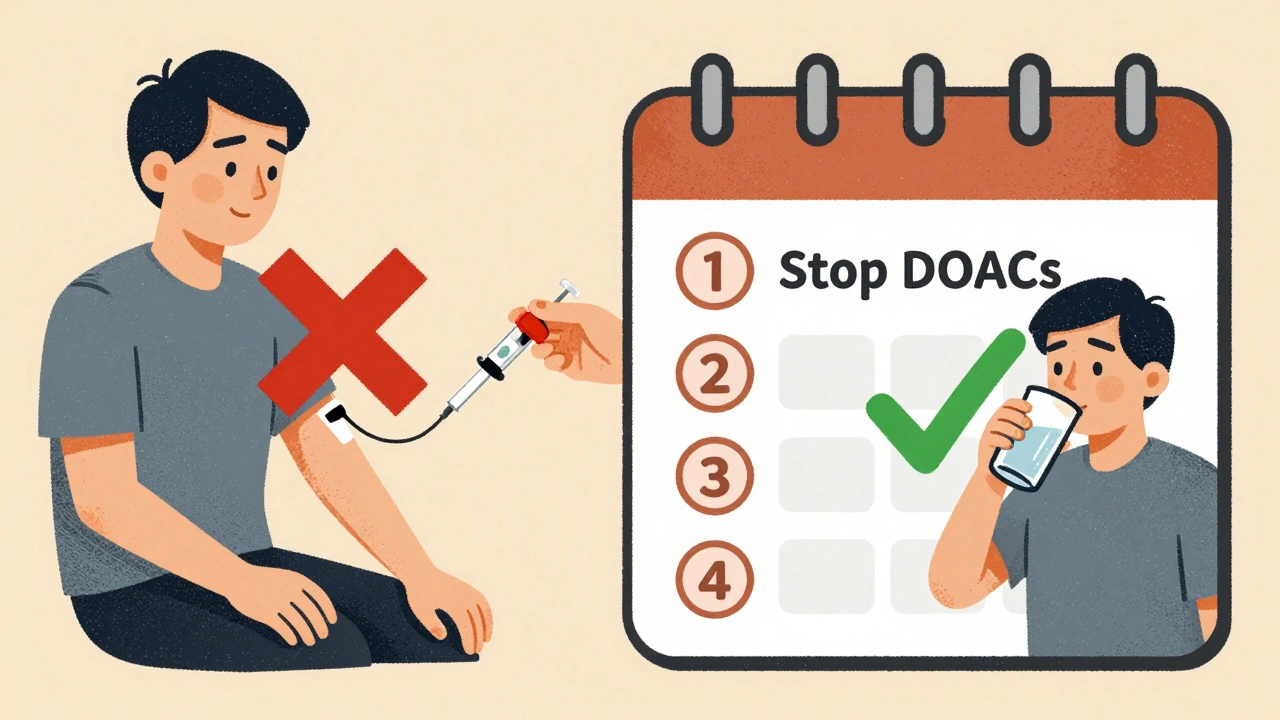
When to Stop Your Blood Thinner: The 3-Day Rule
There’s no one-size-fits-all timeline. It depends on the drug, the surgery, and your kidneys. Here’s what the latest guidelines say:
- For apixaban, rivaroxaban, edoxaban: Stop 3 days before surgery. If your kidneys are weak, stop 4 days out.
- For dabigatran: Stop 4 days before surgery. It sticks around longer, especially if you have kidney issues.
- For neuraxial anesthesia (epidural or spinal): Stop DOACs 3 to 4 days ahead. Spinal bleeding can cause paralysis-so timing here is non-negotiable.
These aren’t suggestions. They’re based on the PAUSE study, which tracked over 3,000 patients. It found that stopping DOACs 2 to 3 days before surgery, then restarting 24 to 72 hours after, kept bleeding and clotting risks both low. No bridging needed. No heparin shots. Just timing.
What About Warfarin? It’s Still Around
Warfarin hasn’t disappeared. It’s still used in people with mechanical heart valves or certain types of clots. For those patients, stopping warfarin means stopping 5 days before surgery. You’ll need an INR test to make sure your blood isn’t too thin. If your INR is still high (over 1.5), you might need vitamin K or fresh frozen plasma to bring it down.
But here’s the twist: even for warfarin, bridging isn’t always needed. The 2022 ASH guidelines found that for most patients-not just those on DOACs-bridging increases bleeding without preventing clots. The exception? People with mechanical mitral valves or recent clots in the last 3 months. For them, bridging might still be considered. But even then, the evidence is shaky.
Resuming Anticoagulants After Surgery: Don’t Rush
Stopping the drug is only half the battle. Restarting it too soon can cause internal bleeding. Too late, and you risk a clot. The sweet spot? Wait at least 24 hours after surgery. Then, it depends on how risky the procedure was.
- Low bleeding risk (cataract surgery, dental work): Restart anticoagulants the next day.
- High bleeding risk (joint replacement, brain surgery): Wait 48 to 72 hours. Some surgeons start with a half-dose first.
The PAUSE study showed that restarting DOACs at full dose 1 to 3 days after surgery was safe. No extra clots. No extra bleeds. The key? Don’t restart before your surgical site has stopped oozing. If you’re still draining blood, wait.
Emergency Surgery? Reversal Agents Are Your Lifeline
What if you need emergency surgery and you’re still on your blood thinner? That’s when things get urgent. You need a reversal agent.
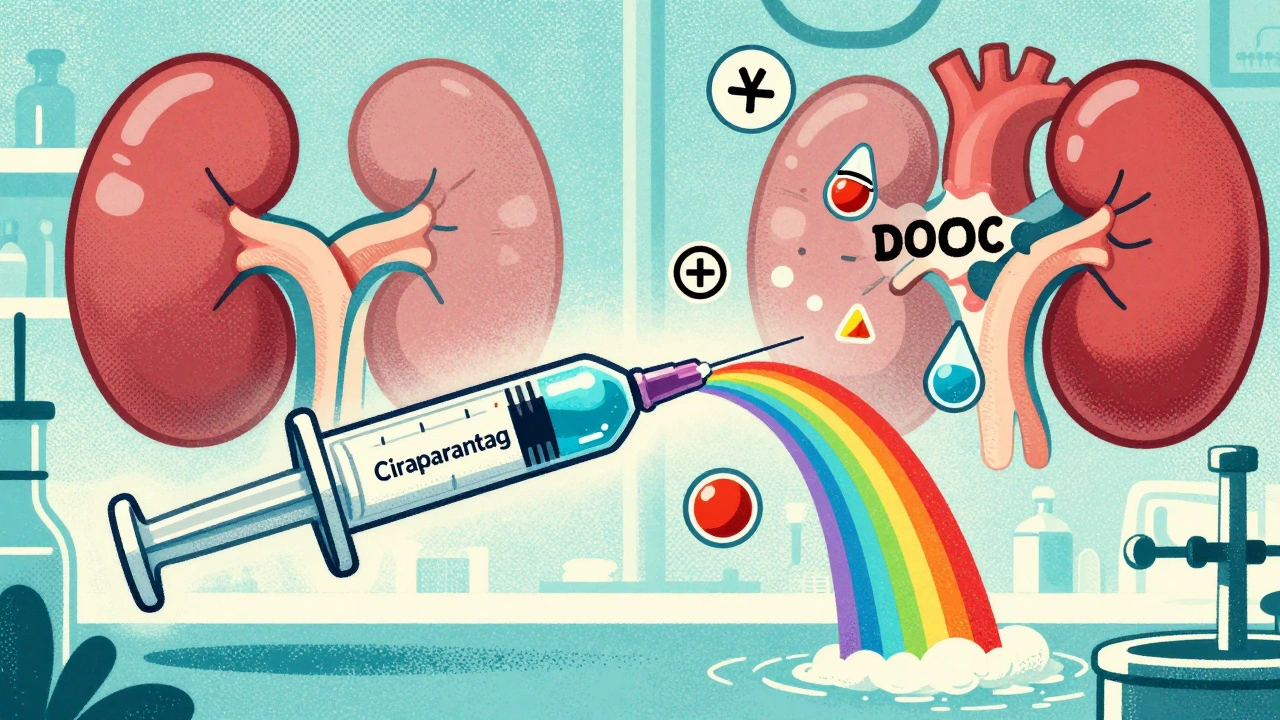
For dabigatran, there’s idarucizumab. It works in minutes. But it costs $3,700 per vial. For apixaban, rivaroxaban, edoxaban, there’s andexanet alfa. It’s more expensive-around $19,000 per dose-and it comes with its own risks. In one study, 13% of patients who got andexanet alfa had a stroke or heart attack within 30 days. That’s because the drug stops the anticoagulant effect but doesn’t stop your body’s tendency to clot.
Bottom line: reversal agents save lives-but they’re not magic bullets. They’re expensive, risky, and should only be used when there’s no time to wait for the drug to clear naturally.
Know Your Risk Scores: CHA₂DS₂-VASc and HAS-BLED
Doctors don’t decide whether to stop your blood thinner based on gut feeling. They use two scores.
CHA₂DS₂-VASc measures your stroke risk if you have atrial fibrillation. Points are added for things like age over 75, high blood pressure, diabetes, prior stroke. A score of 2 or higher means you’re at risk. But even then, stopping your DOAC for 3 to 5 days is safe. The risk of stroke during that time is less than 0.5%.
HAS-BLED measures your bleeding risk. Points for high blood pressure, liver or kidney disease, prior bleeding, labile INR (if on warfarin), age over 65, alcohol use, or drugs that increase bleeding. A score of 3 or higher means you’re at higher risk of bleeding. That doesn’t mean stop the anticoagulant. It means be extra careful with timing and monitor closely.
Studies show that 32% of mistakes in anticoagulant management come from misapplying these scores. Don’t let your doctor skip them.
The Biggest Mistakes Doctors Make
Even with clear guidelines, errors happen. Here are the top three:
- Over-bridging: Giving heparin to everyone, even when it’s unnecessary. This increases bleeding without benefit.
- Restarting too early: Jumping back on anticoagulants before the surgical site has healed. This is the leading cause of post-op bleeding.
- Ignoring kidney function: DOACs are cleared by the kidneys. If your kidneys are weak, the drugs stay in your system longer. Many providers don’t check creatinine clearance before deciding when to stop.
One 2022 study of 45 hospitals found that while 89% of doctors knew when to stop DOACs, only 63% restarted them correctly. That’s a dangerous gap.
What’s Coming Next? A Universal Reversal Agent
Right now, you need a different reversal agent for each drug. But that’s changing. A new drug called ciraparantag is in Phase 3 trials. It can reverse all types of anticoagulants-DOACs, heparin, even warfarin-in under 10 minutes. Early data looks promising. If approved in 2026, it could make perioperative management simpler, safer, and cheaper.
But even with new drugs, the core principle won’t change: individualize care. Your risk isn’t the same as your neighbor’s. Your surgery isn’t the same as someone else’s. The goal isn’t to follow a checklist-it’s to match the timing to your body, your procedure, and your risk.




13 Comments
Rebecca M.
December 2 2025Wow. So we’re just supposed to trust that some 3-day rule won’t turn us into a human popsicle during surgery? 🙄
dave nevogt
December 2 2025It’s fascinating how medicine has shifted from paternalistic dogma to evidence-based nuance. The PAUSE study didn’t just change protocols-it revealed how deeply we’d been conditioned to over-intervene. Bridging wasn’t just unnecessary; it was a symptom of our fear of uncertainty. We’d rather inject heparin into a thousand patients than sit with the discomfort of letting nature take its course. But now, the data says: trust the pharmacokinetics. Trust the half-lives. Trust the kidneys. It’s a quiet revolution in humility.
Alicia Marks
December 4 2025This is actually super helpful. Thank you for laying it out so clearly. 💪
मनोज कुमार
December 4 2025DOACs clearance renal dependent stop 3d if CrCl >50 else 4d dabigatran 4d neuraxial 4d restart 24h low risk 48-72h high risk reversal agents expensive dont use unless emergent CHA2DS2VASc >2 still safe to pause HASBLED >3 dont stop just monitor overbridging main error
Roger Leiton
December 5 2025I love how this article doesn’t just give rules but explains the why. Like, I didn’t realize andexanet alfa could *cause* clots. That’s wild. 🤯
Paul Keller
December 7 2025The clinical implications of this paradigm shift cannot be overstated. The abandonment of blanket bridging protocols represents a fundamental recalibration of risk-benefit calculus in perioperative care. While the 2023 CHEST guidelines are unequivocal in their recommendation against routine heparin bridging for DOAC patients, implementation remains inconsistent across institutions. The persistent overuse of bridging is not merely a knowledge gap-it is a cultural inertia rooted in defensive medicine and institutional legacy protocols. Furthermore, the underutilization of renal function assessment prior to anticoagulant cessation remains a critical blind spot in many outpatient settings. Until creatinine clearance becomes as routinely evaluated as blood pressure, we will continue to see iatrogenic complications arising from pharmacokinetic misjudgment.
Shannara Jenkins
December 8 2025So many people stress about this stuff. Honestly? Just talk to your care team. They’ve got this. You’re not alone. ❤️
Joel Deang
December 9 2025this is lit 😎 i had a knee repl and they made me stop xaban 3 days before and restart next day. no heparin. no drama. like magic. also my doc used the word 'PAUSE' like it was a movie title. i was like 'yo is this a netflix doc?'
Jack Dao
December 9 2025I’m genuinely shocked anyone still uses warfarin. It’s like using a rotary phone in 2024. If your doctor hasn’t switched you to a DOAC by now, you’re being treated like a lab rat from the 90s. And if they’re still bridging? Run. Don’t walk.
Laura Baur
December 10 2025You know what’s truly disturbing? That 32% statistic about misapplying CHA₂DS₂-VASc and HAS-BLED. It’s not ignorance-it’s negligence. These scores were designed to prevent harm, not to be decorative footnotes in an EHR. When a physician skips them because they’re 'too busy,' they’re not just making a mistake-they’re gambling with your life. And then we wonder why trust in medicine is collapsing. It’s not because patients are paranoid. It’s because too many providers treat guidelines like suggestions written in pencil.
Zed theMartian
December 10 2025Oh please. 'Individualize care.' That’s what they say when they don’t want to take responsibility. If there’s a 3-day rule, why not just enforce it? Why make every patient a case study? This isn’t art class. It’s medicine. We need protocols, not philosophy. Ciraparantag? Sounds like a sci-fi drug from a dystopian novel. I’ll wait until it’s on the shelf and not in a Phase 3 trial where someone’s getting a stroke for science.
Arun kumar
December 11 2025in india we dont even have access to reversal agents most times. so we just follow the 3 day rule and pray. also kidney function? who checks creatinine clearance in village hospital? we use warfarin because its cheap. and yes we bridge. because we dont have choice. but i still thank you for this post. atleast now i know what i should ask for.
Lynn Steiner
December 11 2025I had a spinal block last year and they made me stop my rivaroxaban 5 days out because 'better safe than sorry.' Turns out I bled like crazy anyway. Now I’m scared to even sneeze. Thanks for the reassurance, I guess? 😔