Anticoagulant Reversal Agents: Idarucizumab, Andexanet Alfa, PCC, and Vitamin K Explained
Anticoagulant Reversal Agent Selector
Select Your Scenario
When someone on blood thinners suffers a serious bleed-like a fall that causes a brain hemorrhage-the clock starts ticking. Minutes matter. These patients aren’t just at risk; they’re in a medical emergency. That’s where anticoagulant reversal agents come in. They’re not optional. They’re lifesavers. But not all reversal agents are the same. Some work in minutes. Others take hours. Some cost thousands. Others are cheap and everywhere. And choosing the wrong one? That can kill.
Why Reversal Isn’t Optional
About 4 million Americans take blood thinners every day. Most of them are on newer drugs like apixaban, rivaroxaban, or dabigatran-often called DOACs. These drugs are safer than warfarin for most people. But when things go wrong, they don’t just stop working on their own. You need something to undo them fast. Intracranial hemorrhage (ICH) is the worst-case scenario. When a brain bleed happens on blood thinners, the death rate jumps to 30-50%. That’s not a guess. That’s from the American College of Cardiology in 2021. The goal isn’t just to stop the bleeding. It’s to stop it before the brain swells, before the pressure builds, before it’s too late. That’s why reversal agents exist. They’re not about fine-tuning. They’re about survival.Vitamin K: The Old Workhorse
Vitamin K is the original reversal agent. It’s been around since the 1940s. It works only on warfarin and other vitamin K antagonists. It doesn’t touch dabigatran or apixaban. It’s cheap-pennies per dose. But here’s the catch: it takes 4 to 6 hours just to start working. Full reversal? That can take a full day. So if someone’s bleeding out right now, vitamin K alone won’t help. It’s like bringing a fire extinguisher to a gasoline fire. You need something faster. That’s why vitamin K is always given with PCC. The PCC stops the bleeding now. The vitamin K prevents it from starting again later.Prothrombin Complex Concentrate (PCC): The Fast, Affordable Go-To
PCC is a concentrated mix of clotting factors-II, VII, IX, X, and sometimes C and S. Modern 4-factor PCC (4F-PCC) is the standard for reversing warfarin. It works in 15 to 30 minutes. It’s given as an IV push. No waiting. No drip. Just a quick infusion. Dosing is based on INR levels:- INR 2-4: 25-50 units/kg
- INR 4-6: 35-50 units/kg
- INR >6: 50 units/kg

Idarucizumab: The Dabigatran Killer
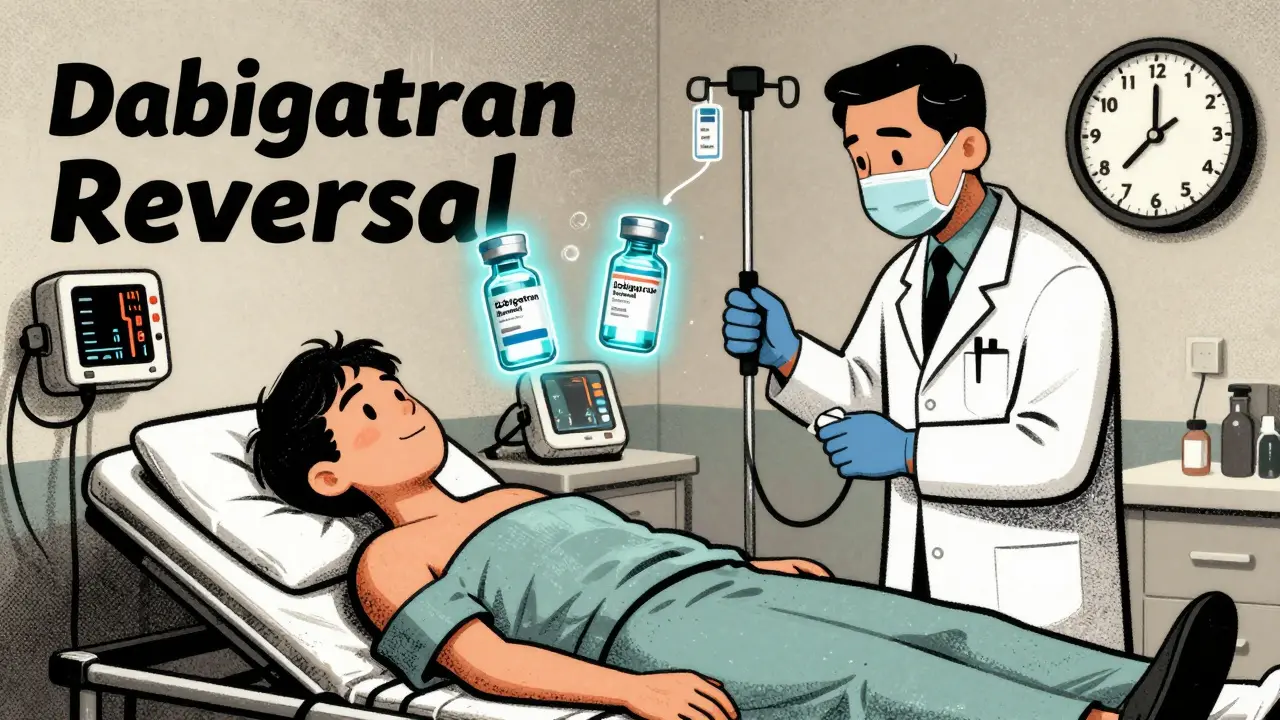
Idarucizumab is a monoclonal antibody. It’s like a molecular magnet for dabigatran. It grabs the drug and neutralizes it-fast. In 5 minutes. That’s not a typo. Five minutes. It’s given as two 2.5-gram IV infusions. Total dose: 5 grams. That’s it. No titration. No complex dosing. No waiting. The RE-VERSE AD trial in 2015 proved it works. And it’s safe. Thrombotic events? Only 5% in trials. That’s lower than PCC. It’s the gold standard for dabigatran reversal. Emergency physicians prefer it. A 2022 survey of 127 ERs found 78% chose idarucizumab over anything else for dabigatran cases. Why? Speed. Simplicity. Safety. Cost? Around $3,500 per vial. That’s expensive. But when you’re saving a brain, cost isn’t the first question.Andexanet Alfa: The Powerful but Risky Option
Andexanet alfa reverses factor Xa inhibitors: apixaban, rivaroxaban, edoxaban. It’s a modified version of factor Xa-so it acts like a decoy. The drug binds to it instead of your natural clotting factors. That frees up your body to clot again. The dosing is complicated. First, a 400-mg IV bolus. Then, a 4 mg/min infusion for 120 minutes. That’s two hours of continuous drip. It’s not something you can do without training. A 2021 JACC meta-analysis said it takes 2-3 hours to teach staff how to use it properly. It works fast-within 2 to 5 minutes. But here’s the catch: it’s risky. The ANNEXA-4 trial showed a 14% rate of thromboembolic events-blood clots, heart attacks, strokes. That’s double the rate of PCC. The FDA even put a boxed warning on it. That’s the strongest warning they give. Cost? $13,500 per treatment. That’s more than three times the price of idarucizumab. And availability? Only 65% of U.S. hospitals stock it. Many rural and community hospitals don’t have it. They can’t afford it. They don’t need it every day.Comparing the Agents: Speed, Cost, Safety
| Agent | Works Against | Time to Effect | Dosing | Cost (per dose) | Thrombotic Risk | Availability |
|---|---|---|---|---|---|---|
| Vitamin K | Warfarin only | 4-24 hours | 5-10 mg IV | $5-$20 | Low | Universal |
| 4F-PCC | Warfarin, off-label for DOACs | 15-30 minutes | 25-50 units/kg based on INR | $1,200-$2,500 | 8% | Universal |
| Idarucizumab | Dabigatran | 5 minutes | 5g IV (two 2.5g doses) | $3,500 | 5% | Widespread |
| Andexanet alfa | Apixaban, rivaroxaban, edoxaban | 2-5 minutes | 400mg bolus + 4mg/min x 120 min | $13,500 | 14% | 65% of U.S. hospitals |

What Do the Experts Say?
Dr. Joshua Goldstein from Harvard says the goal is simple: stop the bleed from growing. He’s cautious about saying one agent is better than another. There’s no head-to-head trial comparing all four. Most data comes from observational studies. Dr. Samuel Goldhaber, a top thrombosis expert, says guidelines prefer specific agents like idarucizumab and andexanet alfa-but there’s no strong proof they’re better than PCC for most patients. The truth? It’s not about the perfect drug. It’s about the right drug, in the right place, at the right time. If someone on dabigatran has a brain bleed? Use idarucizumab. It’s fast, safe, and proven. If it’s apixaban or rivaroxaban and you have andexanet alfa? Great. Use it. But if you don’t? PCC is your backup. It’s not ideal, but it’s better than nothing. If it’s warfarin? PCC plus vitamin K. No debate. That’s been the standard for decades.What’s Coming Next?
A new drug called ciraparantag is in Phase III trials. It’s a synthetic molecule that can reverse almost all anticoagulants-warfarin, heparin, DOACs. One drug for everything. If it works, it could change everything. Approval could come by late 2025. Right now, the market is growing fast. DOAC prescriptions hit 15 million in the U.S. in 2023. That means more people need reversal agents. But cost and access are huge barriers. Andexanet alfa’s price tag makes it unsustainable for many hospitals. PCC remains the workhorse for good reason.Bottom Line: No One-Size-Fits-All
There’s no magic bullet. Each reversal agent has a place. The best choice depends on:- Which anticoagulant the patient is on
- How fast they’re bleeding
- What’s available in your hospital
- What you can afford
Can you reverse blood thinners at home?
No. Anticoagulant reversal requires IV medications, monitoring, and immediate access to emergency care. These are hospital-only interventions. If someone on blood thinners has a serious injury or signs of major bleeding-like confusion, severe headache, vomiting, or weakness-they need to go to the ER immediately. Home reversal is not possible.
Is vitamin K enough to reverse warfarin?
No. Vitamin K takes hours to days to work. For an active bleed, you need PCC to stop the bleeding right away. Vitamin K is given along with PCC to prevent the anticoagulation from coming back after the PCC wears off. Using vitamin K alone in an emergency can be fatal.
Why is andexanet alfa so expensive and not widely used?
Andexanet alfa costs over $13,000 per treatment, and only about two-thirds of U.S. hospitals stock it. Its high cost, complex administration, and increased risk of blood clots make it less attractive than PCC, which is cheaper, more available, and safer for many patients. It’s reserved for cases where the benefits clearly outweigh the risks.
Can PCC be used to reverse DOACs like apixaban?
Yes, even though it’s not FDA-approved for that use, PCC is commonly used off-label for DOAC reversal when specific agents aren’t available. Studies show it helps reduce bleeding in many cases, though it’s not as effective as andexanet alfa for factor Xa inhibitors. Emergency teams often use it as a bridge when the ideal drug isn’t on hand.
What happens if you don’t reverse anticoagulation during a brain bleed?
The bleed keeps growing. Brain tissue gets crushed. Pressure builds. Oxygen stops flowing. Death or permanent disability becomes much more likely. Studies show patients who don’t get reversal have a 30-50% chance of dying from intracranial hemorrhage. Reversal doesn’t guarantee survival-but without it, survival chances drop dramatically.
Are there side effects to these reversal agents?
Yes. PCC can cause blood clots, especially if given in high doses or to patients with heart disease. Andexanet alfa has a 14% risk of clotting events. Idarucizumab is the safest, with only a 5% risk. Vitamin K is very safe but can cause allergic reactions if given too fast. All reversal agents carry some risk-so they’re only used when the bleeding threat is life-threatening.