Primary Biliary Cholangitis Treatment: What Works in 2026
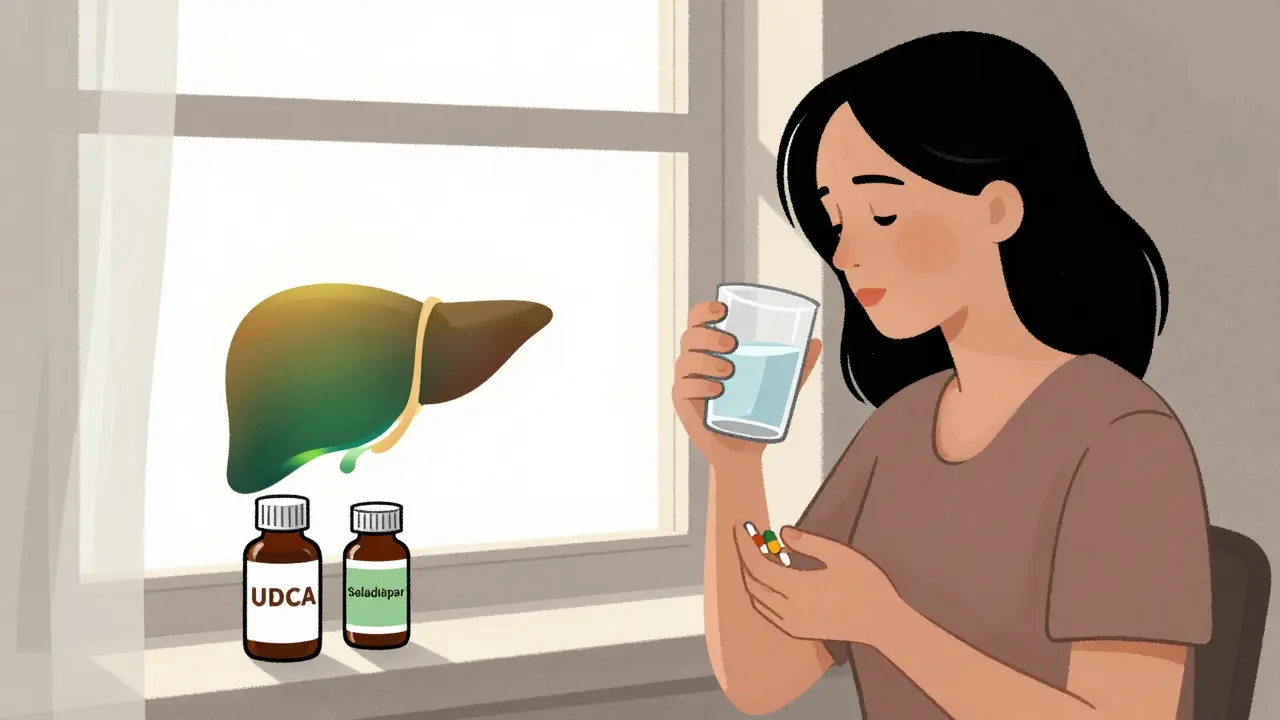
Primary Biliary Cholangitis (PBC) isn't something most people hear about until it affects them or someone they love. It’s a quiet disease - no fever, no sudden pain - just a slow, steady damage to the tiny bile ducts inside the liver. Over time, bile builds up, scarring sets in, and the liver struggles to function. It mostly hits women between 30 and 65, and while we don’t know exactly why, genetics and environmental triggers like certain infections play a role. The good news? We have better tools than ever to stop it in its tracks - if you know what they are.
First-Line Treatment: Ursodeoxycholic Acid (UDCA)
For over 30 years, Ursodeoxycholic acid (a naturally occurring bile acid used to treat PBC by reducing toxic bile buildup and calming immune activity in the liver) has been the foundation of PBC care. Taken daily at a dose of 13-15 mg per kilogram of body weight, it works by replacing harmful bile acids with ones the liver can handle better. It also helps the liver flush out toxins and reduces inflammation.
It’s not perfect - about 35% of patients don’t respond well. But for the rest, it’s life-changing. Studies show that people who respond to UDCA have an 87% chance of living 10 years without needing a transplant. Those who don’t respond? Only 69%. That gap is huge. That’s why checking your liver enzyme levels - especially alkaline phosphatase (ALP) - every 3 to 6 months is non-negotiable. If your ALP stays above 1.67 times the normal limit after a year of UDCA, it’s time to talk about next steps.
The New Second-Line Options: Seladelpar and Elafibranor
Until late 2024, the only real option after UDCA failed was obeticholic acid (Ocaliva). But in September 2025, the FDA pulled it off the market. Why? Too many patients had severe itching, and some faced higher risks of heart problems and liver failure, especially if they already had advanced scarring.
Now, two new drugs have taken its place - and they’re changing the game.
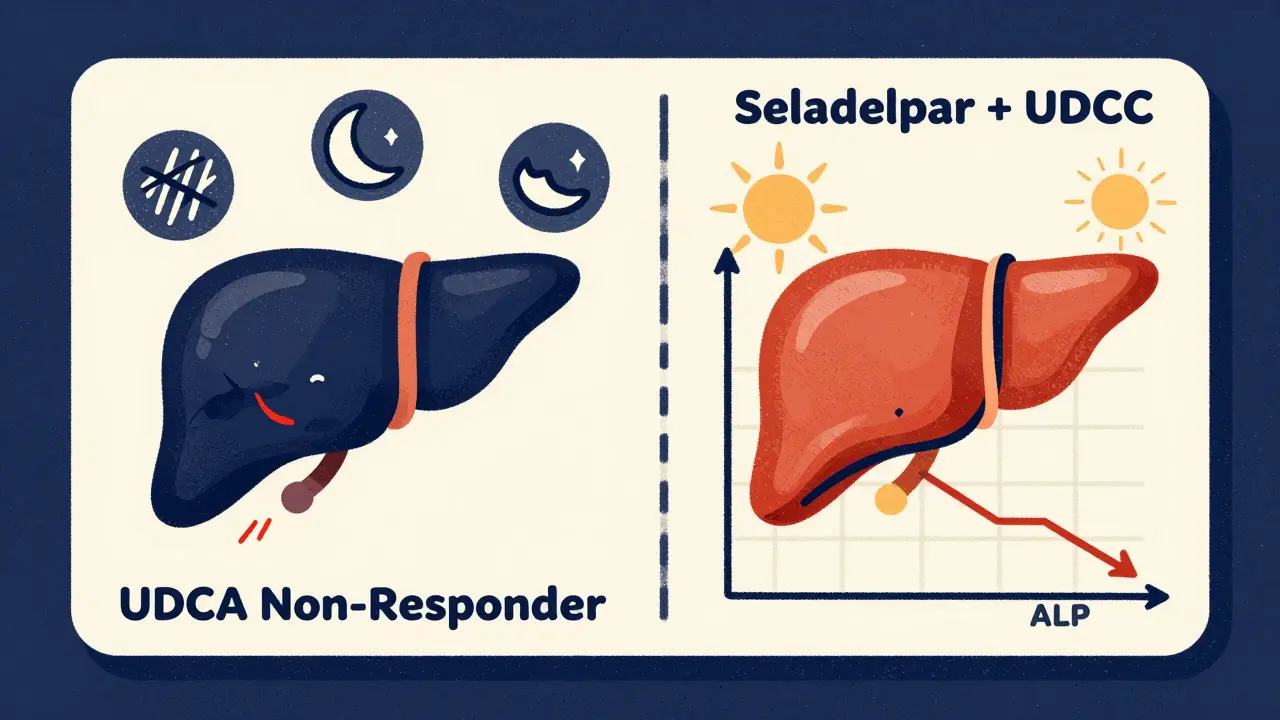
Seladelpar (a selective PPAR-delta agonist approved in December 2024, marketed as Livdelzi by Gilead Sciences) is now the go-to second-line treatment. Taken once daily, starting at 5 mg and increasing to 10 mg after four weeks, it targets the root of liver inflammation. In clinical trials, 70% of patients saw their ALP drop by at least 15%, and 42% got it back to normal levels - nearly seven times better than placebo. What’s more, it significantly reduces itching - a major problem for 7 out of 10 PBC patients. In one trial, itching scores dropped by 45% compared to just 15% with placebo. That’s not just a number - it’s better sleep, less scratching, and the ability to focus on life again.
There’s a catch: about 25% of people feel more itching in the first two weeks. But here’s the good part - in 92% of those cases, it fades by week eight. Doctors now know to prepare patients for this bump, not panic. Real-world data from over 390 patients shows that 85% stick with seladelpar after a year.
Elafibranor (a dual PPAR-alpha/delta agonist approved in November 2024, marketed as Iqirvo by Genfit) is the other option. Taken as one 80 mg pill daily, it’s simpler - no titration needed. It’s slightly less powerful at lowering ALP (56% achieve meaningful reduction, 21% reach normal levels) but better for patients with high triglycerides - it lowers them by 24%, while seladelpar only drops them by 8%. It also helps with itching, cutting scores by 38%. But it can raise creatinine levels in 18% of users, meaning kidney function needs monitoring.
How the Two New Drugs Compare
Choosing between seladelpar and elafibranor depends on your symptoms and health profile.
| Feature | Seladelpar (Livdelzi) | Elafibranor (Iqirvo) |
|---|---|---|
| Approval Date | December 2024 | November 2024 |
| Dosage | 5 mg → 10 mg daily (titrated) | 80 mg daily (fixed) |
| ALP Reduction (≥15%) | 70% | 56% |
| ALP Normalization | 42% | 21% |
| Pruritus Improvement | 45% reduction | 38% reduction |
| Common Side Effect | Temporary itching spike (25%) | Elevated creatinine (18%) |
| Triglyceride Impact | 8% reduction | 24% reduction |
| Best For | Severe itching, high ALP | Metabolic issues, simpler dosing |
For most patients with intense itching and high ALP, seladelpar is the better choice. If you’re also dealing with high cholesterol or triglycerides and don’t have severe itching, elafibranor might be a solid fit. Either way, both are better than the old option - and both are backed by real data from thousands of patients.
What About Fibrates and Other Options?
Before the new drugs came along, doctors sometimes used fibrates - medications like fenofibrate or bezafibrate - off-label for PBC. These are typically used for cholesterol, but they also reduce ALP and improve liver enzymes. Some studies show they help when UDCA alone isn’t enough. They’re cheaper and available as generics, but they’re not FDA-approved for PBC. That means insurance might not cover them, and long-term safety data is thinner.
Right now, experts recommend fibrates only if the newer drugs aren’t accessible - either because of cost or availability. But research is ongoing. Drugs like setanaxib (targeting oxidative stress) and VE-202 (a gut microbiome therapy) are in trials. One of them might be next.
Monitoring and Real-World Outcomes
It’s not enough to just take the medicine. You need to track progress. ALP levels shouldn’t be checked once and forgotten. They need to be followed every 3 months during the first year, then every 6 months. A single high number doesn’t mean treatment failed - trends do. If your ALP drops by 15% and stays down, even if it’s not perfectly normal, you’re still gaining protection.
Real-world data from Johns Hopkins and other centers shows patients switching from Ocaliva to seladelpar often feel better within 8 weeks. Quality of life improves. Fatigue lifts. Sleep returns. That’s not just science - it’s lived experience.
But access is still a hurdle. Medicare requires proof of UDCA failure and ALP >1.67x normal before approving seladelpar or elafibranor. And even then, 28% of prior authorization requests get denied. That’s why working with a hepatologist who knows the system matters. Many academic centers have streamlined this process. Community clinics? Not always.
The Future: More Than Just ALP
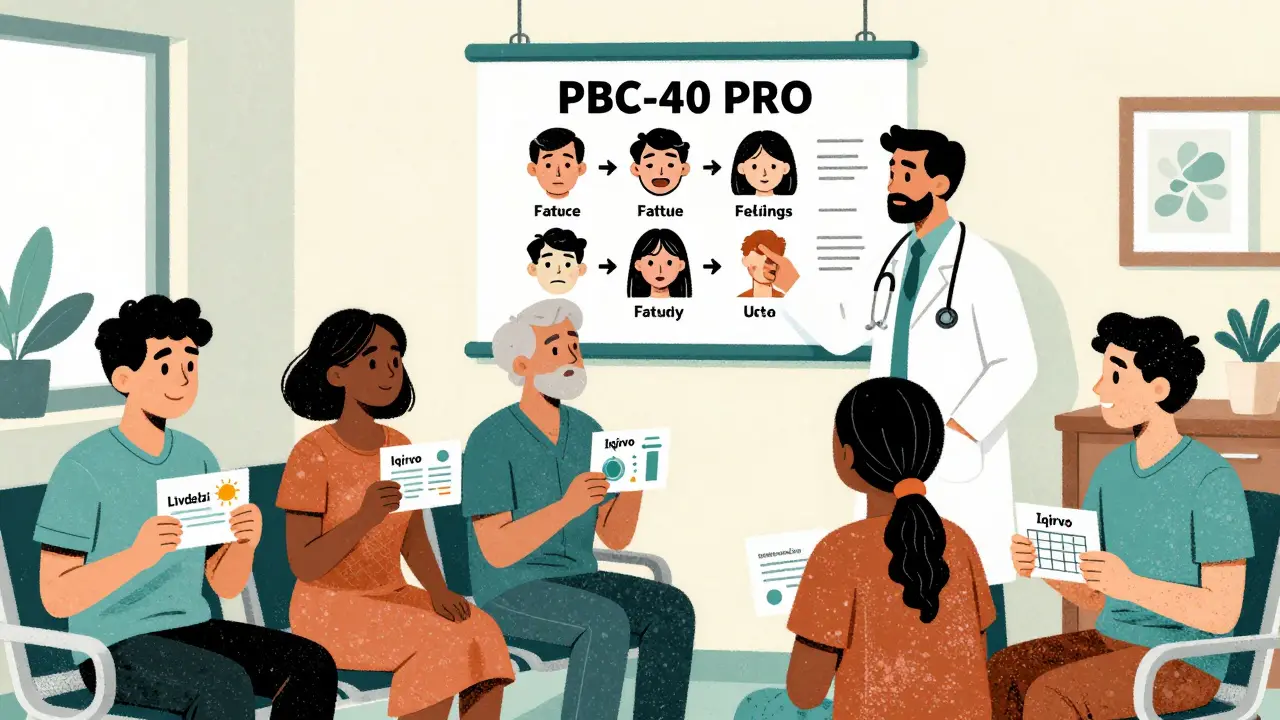
The field is shifting. We’re no longer just chasing enzyme numbers. The FDA just approved a new tool called PBC-40 PRO - a patient-reported survey that measures itching, fatigue, and quality of life. In the next 5 years, trials will need to prove they improve how patients feel, not just what labs show.
And affordability? That’s the next battle. Right now, 40% of insured patients pay over $500 a month out of pocket for these new drugs. That’s unsustainable. Advocacy groups are pushing for value-based pricing. Until then, patients need to know: help is out there - from nonprofit support programs to manufacturer assistance apps like the PBC Foundation’s Treatment Navigator.
There’s no cure yet. But we’ve gone from watching the disease creep forward to having real tools to stop it. The key is knowing what’s available, staying on top of your numbers, and not giving up if the first drug doesn’t work. PBC is slow - but so are the answers. And now, they’re working.
Is Primary Biliary Cholangitis the same as autoimmune hepatitis?
No. While both are autoimmune liver diseases, they’re different. PBC attacks the small bile ducts inside the liver, leading to bile buildup. Autoimmune hepatitis attacks liver cells themselves, causing inflammation and high liver enzymes. They can sometimes occur together, but they’re treated differently. PBC responds to UDCA and newer PPAR agonists; autoimmune hepatitis usually needs steroids and immunosuppressants like azathioprine.
Can I stop taking UDCA if I start seladelpar or elafibranor?
No. UDCA is still the foundation. The newer drugs are used alongside it, not instead of it. Stopping UDCA without medical supervision can lead to faster disease progression. Always follow your doctor’s guidance on combining treatments.
Why was Ocaliva taken off the market?
The FDA withdrew Ocaliva in September 2025 after reviewing long-term safety data. It showed higher rates of serious liver damage and cardiovascular events in patients with advanced scarring. Severe itching also led many to stop taking it. The risks outweighed the benefits, especially when safer alternatives like seladelpar became available.
How long does it take for seladelpar to start working?
Most patients see ALP levels begin to drop within 12 weeks. Pruritus improvement often happens faster - some notice relief in 4 to 8 weeks. Full benefit usually takes 6 to 12 months. Patience is key, but so is consistency - missing doses can delay results.
Do I need a liver transplant if I have PBC?
Not necessarily. With early diagnosis and proper treatment, many people live normal lifespans without needing a transplant. Transplant is now reserved for those who don’t respond to medication and develop cirrhosis or liver failure. About 15-20% of PBC patients eventually need one - but that number is dropping as newer drugs improve outcomes.
Can diet or lifestyle changes help with PBC?
Yes, but not as a replacement for medication. A healthy diet low in saturated fats, regular exercise, avoiding alcohol, and getting enough vitamin D and calcium help support liver health. Some patients report less itching with reduced sugar and processed foods. But these habits work best alongside medical treatment - not instead of it.




13 Comments
LiV Beau
March 9 2026Just started seladelpar last month and holy crap-my itching went from ‘can’t sleep’ to ‘mild annoyance’ in 3 weeks. I thought I’d be scratching my skin off forever. Also, no more 3am panic attacks wondering if I’m dying. Thank you, science. 🙌
Alexander Erb
March 10 2026Same. I was on Ocaliva until it got pulled. My ALP was still climbing and I felt like a ghost. Seladelpar? I’m back to hiking, cooking, and actually remembering what my kids’ voices sound like without me being too tired to answer. This drug didn’t just fix labs-it gave me my life back. 💪
Donnie DeMarco
March 12 2026Elafibranor’s the real MVP for me. Low triglycerides + less itching? Sign me up. My doc was like ‘you’re a unicorn case’-turns out I just had the right combo of junk food metabolism and PBC. Also, no titration? I can handle one pill a day. Easy. 🤙
Adam Kleinberg
March 13 2026Why did the FDA pull Ocaliva again? Was it really the side effects or just Big Pharma playing chess with our livers? I mean why now? Why not 2 years ago? And why are these new drugs so expensive? Someone’s making bank while we’re stuck choosing between rent and pills
Miranda Varn-Harper
March 15 2026While the data is compelling, I must emphasize that the long-term safety profile of PPAR agonists remains unproven beyond 24 months. The FDA’s accelerated approval pathway should not be conflated with definitive efficacy. One must consider the risk-benefit ratio in light of decades of UDCA use, which has a far more robust safety record. This is not to dismiss innovation, but to uphold scientific rigor.
Denise Jordan
March 16 2026So basically we’re just swapping one overpriced drug for two other overpriced drugs? And we’re supposed to be excited? I’m just here for the free vitamins and the ‘you’re doing great!’ pep talks.
Gene Forte
March 17 2026Every step forward in PBC treatment is a victory for human resilience. We’re not just treating enzymes-we’re restoring dignity, sleep, and hope. The fact that someone can now live with this disease without being consumed by itching or fatigue? That’s medicine at its best. Keep pushing. Keep fighting. You’re not alone.
Shourya Tanay
March 18 2026As someone who’s been tracking PBC biomarkers since 2018, the shift from ALP-centric metrics to PBC-40 PRO is monumental. The validation of patient-reported outcomes as primary endpoints in phase 3 trials represents a paradigm shift toward value-based care. That said, the pharmacodynamic profiles of seladelpar and elafibranor suggest distinct PPAR isoform engagement-delta vs. alpha/delta-which may explain differential effects on pruritus and lipid metabolism. The real clinical insight lies in phenotyping patients by baseline inflammatory signatures, not just ALP thresholds.
Tom Bolt
March 18 2026My sister was on UDCA for 7 years. ALP never budged. Then they tried Ocaliva. She developed liver failure. Then they switched her to seladelpar. She’s now ALP-normal, sleeping through the night, and actually laughing. I cried when I saw her eat pizza without wincing. This isn’t science. This is a miracle. And if you’re still on the fence? Stop. Just… stop.
Kenneth Zieden-Weber
March 19 2026So let me get this straight-we replaced a drug that caused itching with a drug that *temporarily* causes itching… and now we’re calling it progress? I mean, congrats? At least now you’re itching for a different reason. 🤡
David L. Thomas
March 19 2026One thing nobody talks about: the psychological toll of being told ‘your liver is dying slowly’ for years. The new drugs aren’t just about ALP-they’re about reclaiming identity. I used to feel like a walking lab report. Now I’m just… me. And that’s worth more than any trial statistic.
Bridgette Pulliam
March 21 2026My mom’s on elafibranor. Her creatinine went up a bit, but her ALP dropped 40%. Her nephrologist says it’s manageable. We’re monitoring. Honestly? If this means she can watch her grandkids grow up without being stuck on the couch… I’ll take the creatinine bump. No regrets.
Alexander Erb
March 22 2026For real though-have y’all tried the PBC Foundation’s Treatment Navigator app? It walks you through insurance denials, helps you fill out prior auth forms, and even connects you with patient advocates. I got my meds for $10/month after they helped me appeal. Seriously. Do it. You’re not alone.