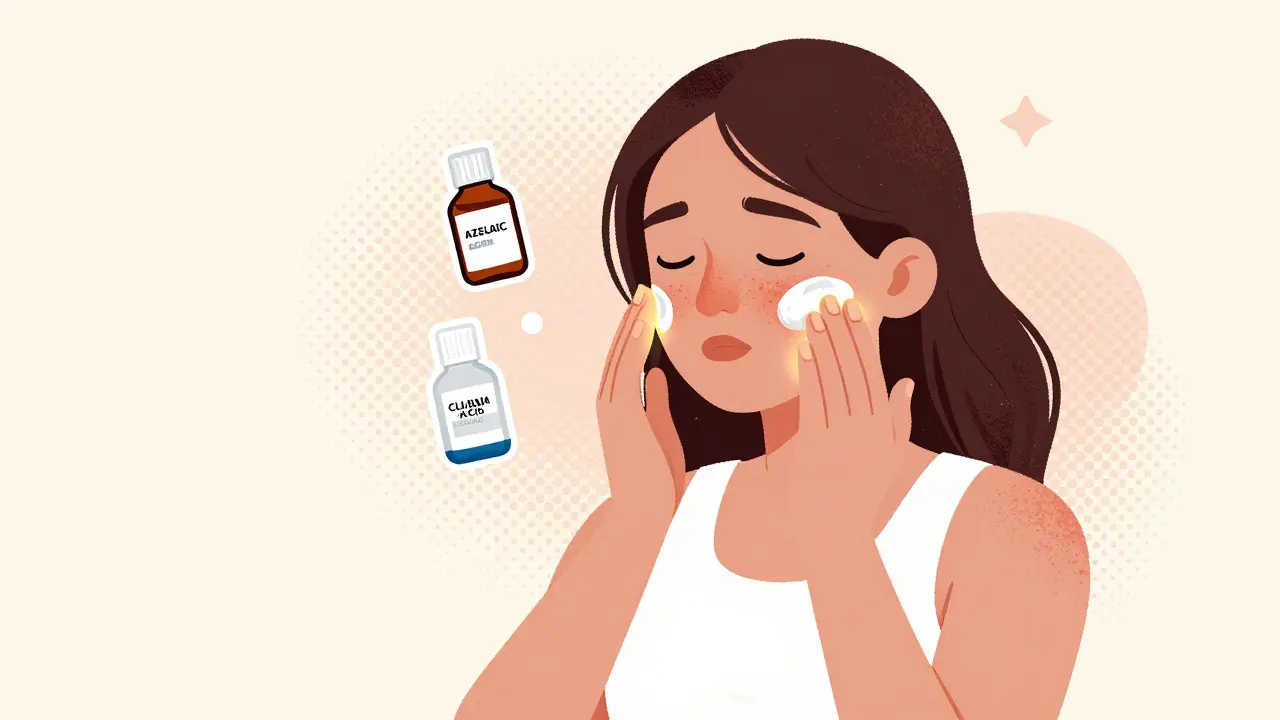
Safe Topical Medications and Creams During Pregnancy: What You Can and Can’t Use
When you’re pregnant, your skin changes. Maybe you get acne. Maybe your eczema flares up. Or you develop melasma - that dark patch on your face some call the "mask of pregnancy." You want to treat it, but you’re terrified of harming your baby. The truth? Most topical medications are far safer than you think. But not all of them. And knowing the difference could save you from unnecessary worry - or worse, a preventable risk.
Why Topical Creams Are Usually Safer Than Pills
When you swallow a pill, it goes into your bloodstream and travels everywhere - including your baby. Topical creams? They mostly stay on the surface. Studies show that only 1% to 10% of what you apply on your skin actually gets absorbed into your blood. That’s why doctors often recommend creams over pills during pregnancy. But "mostly" doesn’t mean "always." Some ingredients slip through - especially on thin skin like your face, neck, or armpits. And a few can still cause harm, even in tiny amounts.What’s Safe: Top Acne Treatments
Acne is one of the most common skin issues during pregnancy. Hormones spike, oil glands go wild. You need something that works - without risking your baby.- Benzoyl peroxide (5-10%) is considered safe. It kills bacteria and dries out pimples. It’s absorbed so little that studies haven’t linked it to birth defects. You’ll find it in over-the-counter products like Clean & Clear or Neutrogena On-the-Spot.
- Topical clindamycin and erythromycin are antibiotics that are also safe. They’re often prescribed together with benzoyl peroxide. Even though your skin absorbs a little of them, serum levels stay too low to affect the fetus.
- Azelaic acid (15-20%) is another winner. It reduces redness and dark spots - great for melasma too. It’s Category B, meaning animal studies showed no harm, and human data supports its safety. Many women report clear skin with no side effects.
What to Avoid: Topical Retinoids
This is the big one. Topical retinoids - including tretinoin (Retin-A), adapalene (Differin), and tazarotene - are not safe during pregnancy. Even though they’re applied to the skin, case reports exist of birth defects in babies whose mothers used them in early pregnancy. The American College of Obstetricians and Gynecologists (ACOG) says to stop using them before you even try to get pregnant. Don’t assume "a little bit won’t hurt." There’s no proven safe dose. If you used it before you knew you were pregnant, don’t panic - the risk is low, but talk to your doctor right away.Corticosteroids: Mild Is Okay, Strong Is Risky
If you have eczema, psoriasis, or a bad rash, hydrocortisone cream can be a lifesaver. But not all steroids are equal.- Mild hydrocortisone (0.5% to 1%) - available without a prescription - is generally safe for short-term use on small areas.
- Moderate steroids like triamcinolone are okay if your doctor prescribes them and you use them sparingly.
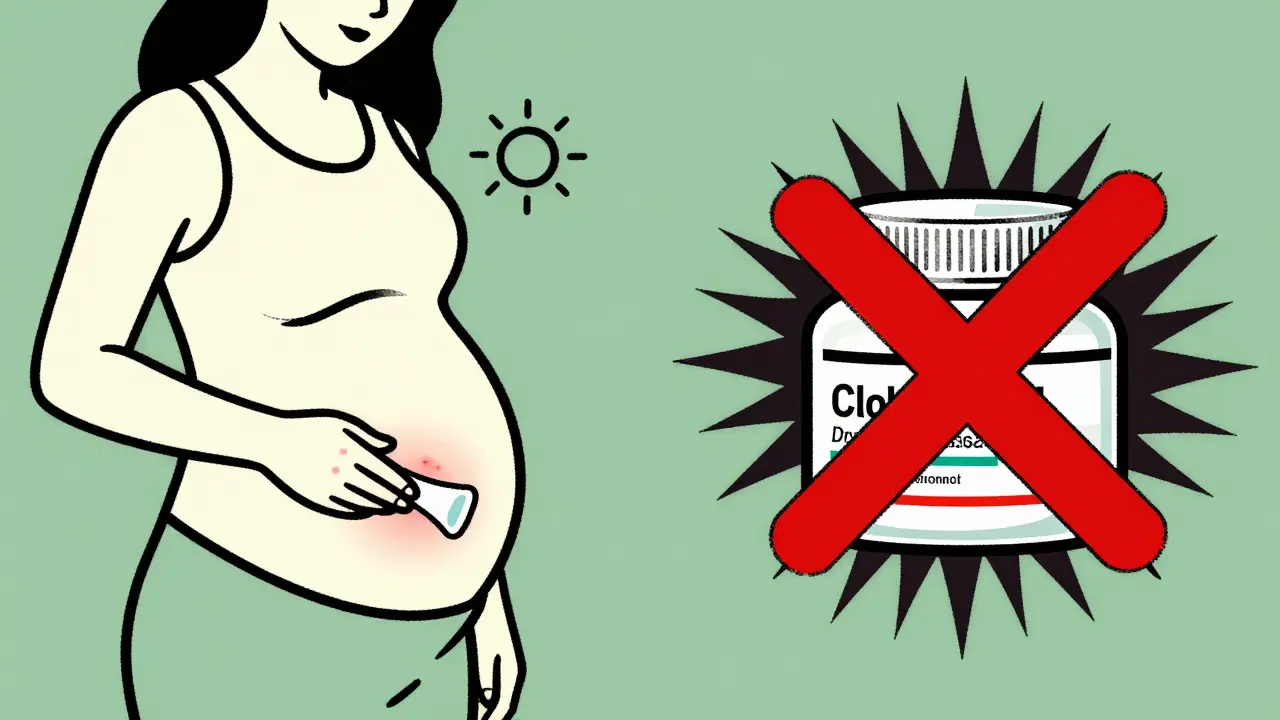
- Potent steroids like clobetasol or betamethasone? Avoid them unless absolutely necessary. Using them for weeks on large areas - especially on your belly, breasts, or face - can increase the risk of low birth weight. The skin on your eyelids, neck, and groin absorbs more. So if you’re using a strong cream on your face, you’re exposing your baby to more than you think.
Antifungal Creams: What Works for Yeast Infections
Vaginal yeast infections are super common during pregnancy. You might also get fungal rashes on your skin - especially in skin folds.- Clotrimazole and miconazole - found in Monistat and other OTC brands - are first-line choices. They’re not absorbed much and have been used safely for decades.
- Nystatin is also safe. It’s often used for diaper rash or oral thrush in babies, so it’s well-studied in pregnancy.
- Econazole should be avoided in the first trimester. Use only if your doctor says it’s necessary later on.
NSAIDs: Skip the Patches and Gels After 30 Weeks
You might think a topical pain reliever like diclofenac gel (Voltaren) or ibuprofen cream is safe because it’s not a pill. But here’s the catch: even small amounts absorbed through the skin can affect your baby’s heart.- After 30 weeks, these creams can cause the ductus arteriosus - a vital blood vessel in your baby’s heart - to close too early. This can lead to serious heart problems.
- Before 30 weeks, occasional use on a small area (like a sore knee) is likely okay, but don’t use them daily or on large areas.
- For pain relief, acetaminophen (Tylenol) is still the safest oral option. For topical relief, try cold packs or massage instead.
Antiviral Creams: Cold Sores and Herpes
If you get cold sores, acyclovir cream (Zovirax) is safe. It’s been studied in thousands of pregnant women with no increased risk of birth defects. Same goes for penciclovir. These creams work locally and don’t enter your bloodstream in meaningful amounts. But avoid podofilox and podophyllin resin - used for genital warts. They’re absorbed more and can cause serious fetal damage. If you have warts, talk to your OB-GYN. There are safer ways to treat them.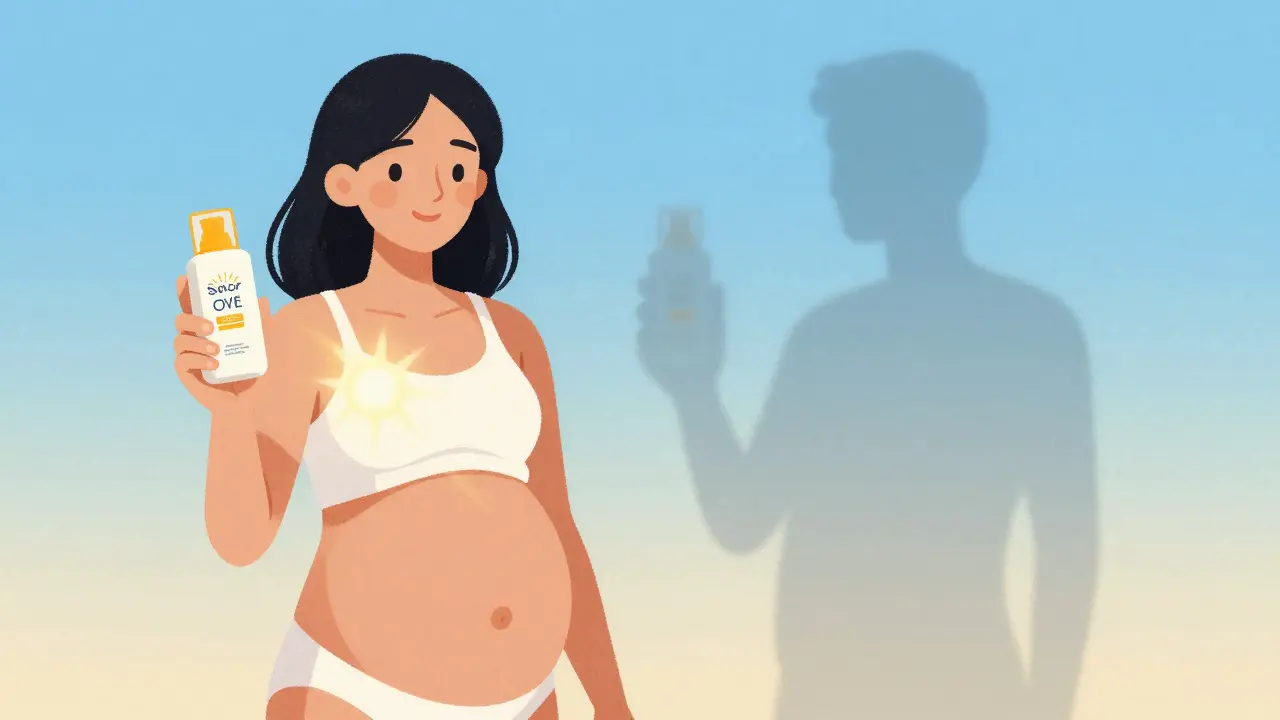
Moisturizers and Sunscreens: Your Daily Must-Haves
You don’t need medication to care for your skin. Basic moisturizers and sunscreens are not just safe - they’re essential.- Look for fragrance-free, hypoallergenic lotions. Brands like CeraVe, Vanicream, and Eucerin are widely recommended.
- For sunscreen, choose mineral-based options with zinc oxide or titanium dioxide. They sit on top of the skin and don’t absorb. Avoid chemical sunscreens like oxybenzone - not because they’re proven dangerous, but because they’re absorbed into your blood, and we don’t have enough data on long-term effects.
- Wear SPF 30+ every day. Melasma gets worse with sun exposure, and UV rays can damage your baby’s developing skin.
What to Do If You Accidentally Used Something Risky
You’re not alone. Many women panic after realizing they used a retinoid or steroid cream before knowing they were pregnant.- Stop using the product immediately.
- Don’t assume the worst. Most of the time, the risk is very low - especially if you used it for a few days or in a small area.
- Call your OB-GYN or the InfantRisk Center (1-806-352-2519). They handle over 1,200 pregnancy medication questions every month. They’ll help you assess the real risk based on what you used, how much, and when.
How to Choose Safely: A Quick Guide
You don’t need to memorize every ingredient. Just follow this simple rule:- Safe to use: Benzoyl peroxide, azelaic acid, clindamycin, erythromycin, hydrocortisone (1%), clotrimazole, miconazole, nystatin, acyclovir, zinc oxide sunscreen, fragrance-free moisturizers.
- Avoid: Tretinoin, adapalene, tazarotene, potent corticosteroids (clobetasol, betamethasone), topical NSAIDs after 30 weeks, podofilox, econazole (first trimester).
- Ask your doctor: If you’re unsure about any product - even if it’s "natural" or "organic." Some plant extracts (like tea tree oil in high doses) or herbal creams aren’t tested in pregnancy.
Final Thought: You’re Not Alone
Pregnancy makes you hyper-aware of every little thing you touch, eat, or apply. That’s normal. But don’t let fear stop you from treating your skin. Millions of women have safely used creams for acne, eczema, and yeast infections. The key is knowing which ones are safe - and which ones aren’t. Talk to your doctor, read labels carefully, and when in doubt, skip it. Your skin matters. Your baby matters. And with the right info, you can take care of both.Is hydrocortisone cream safe during pregnancy?
Yes, low-strength hydrocortisone cream (0.5% to 1%) is generally safe for short-term use on small areas during pregnancy. Avoid using it on large areas, your face, or for extended periods. Stronger prescription steroids should only be used under a doctor’s supervision.
Can I use acne cream while pregnant?
You can use benzoyl peroxide, azelaic acid, and topical antibiotics like clindamycin or erythromycin. Avoid all retinoids - including adapalene and tretinoin - even if they’re labeled "over-the-counter." These are linked to birth defects in rare cases.
Is it safe to use Neutrogena products during pregnancy?
Many Neutrogena products are safe. Their On-the-Spot Acne Treatment (benzoyl peroxide) is fine. But avoid any with retinol, salicylic acid in high concentrations, or chemical sunscreens like oxybenzone. Always check the ingredient list.
Can topical NSAIDs cause miscarriage?
There’s no strong evidence that topical NSAIDs cause miscarriage. But after 30 weeks, they can cause a serious heart problem in the baby called premature ductus arteriosus closure. Avoid them completely in the third trimester. Before then, use only occasionally and on small areas.
What’s the safest moisturizer for pregnancy?
Fragrance-free, hypoallergenic moisturizers with simple ingredients are best. Look for brands like CeraVe, Vanicream, Eucerin, or Aveeno. Avoid anything with retinoids, essential oils, or untested herbal extracts. Mineral-based sunscreens with zinc oxide are also safe and recommended.

14 Comments
kenneth pillet
January 19 2026benzoyl peroxide works great for acne i used it all through my second trimester no issues
just dont overdo it or your skin turns into a dried prune
Zoe Brooks
January 21 2026so glad someone finally laid this out clearly
so many moms panic over nothing and then avoid everything
you can treat your skin and still keep your baby safe
knowledge is power
Kristin Dailey
January 22 2026retinoids are dangerous. period. dont even think about it.
Wendy Claughton
January 24 2026thank you for this!!
i was so scared to use anything after my first trimester…
but now i know hydrocortisone is okay in small amounts
and i’ve been using cerave every day and it’s been a game-changer
also-zinc oxide sunscreen is my new best friend 😌
Aysha Siera
January 24 2026they say it’s safe but who really knows what’s in those creams?
big pharma doesn’t want you to know the truth
they’re testing on pregnant women and calling it ‘safe’
you think your baby’s fine but wait till age 5…
rachel bellet
January 25 2026the pharmacokinetic profile of topical retinoids is well-documented in teratogenicity literature
even subcutaneous absorption thresholds exceed the LD50 thresholds in murine models
the ACOG recommendation is not conservative-it’s evidence-based
you’re not ‘just being cautious’-you’re avoiding iatrogenic malformations
Pat Dean
January 27 2026you’re telling me it’s okay to use neutrogena but not to use ‘natural’ oils?
what a joke
your body knows what’s good for it
they’ve been poisoning us with chemicals for decades
and now you want me to trust a doctor who works for a drug company?
Jay Clarke
January 27 2026okay but like… why is everyone so scared?
i used adapalene for 3 weeks before i knew i was pregnant
and now my kid is 2 and runs like a cheetah
you’re all overreacting
it’s not a nuclear bomb
it’s a cream
chill
Selina Warren
January 28 2026you’re not broken because you need a cream
you’re not weak because you want to feel like yourself again
pregnancy doesn’t mean you have to suffer through acne or eczema
you deserve to feel good in your skin
and yes-you can treat it safely
you’re not alone in this
Robert Davis
January 28 2026did you know that the FDA doesn’t require pregnancy safety testing for topical products?
so when they say ‘safe’… it’s just based on animal studies
and animal studies don’t always translate
so technically… we’re all just guessing
but hey, go ahead and use that benzoyl peroxide
Eric Gebeke
January 30 2026you say ‘don’t panic’ but then you list 12 things you shouldn’t use
and then you say ‘ask your doctor’
but doctors don’t know anything
they just read the pamphlets
and now i’m more confused than when i started
Jake Moore
January 30 2026for anyone worried about sunscreen-zinc oxide is the gold standard
it doesn’t absorb, it sits on top, reflects UV
my OB gave me a tube of CeraVe Baby SPF 50
used it daily since week 8
no melasma, no burns
and my baby’s skin came out perfect
trust the mineral stuff, skip the chemicals
Joni O
January 31 2026i used clotrimazole for a yeast infection at 16 weeks
and honestly? i felt like a superhero
no more itching, no more crying in the shower
and now my daughter is 10 months old and laughs every time i say ‘monistat’
you’re not alone, mama. you’re doing great.
Praseetha Pn
February 2 2026they say azelaic acid is safe but what about the heavy metals in the base formula?
they don’t test for that
and what if the cream was made in a factory in china?
your skin absorbs everything
even the air you breathe is laced with toxins
you think you’re safe but you’re just one step away from a disaster
you should be using coconut oil and prayer