SGLT2 Inhibitors and Yeast Infections: Urinary Complications Explained
SGLT2 Inhibitor Risk Assessment Calculator
This tool helps you understand your personal risk of urinary and genital infections when taking SGLT2 inhibitors. Based on the 2024 risk assessment model from the article, select your current health factors to determine your risk level.
Your Risk Factors
When you start taking medication for diabetes, you expect it to lower your blood sugar. You do not expect it to invite infections into your body. Yet, this is the reality for many people using a specific class of drugs known as SGLT2 Inhibitors is a class of prescription medications for type 2 diabetes mellitus developed to lower blood glucose levels by inhibiting renal glucose reabsorption. These drugs have revolutionized heart and kidney care, but they come with a specific trade-off that every patient needs to understand clearly. The mechanism that saves your heart can unfortunately create an environment where yeast and bacteria thrive in your urinary tract.
How the Medication Works and Why It Matters
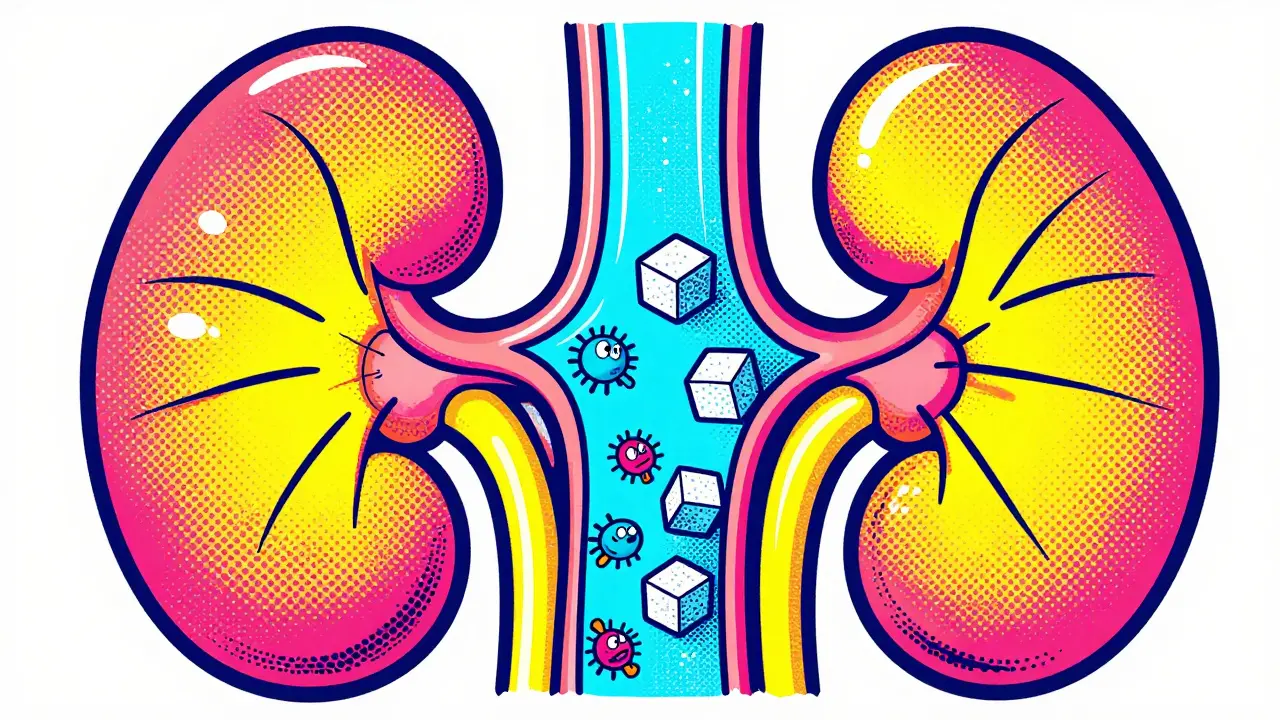
To understand the risk, you first need to understand the action. These medications block a protein called SGLT2 in your kidneys. Normally, your kidneys filter sugar out of your blood but then reabsorb almost all of it back into your system. These drugs stop that reabsorption. Instead, the sugar goes straight into your urine. You might lose 40 to 110 grams of glucose in your urine every single day depending on the dose. This is great for lowering blood sugar levels without causing dangerous lows, but sugar is food for microbes.
When you have high levels of glucose in your urine, you are essentially leaving an open buffet for yeast and bacteria. This condition is called glycosuria. It changes the chemistry of your urinary tract and genital area. The extra sugar provides the energy that pathogens need to multiply rapidly. This is not a theoretical risk; it is a direct result of the drug's primary function. While the cardiovascular benefits are significant, the infection risk is built into the biology of how the drug works.
The Real Numbers Behind the Risk
Many people worry about side effects without knowing the actual statistics. Data from a major meta-analysis published in 2022 shows that these drugs increase the risk of urinary tract infections significantly. Specifically, the risk is 1.78 times higher compared to another common class of diabetes drugs called DPP-4 inhibitors. When compared to sulfonylureas, the risk is 1.72 times higher. In absolute terms, this means the risk increases by about 2.1% to 3.8% depending on what you compare it to. For genital infections, the numbers are even starker, with risks nearly four times higher than with DPP-4 inhibitors.
It is not just about mild discomfort. Serious complications do occur. The FDA analyzed safety reports from 2013 to 2014 and found 19 definite cases of urosepsis, which is a life-threatening infection of the blood caused by a urinary infection. All 19 patients required hospitalization. Four of them needed intensive care, and two required dialysis because their kidneys failed. The median time for these severe infections to appear was 45 days after starting the medication, though some happened as early as two days. This tells us that the danger is present early in treatment, not just after years of use.
Common Infections and Severe Complications
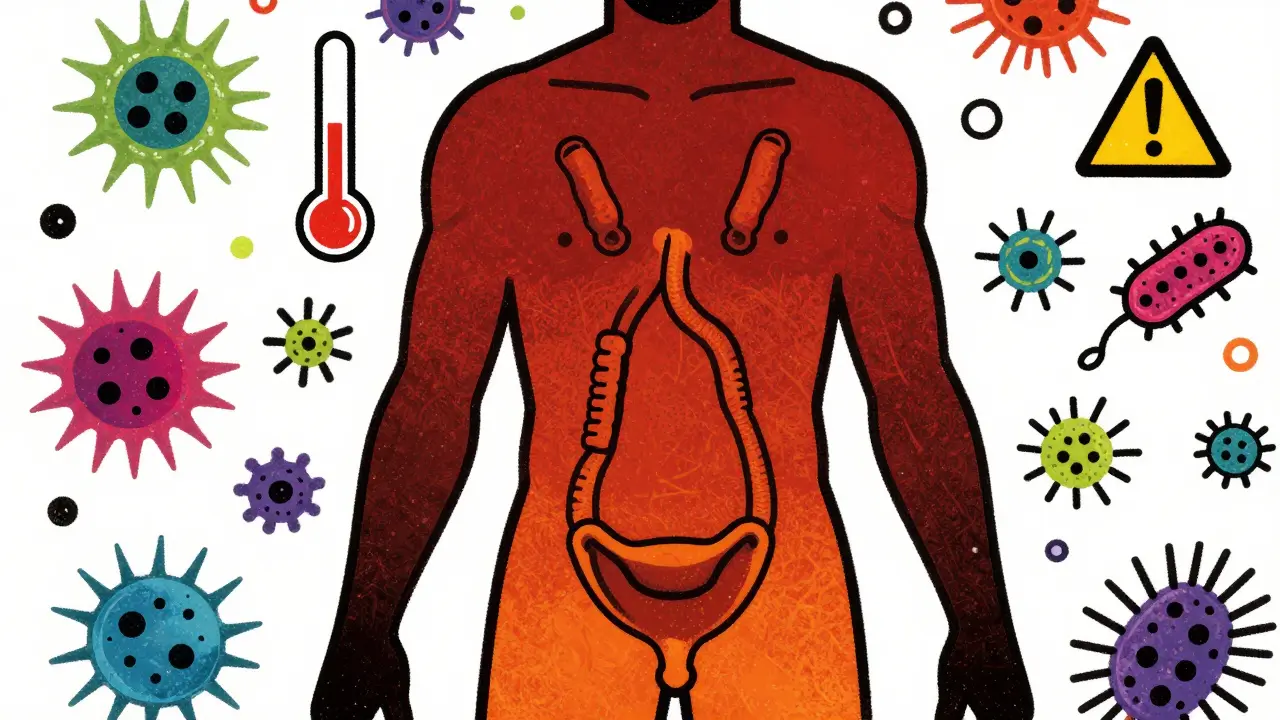
Most infections are manageable, but you need to know what they look like. The most common issue is a yeast infection. In women, this appears as vulvovaginal candidiasis, causing itching and discharge. In men, it shows up as balanitis, which is inflammation of the head of the penis. These occur in about 3 to 5% of patients, compared to only 1 to 2% of people taking a placebo. Usually, these happen within the first few months of starting therapy.
Bacterial infections are more dangerous. A urinary tract infection (UTI) can feel like a burning sensation when you pee, frequent urges to go, or cloudy urine. However, in some cases, the infection moves up to the kidneys. There are rare but terrifying cases of emphysematous pyelonephritis. This is a gas-forming infection of the kidney. One documented case involved a 64-year-old woman with no history of UTIs who developed this condition while taking dapagliflozin. She needed surgery to drain an abscess around her kidney. Even after stopping the drug, she had a recurrence 11 months later when she restarted it. This highlights that once the susceptibility is established, it can be a recurring problem.
Who Is at Higher Risk
Not everyone who takes these drugs will get an infection, but some people are much more vulnerable. If you are a woman, your risk is higher than if you are a man. This is partly due to anatomy, as the urethra is shorter, making it easier for bacteria to reach the bladder. If you have had recurrent urinary tract infections in the past, you are a prime candidate for complications. Structural issues in your urinary tract also increase the danger. People with compromised immune systems, such as those on chemotherapy or with HIV, should be extremely cautious.
Age and kidney function play a role too. A risk score validated in 2024 suggests that patients over 65, women, those with an HbA1c above 8.5%, and those with kidney function (eGFR) below 60 mL/min/1.73m² are at the highest risk. If you check more than a few of these boxes, the absolute risk of a complicated UTI could be over 15%. This is not a number to ignore. Doctors often use this profile to decide whether the heart benefits outweigh the infection risks for your specific situation.
Prevention and Management Strategies
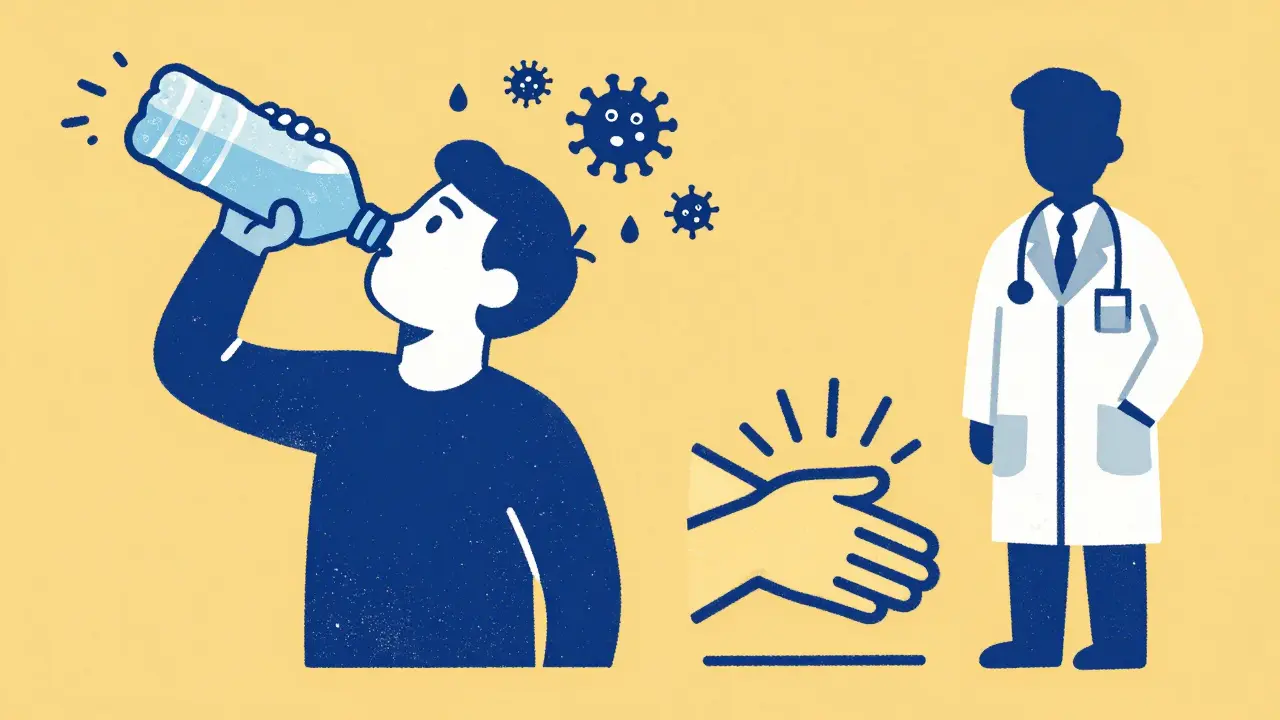
You do not have to stop taking the medication just because of the risk, but you must be proactive. The American Diabetes Association recommends assessing your history of UTIs before starting. If you have a history, your doctor might suggest an alternative like a DPP-4 inhibitor or a GLP-1 receptor agonist. If you do start the medication, hygiene is your first line of defense. You should clean your genital area carefully after using the toilet. Some experts suggest wiping from front to back to prevent bacteria from moving to the urethra.
Hydration is another critical tool. Drinking plenty of water helps flush bacteria out of your urinary tract before they can establish an infection. Some emerging evidence from 2023 suggests that prophylactic cranberry products might reduce UTI incidence by about 29%, though this is not an official medical guideline yet. You should also watch your blood sugar levels. Even though the drug lowers sugar, if your levels are still high, the risk remains. If you notice any symptoms like fever above 100.4°F, tenderness, or swelling, you need to seek medical attention immediately. Delaying treatment can turn a simple UTI into urosepsis very quickly.
Comparison with Other Diabetes Medications
It helps to see how these drugs stack up against other options. The table below breaks down the key differences regarding infection risk and other benefits. This comparison is based on clinical trial data and regulatory safety communications.
| Medication Class | UTI Risk | Genital Infection Risk | Cardiovascular Benefit | Hypoglycemia Risk |
|---|---|---|---|---|
| SGLT2 Inhibitors | High (1.78x) | High (4.57x) | Proven (14% reduction) | Low |
| DPP-4 Inhibitors | Low (Baseline) | Low (Baseline) | Neutral | Low |
| Sulfonylureas | Low (Baseline) | Low (Baseline) | Neutral | High |
| Metformin | Low (Baseline) | Low (Baseline) | Neutral | Very Low |
As you can see, the infection risk is unique to this class. Sulfonylureas, for example, carry a high risk of low blood sugar, which is a different kind of danger. Metformin is generally safe regarding infections but does not offer the same heart protection. The choice often comes down to whether your doctor prioritizes heart protection over infection risk. For patients with established heart failure, the heart benefit often wins the argument. For those with a history of frequent UTIs, the risk might be too high to ignore.
When to Stop or Switch
There are times when continuing the medication is not safe. If you develop a complicated urinary tract infection, your doctor will likely tell you to stop the drug temporarily. In some cases, like the one mentioned earlier with the kidney abscess, the patient had to stop permanently. Real-world data from Sweden showed that nearly 24% of patients discontinued these drugs within two years due to genitourinary side effects. This is a significant number and suggests that for some people, the side effects are simply too much to handle.
Discontinuation does not mean you are out of options. You can switch to a GLP-1 receptor agonist, which also helps with weight loss and heart health but does not dump sugar into the urine. Or you can go back to Metformin. The key is to communicate openly with your healthcare provider. Do not suffer in silence because you think you must stay on the drug. Your safety is the priority. If the infection keeps coming back, the medication is no longer the right fit for your body.
Regulatory Warnings and Patient Safety
Regulatory bodies take these risks seriously. The FDA required updated warning labels for all drugs in this class in 2015. They specifically cited the cases of urosepsis. The Patient Medication Guides now explicitly warn about symptoms requiring immediate attention. This includes tenderness, redness, or swelling of the genitals or the area from the genitals back to the rectum. If you have a fever or feel generally unwell, you should not wait. The European Medicines Agency also updated information to include warnings about Fournier's gangrene, a rare but life-threatening infection of the perineum. These warnings exist to protect you, so read the leaflet that comes with your prescription.
The market continues to grow despite these risks. Global sales reached $12.7 billion in 2022. This shows that the benefits are still valued highly by the medical community. However, the industry is also working on solutions. There is research into dual inhibitors that might reduce the sugar in the urine while keeping the heart benefits. There are also personalized risk prediction tools being developed to help doctors choose the right patients. Until then, awareness and vigilance are your best tools for staying safe.
Can SGLT2 inhibitors cause yeast infections?
Yes, yeast infections are a common side effect. They occur in about 3 to 5% of patients taking these drugs compared to 1 to 2% in placebo groups. Women typically experience vulvovaginal candidiasis, while men may develop balanitis.
What are the symptoms of a serious urinary infection?
Symptoms include fever above 100.4°F, tenderness or swelling of the genitals, pain during urination, cloudy urine, or a general feeling of being unwell. Severe cases may involve back pain or shaking chills.
Should I stop taking the medication if I get a UTI?
You should contact your doctor immediately. They will likely advise you to stop the medication temporarily until the infection clears. In cases of severe infection like urosepsis, permanent discontinuation may be necessary.
Are there ways to prevent these infections?
Yes, maintaining good genital hygiene, drinking plenty of water to flush the system, and reporting symptoms early can help. Some evidence suggests cranberry products may reduce risk, but consult your doctor first.
Who is at the highest risk for complications?
Women, people over 65, those with a history of UTIs, and patients with lower kidney function are at higher risk. A 2024 risk score identifies these groups as having a greater than 15% absolute risk of complicated infections.



9 Comments
Jordan Marx
March 27 2026The mechanism of renal glucose reabsorption inhibition fundamentally alters the urinary environment. Patients must understand that glycosuria is a direct pharmacological outcome. This creates a substrate for microbial proliferation in the lower urinary tract. Clinical data indicates a significant elevation in the hazard ratio for candidiasis. We need to discuss the balance between cardiovascular protection and infectious risk. The trade-off involves a specific metabolic pathway that favors pathogen growth. Renal excretion of glucose is the primary driver of this side effect profile. It is essential to monitor HbA1c levels alongside infection symptoms. Early detection of balanitis or vulvovaginal symptoms is crucial for management. Prophylactic hygiene measures can mitigate the absolute risk somewhat. However, the biological predisposition remains inherent to the drug class. Physicians should assess individual risk factors before prescribing. History of recurrent infections is a major contraindication for many patients. The data regarding urosepsis cases is particularly concerning for safety. We must prioritize patient education on symptom recognition. Delayed treatment can lead to septic shock and hospitalization. The benefits for heart failure are undeniable but come with caveats. Shared decision making is the only viable path forward here.
Sophie Hallam
March 29 2026That is a very thorough explanation of the mechanism. I agree that patient education is the most important factor.
kendra 0712
March 31 2026I really think we need to talk about the hydration aspect more! Drinking water is so important to flush out the system!! It helps remove the bacteria before they can stick around! I have seen people ignore this and then they get sick! You have to be proactive about your health! The numbers are scary but manageable if you are careful! Please listen to your body if you feel anything weird! It is better to be safe than sorry!
Rohan Kumar
April 1 2026Big Pharma knows this and hides the real data from us 🙄💊
Sarah Klingenberg
April 2 2026I get that feeling sometimes but the FDA does require labels :) We just need to be careful with our meds.
Sabrina Herciu
April 3 2026The statistical analysis from the 2022 meta-analysis is quite definitive regarding the risk elevation. Patients should be aware that the relative risk is nearly double compared to DPP-4 inhibitors. This is not a minor side effect that can be ignored by the medical community. We must look at the absolute risk percentages to understand the true impact. A 3.8% increase in absolute risk is significant for a large population. The cases of emphysematous pyelonephritis are rare but devastating for the individual. Medical professionals need to screen for structural urinary tract issues before starting therapy. Hydration protocols should be standardized for all patients on this medication class. We cannot rely solely on patient self-reporting of symptoms. Regular follow-ups are necessary to catch early signs of infection. The cost of treating a severe infection outweighs the cost of the medication. Insurance coverage often does not account for these downstream complications. Prevention strategies like cranberry products show promise in preliminary studies. However, these should not replace standard medical advice and hygiene. The warning labels mandated by the FDA are a necessary safeguard. We must respect the biological reality of glucose in the urine.
Rachael Hammond
April 4 2026tht is a lot of info but i think the main point is to just stay clean. i misspell alot but the idea is simple. dont ignore the signs.
Paul Vanderheiden
April 6 2026You have to keep going even if it is scary because the heart benefits are real and we need to stay positive about managing diabetes. It is hard but we can do this together and support each other through the side effects.
Austin Oguche
April 7 2026The data supports the need for vigilance.